Global Adjustable Gastric Banding Market, By Type (Lap-Band, Realize Band), By Application, and By Region - Trends and Forecast Analysis, 2021-2035
Publish Date: 2026-04-30 | Format: PDF | Category: Healthcare and Pharmaceutical | Pages: 358
Global Adjustable Gastric Banding Market Size is expected to reach USD 22.2 Billion by 2035 from USD 4.07 Billion in 2024, with a CAGR of around 16.65% between 2024 and 2035. Leading pharmaceutical companies have been advancing acute myeloid leukemia (AML) therapeutics through innovative treatments and strategic collaborations. Bristol-Myers Squibb has developed Onureg, an oral hypomethylating agent approved for continued treatment in AML patients in first remission, aiming to prolong overall survival and reduce relapse risk. Novartis has focused on targeted therapies, with midostaurin receiving Breakthrough Therapy designation for newly diagnosed FLT3-mutated AML, marking a significant step in personalized medicine. Genmab has been exploring novel antibody-based treatments, such as GEN3014, a HexaBody-CD38 monoclonal antibody showing potent anti-tumor activity in hematologic malignancies. Roche has continued its commitment to oncology by developing therapies that target specific genetic mutations associated with AML, enhancing treatment efficacy. GlaxoSmithKline Pharmaceuticals has invested in research to develop innovative treatments for hematologic cancers, contributing to the evolving landscape of AML therapeutics. These developments reflect a broader trend towards personalized medicine, with companies focusing on therapies tailored to individual genetic profiles, improving patient outcomes and offering new hope in AML treatment.
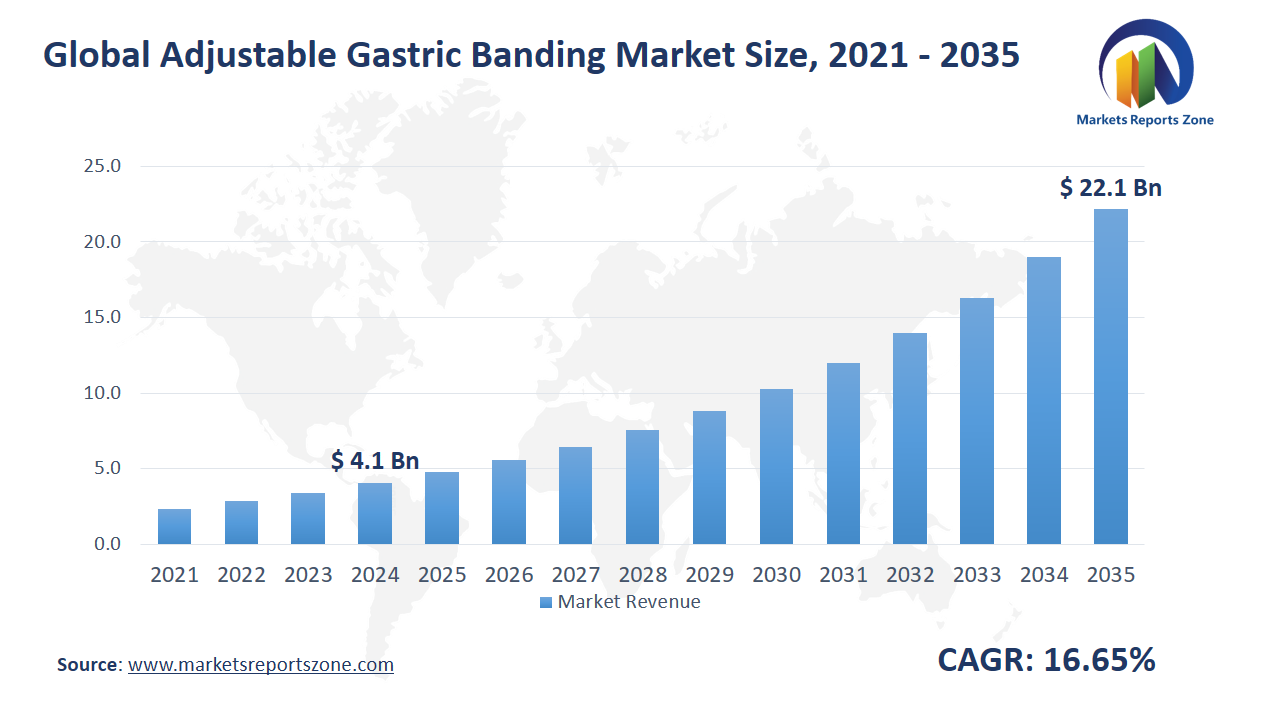
Driver: Obesity Surge and Surgical Advancements Drive Market
The global adjustable gastric banding market has been driven by two key factors. The increasing prevalence of obesity has led to a higher demand for weight-loss surgeries. In countries like the United States, the rising obesity rates have resulted in more individuals seeking surgical interventions for weight management. Technological advancements in surgical techniques have improved the safety and effectiveness of adjustable gastric banding procedures. For instance, the development of bands that can be adjusted remotely has enhanced patient convenience and reduced the need for multiple follow-up visits. However, the market faces a significant restraint in the form of band-related complications. Issues such as band slippage or erosion may require reoperation, impacting patient satisfaction and overall market growth. Despite this, opportunities exist in emerging markets where the prevalence of obesity is increasing rapidly. Countries like China and India are witnessing a surge in demand for weight-loss procedures due to rising disposable incomes and changing lifestyles. Additionally, technological innovations in adjustable gastric banding devices present opportunities for market growth. The integration of smart technology in gastric bands, such as sensors and connectivity, can enhance patient experience and disease management, making these devices more appealing to a tech-savvy consumer base.
Key Insights:
- The adoption rate of adjustable gastric banding (AGB) has declined over recent years, with the procedure now constituting about 56% of bariatric surgeries in some established clinics.
- In a large UK cohort, 2246 patients underwent AGB between 2004 and 2014, with a re-operation rate for complications of 4.2% over 9 years and an explantation rate of 1.5%.
- Long-term follow-up studies show that up to 52.2% of gastric bands may require removal within 10 years due to complications or insufficient weight loss.
- The mean excess weight loss after 12 years or longer post-AGB is approximately 42.8%, based on follow-up data from over half of patients.
- Adjustable gastric bands accounted for about 86.1% of the gastric bands market share in 2024, reflecting strong preference for their flexibility and adjustability.
Segment Analysis:
The adjustable gastric banding market is segmented by type into Lap-Band and Realize Band, and by application into hospitals and clinics. Lap-Band, a well-known adjustable gastric band, has been widely used due to its ease of placement and the ability to adjust it post-surgery for optimal weight loss. For example, a 35-year-old patient undergoing surgery at a major hospital opted for the Lap-Band to address obesity. The procedure was done under laparoscopic guidance, and the patient was able to adjust the band as required during follow-up visits. The Realize Band, on the other hand, has gained popularity due to its advanced features, such as a wider band and a more gradual adjustment process, offering potentially smoother weight loss results. In a private clinic, a patient with a BMI of 40 was offered the Realize Band for its precision in controlling weight loss over time. The application of these bands occurs predominantly in hospitals and clinics, where patients receive detailed pre-operative counseling and post-operative care. Hospitals offer comprehensive care for patients with more complex health conditions, while clinics are preferred by those seeking less intensive care. For instance, a clinic in a suburban area was able to provide quick follow-ups and personalized care for patients using these bands, offering both convenience and specialized attention.
Regional Analysis:
The adjustable gastric banding market has seen diverse growth across North America, Europe, Asia-Pacific, Latin America, and the Middle East & Africa. In North America, where obesity rates are high, hospitals are increasingly performing gastric banding surgeries. A 50-year-old male in the U.S. recently underwent a Lap-Band procedure to address his obesity-related health issues, benefiting from advanced post-operative care. In Europe, countries like Germany have incorporated adjustable gastric banding as a part of their national healthcare services. A clinic in Paris specializes in offering both Lap-Band and Realize Band options to patients seeking weight-loss solutions. Asia-Pacific has experienced rapid growth due to rising obesity rates in countries like China and India, where people are becoming more aware of the health risks associated with obesity. In a clinic in India, a young patient received a Realize Band for weight loss, seeing significant improvements over a year. Latin America has embraced these procedures as well, with clinics in Brazil increasingly performing gastric banding surgeries as the middle class expands. The Middle East & Africa, despite facing healthcare infrastructure challenges, has seen an uptick in demand. A clinic in Dubai recently conducted gastric banding surgeries, helping several patients manage their weight more effectively, demonstrating a shift towards addressing obesity-related health issues in the region.
Competitive Scenario:
The adjustable gastric banding market has experienced significant developments with contributions from key industry players. Apollo Endosurgery has advanced the field by publishing the MERIT study in The Lancet, demonstrating the effectiveness of its Endoscopic Sleeve Gastroplasty (ESG) procedure. This minimally invasive technique has shown promising results in weight loss and improvement in obesity-related comorbidities. Ethicon, a subsidiary of Johnson & Johnson, discontinued its Realize Band in 2016 due to declining popularity and high complication rates, such as band slippage and erosion . In contrast, Helioscopie's Heliogast HAGA band features a double balloon design for enhanced stability and a 360° accessible port, aiming to reduce complications and improve patient outcomes . MID Medical Innovation Developpement offers the MIDBAND™, a latex-free, adjustable gastric band designed for laparoscopic implantation. Its low-pressure adjustment system and reversible nature make it a less invasive option with potential for future surgical interventions . Cousin Biotech has introduced the Cousin Gastric Band, focusing on patient comfort and ease of adjustment. These innovations reflect a shift towards more personalized and less invasive bariatric solutions, catering to the evolving needs of patients seeking effective weight-loss interventions.
Adjustable Gastric Banding Market Report Scope
| Report Attribute | Details |
|---|---|
| Market Size Value in 2024 | USD 4.07 Billion |
| Revenue Forecast in 2035 | USD 22.2 Billion |
| Growth Rate | CAGR of 16.65% from 2025 to 2035 |
| Historic Period | 2021 - 2024 |
| Forecasted Period | 2025 - 2035 |
| Report Coverage | Revenue forecast, company ranking, competitive landscape, growth factors, and trends |
| Regions Covered | North America; Europe; Asia Pacific; Latin America; Middle East & Africa |
| Countries Covered | U.S.; Canada; Mexico, UK; Germany; France; Spain; Italy; Russia; China; Japan; India; South Korea; Australia; Southeast Asia; Brazil; Argentina; Saudi Arabia; UAE; South Africa |
| Key companies profiled | Apollo Endosurgery; Ethicon (Johnson & Johnson); Helioscopie (Sante Actions Group); MID (Medical Innovation Developpement); Cousin Biotech |
| Customization | Free report customization (equivalent up to 8 analysts working days) with purchase. Addition or alteration to country, regional & segment scope. |
The Global Adjustable Gastric Banding Market report is segmented as follows:
By Type,
- Lap-Band
- Realize Band
By Application,
- Hospitals
- Clinics
By Region,
- North America
- U.S.
- Canada
- Mexico
- Europe
- UK
- Germany
- France
- Spain
- Italy
- Russia
- Rest of Europe
- Asia Pacific
- China
- Japan
- India
- South Korea
- Australia
- Southeast Asia
- Rest of Asia Pacific
- Latin America
- Brazil
- Argentina
- Rest of Latin America
- Middle East & Africa
- Saudi Arabia
- UAE
- South Africa
- Rest of Middle East and Africa
Key Market Players,
- Apollo Endosurgery
- Ethicon (Johnson & Johnson)
- Helioscopie (Sante Actions Group)
- MID (Medical Innovation Developpement)
- Cousin Biotech
Frequently Asked Questions
Research Objectives
- Proliferation and maturation of trade in the global Adjustable Gastric Banding Market.
- The market share of the global Adjustable Gastric Banding Market, supply and demand ratio, growth revenue, supply chain analysis, and business overview.
- Current and future market trends that are influencing the growth opportunities and growth rate of the global Adjustable Gastric Banding Market.
- Feasibility study, new market insights, company profiles, investment return, market size of the global Adjustable Gastric Banding Market.
Chapter 1 Adjustable Gastric Banding Market Executive Summary
- 1.1 Adjustable Gastric Banding Market Research Scope
- 1.2 Adjustable Gastric Banding Market Estimates and Forecast (2021-2035)
- 1.2.1 Global Adjustable Gastric Banding Market Value and Growth Rate (2021-2035)
- 1.2.2 Global Adjustable Gastric Banding Market Price Trend (2021-2035)
- 1.3 Global Adjustable Gastric Banding Market Value Comparison, by Type (2021-2035)
- 1.3.1 Lap-Band
- 1.3.2 Realize Band
- 1.4 Global Adjustable Gastric Banding Market Value Comparison, by Application (2021-2035)
- 1.4.1 Hospitals
- 1.4.2 Clinics
Chapter 2 Research Methodology
- 2.1 Introduction
- 2.2 Data Capture Sources
- 2.2.1 Primary Sources
- 2.2.2 Secondary Sources
- 2.3 Market Size Estimation
- 2.4 Market Forecast
- 2.5 Assumptions and Limitations
Chapter 3 Market Dynamics
- 3.1 Market Trends
- 3.2 Opportunities and Drivers
- 3.3 Challenges
- 3.4 Market Restraints
- 3.5 Porter's Five Forces Analysis
Chapter 4 Supply Chain Analysis and Marketing Channels
- 4.1 Adjustable Gastric Banding Supply Chain Analysis
- 4.2 Marketing Channels
- 4.3 Adjustable Gastric Banding Suppliers List
- 4.4 Adjustable Gastric Banding Distributors List
- 4.5 Adjustable Gastric Banding Customers
Chapter 5 COVID-19 & Russia?Ukraine War Impact Analysis
- 5.1 COVID-19 Impact Analysis on Adjustable Gastric Banding Market
- 5.2 Russia-Ukraine War Impact Analysis on Adjustable Gastric Banding Market
Chapter 6 Adjustable Gastric Banding Market Estimate and Forecast by Region
- 6.1 Global Adjustable Gastric Banding Market Value by Region: 2021 VS 2023 VS 2035
- 6.2 Global Adjustable Gastric Banding Market Scenario by Region (2021-2023)
- 6.2.1 Global Adjustable Gastric Banding Market Value Share by Region (2021-2023)
- 6.3 Global Adjustable Gastric Banding Market Forecast by Region (2024-2035)
- 6.3.1 Global Adjustable Gastric Banding Market Value Forecast by Region (2024-2035)
- 6.4 Geographic Market Analysis: Market Facts and Figures
- 6.4.1 North America Adjustable Gastric Banding Market Estimates and Projections (2021-2035)
- 6.4.2 Europe Adjustable Gastric Banding Market Estimates and Projections (2021-2035)
- 6.4.3 Asia Pacific Adjustable Gastric Banding Market Estimates and Projections (2021-2035)
- 6.4.4 Latin America Adjustable Gastric Banding Market Estimates and Projections (2021-2035)
- 6.4.5 Middle East & Africa Adjustable Gastric Banding Market Estimates and Projections (2021-2035)
Chapter 7 Global Adjustable Gastric Banding Competition Landscape by Players
- 7.1 Global Top Adjustable Gastric Banding Players by Value (2021-2023)
- 7.2 Adjustable Gastric Banding Headquarters and Sales Region by Company
- 7.3 Company Recent Developments, Mergers & Acquisitions, and Expansion Plans
Chapter 8 Global Adjustable Gastric Banding Market, by Type
- 8.1 Global Adjustable Gastric Banding Market Value, by Type (2021-2035)
- 8.1.1 Lap-Band
- 8.1.2 Realize Band
Chapter 9 Global Adjustable Gastric Banding Market, by Application
- 9.1 Global Adjustable Gastric Banding Market Value, by Application (2021-2035)
- 9.1.1 Hospitals
- 9.1.2 Clinics
Chapter 10 North America Adjustable Gastric Banding Market
- 10.1 Overview
- 10.2 North America Adjustable Gastric Banding Market Value, by Country (2021-2035)
- 10.2.1 U.S.
- 10.2.2 Canada
- 10.2.3 Mexico
- 10.3 North America Adjustable Gastric Banding Market Value, by Type (2021-2035)
- 10.3.1 Lap-Band
- 10.3.2 Realize Band
- 10.4 North America Adjustable Gastric Banding Market Value, by Application (2021-2035)
- 10.4.1 Hospitals
- 10.4.2 Clinics
Chapter 11 Europe Adjustable Gastric Banding Market
- 11.1 Overview
- 11.2 Europe Adjustable Gastric Banding Market Value, by Country (2021-2035)
- 11.2.1 UK
- 11.2.2 Germany
- 11.2.3 France
- 11.2.4 Spain
- 11.2.5 Italy
- 11.2.6 Russia
- 11.2.7 Rest of Europe
- 11.3 Europe Adjustable Gastric Banding Market Value, by Type (2021-2035)
- 11.3.1 Lap-Band
- 11.3.2 Realize Band
- 11.4 Europe Adjustable Gastric Banding Market Value, by Application (2021-2035)
- 11.4.1 Hospitals
- 11.4.2 Clinics
Chapter 12 Asia Pacific Adjustable Gastric Banding Market
- 12.1 Overview
- 12.2 Asia Pacific Adjustable Gastric Banding Market Value, by Country (2021-2035)
- 12.2.1 China
- 12.2.2 Japan
- 12.2.3 India
- 12.2.4 South Korea
- 12.2.5 Australia
- 12.2.6 Southeast Asia
- 12.2.7 Rest of Asia Pacific
- 12.3 Asia Pacific Adjustable Gastric Banding Market Value, by Type (2021-2035)
- 12.3.1 Lap-Band
- 12.3.2 Realize Band
- 12.4 Asia Pacific Adjustable Gastric Banding Market Value, by Application (2021-2035)
- 12.4.1 Hospitals
- 12.4.2 Clinics
Chapter 13 Latin America Adjustable Gastric Banding Market
- 13.1 Overview
- 13.2 Latin America Adjustable Gastric Banding Market Value, by Country (2021-2035)
- 13.2.1 Brazil
- 13.2.2 Argentina
- 13.2.3 Rest of Latin America
- 13.3 Latin America Adjustable Gastric Banding Market Value, by Type (2021-2035)
- 13.3.1 Lap-Band
- 13.3.2 Realize Band
- 13.4 Latin America Adjustable Gastric Banding Market Value, by Application (2021-2035)
- 13.4.1 Hospitals
- 13.4.2 Clinics
Chapter 14 Middle East & Africa Adjustable Gastric Banding Market
- 14.1 Overview
- 14.2 Middle East & Africa Adjustable Gastric Banding Market Value, by Country (2021-2035)
- 14.2.1 Saudi Arabia
- 14.2.2 UAE
- 14.2.3 South Africa
- 14.2.4 Rest of Middle East & Africa
- 14.3 Middle East & Africa Adjustable Gastric Banding Market Value, by Type (2021-2035)
- 14.3.1 Lap-Band
- 14.3.2 Realize Band
- 14.4 Middle East & Africa Adjustable Gastric Banding Market Value, by Application (2021-2035)
- 14.4.1 Hospitals
- 14.4.2 Clinics
Chapter 15 Company Profiles and Market Share Analysis: (Business Overview, Market Share Analysis, Products/Services Offered, Recent Developments)
- 15.1 Apollo Endosurgery
- 15.2 Ethicon (Johnson & Johnson)
- 15.3 Helioscopie (Sante Actions Group)
- 15.4 MID (Medical Innovation Developpement)
- 15.5 Cousin Biotech

Report ID:
236
Published Date:
April 2026
Trusted by more than 10,500 organizations globally



Infaluble Methodology
Customization
Analyst Support
Targeted Market View