Global Adult Condom Market, By Type (Latex Condom, Non-Latex Condom), By Application, and By Region - Trends and Forecast Analysis, 2021-2035
Publish Date: 2026-04-30 | Format: PDF | Category: Healthcare and Pharmaceutical | Pages: 335
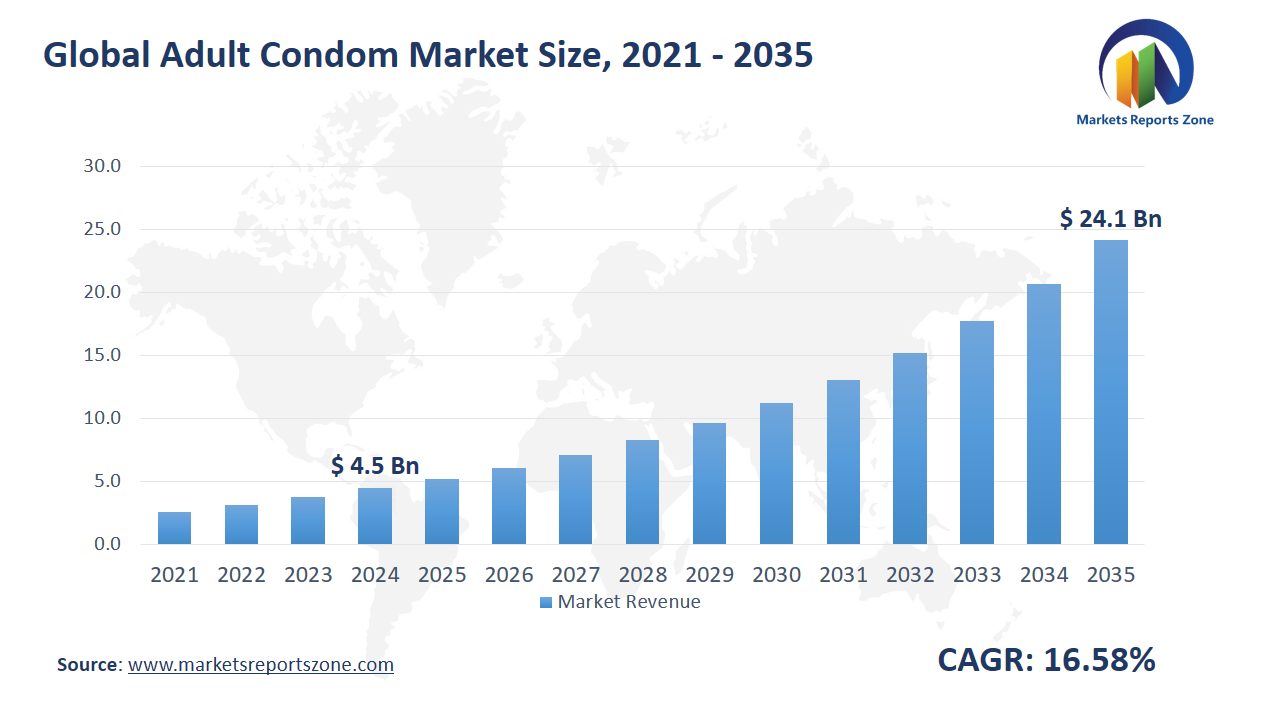
Global Adult Condom Market Size is expected to reach USD 24.14 Billion by 2035 from USD 4.46 Billion in 2024, with a CAGR of around 16.58% between 2024 and 2035. The global adult condom market is experiencing growth driven by increasing awareness of sexual health and innovations in product design. Educational campaigns by governments and NGOs have emphasized the importance of condom use in preventing sexually transmitted infections (STIs) and unintended pregnancies. For instance, in India, Durex has shifted its marketing strategy to target women and rural consumers, aiming to overcome cultural taboos and improve accessibility in underserved areas . Additionally, advancements in condom materials, such as the introduction of ultra-thin and non-latex options, have attracted consumers seeking enhanced comfort and safety. However, the market faces challenges due to cultural and social barriers, with condom use often stigmatized in conservative societies. In some regions, discussing sexual health remains taboo, leading to lower usage rates and hindering market growth . Despite these challenges, opportunities exist in emerging markets where rising disposable incomes and urbanization are increasing demand for sexual wellness products. For example, in the Asia-Pacific region, the growing middle class and improved healthcare infrastructure are contributing to the expansion of the condom market . Furthermore, the rise of e-commerce platforms offers a discreet and convenient purchasing option, particularly appealing to younger consumers seeking privacy and a wider product selection.
Driver: Rising Sexual Health Awareness Boosts Market
Increased awareness of sexual health has significantly driven the global adult condom market. Many public health initiatives have worked tirelessly to educate populations about the importance of safe sex in preventing sexually transmitted infections (STIs) and unintended pregnancies. In several countries, educational programs in schools have raised awareness from a young age, helping to normalize condom use. For example, in the UK, NHS campaigns have provided free condoms in certain areas, making them more accessible to the youth. These initiatives have been successful in changing attitudes toward sexual health, promoting condom use as a necessary part of healthy sexual behavior. In Brazil, the government’s extensive outreach programs have also encouraged condom use, especially in rural areas where sexual health education was once limited. Local NGOs and community outreach have played a pivotal role in these regions, helping to reduce stigma around contraception. As awareness spreads, more individuals are becoming proactive in purchasing condoms, especially in urban settings where sexual health is openly discussed. This shift has also been reflected in more widespread condom usage among younger generations, who are more open to using protective measures. As education efforts continue, more people are seeking better protection options, contributing to the growth of the global adult condom market.
Key Insights:
- The global annual sales volume of condoms is approximately 2.1 billion units, combining both commercial and socially marketed products.
- In the United States, around 450 million condoms are sold annually, reflecting significant consumer adoption.
- Male condoms exhibit an effectiveness rate of 98%, while female condoms have an effectiveness rate of 95% when used correctly.
- Approximately 89.7% of sexually active high school students in the U.S. reported using condoms during their last sexual encounter, according to a CDC survey.
- Eastern and South-Eastern Asia saw condom usage rise from 5% in 1994 to 17% in 2019 as a contraceptive method.
- In India, Manforce held the largest market share for condoms at 32% as of 2021, followed by Durex and Kamasutra at 14% each.
- A couple requires an average of 120 condoms annually for effective pregnancy prevention.
Segment Analysis:
The global adult condom market is segmented by type into latex and non-latex condoms and by application into age groups: under 25 years old, 25-34 years old, 35-49 years old, and above 50 years old. Latex condoms remain the most widely used due to their cost-effectiveness and proven reliability in preventing STIs and pregnancies. However, non-latex condoms have been gaining traction, particularly among individuals with latex allergies, offering an alternative in materials like polyurethane or polyisoprene. For instance, a 28-year-old couple in the U.S. recently switched to non-latex condoms due to a mild allergic reaction with latex-based products. In terms of age groups, the under-25 demographic is the largest consumer segment, driven by increasing sexual awareness and experimentation among younger individuals. A 22-year-old student in the UK, for example, regularly uses condoms as a precautionary measure. The 25-34 age group follows closely, with many individuals in this range seeking to protect against both STIs and unplanned pregnancies as they establish serious relationships or start families. Meanwhile, the 35-49-year-old segment is more focused on family planning, and their condom usage is often driven by a desire for contraception after children are born. Finally, the above-50 age group, although a smaller segment, continues to seek condoms for safe sex, often due to concerns over STIs as they return to the dating scene.
Regional Analysis:
The global adult condom market shows distinct regional trends, driven by cultural, economic, and social factors. In North America, condom use is high, with strong awareness of sexual health and easy access to a variety of products. A young couple in Canada might frequently purchase condoms from local stores, reflecting the open attitude toward safe sex in the region. In Europe, particularly in countries like Sweden and the Netherlands, condom use is common and socially accepted, with government initiatives further promoting awareness of sexual health. Meanwhile, in Asia-Pacific, condom use is growing, especially in countries like Japan and South Korea, where changing attitudes towards sexual health are reshaping the market. An increasing number of young adults in urban areas are purchasing condoms, driven by both education and greater availability. In Latin America, countries like Mexico and Brazil have seen a rise in condom sales, largely due to public health campaigns that aim to reduce the spread of STIs. In the Middle East & Africa, condom use is less prevalent due to cultural and religious factors, though some urban areas, like Dubai, are witnessing an increase in condom sales as attitudes towards contraception slowly evolve. These regional dynamics illustrate how cultural attitudes, public health efforts, and economic conditions shape the adult condom market worldwide.
Competitive Scenario:
The global adult condom market has witnessed notable advancements driven by key players focusing on innovation, sustainability, and expanding consumer bases. Durex has introduced hyaluronic acid-coated condoms in China, offering moisturizing benefits and targeting comfort-conscious users. In India, Durex is shifting its marketing strategy to focus on women and rural consumers, aiming to overcome cultural taboos and improve accessibility in underserved areas. Ansell has committed to achieving net-zero emissions by 2040, emphasizing sustainability in its operations. Okamoto has expanded its non-latex product range to cater to consumers with latex allergies, addressing a growing demand for hypoallergenic options. Church & Dwight, however, has faced challenges due to a lawsuit alleging the presence of PFAS, or "forever chemicals," in its Trojan condoms, raising concerns about product safety. Karex has launched the world's first graphene condom, ONE Flex, aiming to offer enhanced strength and sensitivity. These developments reflect the industry's shift towards addressing diverse consumer needs, prioritizing safety, comfort, and environmental responsibility. As companies continue to innovate and adapt to changing market dynamics, the adult condom market is poised for sustained growth and increased consumer engagement worldwide.
Adult Condom Market Report Scope
| Report Attribute | Details |
|---|---|
| Market Size Value in 2024 | USD 4.46 Billion |
| Revenue Forecast in 2035 | USD 24.14 Billion |
| Growth Rate | CAGR of 16.58% from 2025 to 2035 |
| Historic Period | 2021 - 2024 |
| Forecasted Period | 2025 - 2035 |
| Report Coverage | Revenue forecast, company ranking, competitive landscape, growth factors, and trends |
| Regions Covered | North America; Europe; Asia Pacific; Latin America; Middle East & Africa |
| Countries Covered | U.S.; Canada; Mexico, UK; Germany; France; Spain; Italy; Russia; China; Japan; India; South Korea; Australia; Southeast Asia; Brazil; Argentina; Saudi Arabia; UAE; South Africa |
| Key companies profiled | Durex; Okamoto; Ansell; Church & Dwight; Humanwell Healthcare Group (Jissbon); Karex; Guilin HBM Healthcares; Sagami; Fuji Latex; Gulin Latex; Guangdong NOX Technology; Thai Nippon Rubber; HANKOOK LATEX; HLL Lifecare; Sir Richard?s; GLYDE Healthcare; BioGenetics Co Ltd; Indus Medicare Limited; Nulatex Sdn Bhd; Innolatex (Thailand) Co.,Ltd; Donless; Guangzhou Double One Latex Products; Lanzhou Ketian Health Technologies (Zoncome); Shanghai Mingbang Rubber Products; The Female Health Company; TTK Protective Devices; Qingdao Double Butterfly Group |
| Customization | Free report customization (equivalent up to 8 analysts working days) with purchase. Addition or alteration to country, regional & segment scope. |
The Global Adult Condom Market report is segmented as follows:
By Type,
- Latex Condom
- Non-Latex Condom
By Application,
- Under 25 Years Old
- 25-34 Years Old
- 35-49 Years Old
- Above 50 Years Old
By Region,
- North America
- U.S.
- Canada
- Mexico
- Europe
- UK
- Germany
- France
- Spain
- Italy
- Russia
- Rest of Europe
- Asia Pacific
- China
- Japan
- India
- South Korea
- Australia
- Southeast Asia
- Rest of Asia Pacific
- Latin America
- Brazil
- Argentina
- Rest of Latin America
- Middle East & Africa
- Saudi Arabia
- UAE
- South Africa
- Rest of Middle East and Africa
Key Market Players,
- Durex
- Okamoto
- Ansell
- Church & Dwight
- Humanwell Healthcare Group (Jissbon)
- Karex
- Guilin HBM Healthcares
- Sagami
- Fuji Latex
- Gulin Latex
- Guangdong NOX Technology
- Thai Nippon Rubber
- HANKOOK LATEX
- HLL Lifecare
- Sir Richard?s
- GLYDE Healthcare
- BioGenetics Co Ltd
- Indus Medicare Limited
- Nulatex Sdn Bhd
- Innolatex (Thailand) Co.,Ltd
- Donless
- Guangzhou Double One Latex Products
- Lanzhou Ketian Health Technologies (Zoncome)
- Shanghai Mingbang Rubber Products
- The Female Health Company
- TTK Protective Devices
- Qingdao Double Butterfly Group
Frequently Asked Questions
Research Objectives
- Proliferation and maturation of trade in the global Adult Condom Market.
- The market share of the global Adult Condom Market, supply and demand ratio, growth revenue, supply chain analysis, and business overview.
- Current and future market trends that are influencing the growth opportunities and growth rate of the global Adult Condom Market.
- Feasibility study, new market insights, company profiles, investment return, market size of the global Adult Condom Market.
Chapter 1 Adult Condom Market Executive Summary
- 1.1 Adult Condom Market Research Scope
- 1.2 Adult Condom Market Estimates and Forecast (2021-2035)
- 1.2.1 Global Adult Condom Market Value and Growth Rate (2021-2035)
- 1.2.2 Global Adult Condom Market Price Trend (2021-2035)
- 1.3 Global Adult Condom Market Value Comparison, by Type (2021-2035)
- 1.3.1 Latex Condom
- 1.3.2 Non-Latex Condom
- 1.4 Global Adult Condom Market Value Comparison, by Application (2021-2035)
- 1.4.1 Under 25 Years Old
- 1.4.2 25-34 Years Old
- 1.4.3 35-49 Years Old
- 1.4.4 Above 50 Years Old
Chapter 2 Research Methodology
- 2.1 Introduction
- 2.2 Data Capture Sources
- 2.2.1 Primary Sources
- 2.2.2 Secondary Sources
- 2.3 Market Size Estimation
- 2.4 Market Forecast
- 2.5 Assumptions and Limitations
Chapter 3 Market Dynamics
- 3.1 Market Trends
- 3.2 Opportunities and Drivers
- 3.3 Challenges
- 3.4 Market Restraints
- 3.5 Porter's Five Forces Analysis
Chapter 4 Supply Chain Analysis and Marketing Channels
- 4.1 Adult Condom Supply Chain Analysis
- 4.2 Marketing Channels
- 4.3 Adult Condom Suppliers List
- 4.4 Adult Condom Distributors List
- 4.5 Adult Condom Customers
Chapter 5 COVID-19 & Russia?Ukraine War Impact Analysis
- 5.1 COVID-19 Impact Analysis on Adult Condom Market
- 5.2 Russia-Ukraine War Impact Analysis on Adult Condom Market
Chapter 6 Adult Condom Market Estimate and Forecast by Region
- 6.1 Global Adult Condom Market Value by Region: 2021 VS 2023 VS 2035
- 6.2 Global Adult Condom Market Scenario by Region (2021-2023)
- 6.2.1 Global Adult Condom Market Value Share by Region (2021-2023)
- 6.3 Global Adult Condom Market Forecast by Region (2024-2035)
- 6.3.1 Global Adult Condom Market Value Forecast by Region (2024-2035)
- 6.4 Geographic Market Analysis: Market Facts and Figures
- 6.4.1 North America Adult Condom Market Estimates and Projections (2021-2035)
- 6.4.2 Europe Adult Condom Market Estimates and Projections (2021-2035)
- 6.4.3 Asia Pacific Adult Condom Market Estimates and Projections (2021-2035)
- 6.4.4 Latin America Adult Condom Market Estimates and Projections (2021-2035)
- 6.4.5 Middle East & Africa Adult Condom Market Estimates and Projections (2021-2035)
Chapter 7 Global Adult Condom Competition Landscape by Players
- 7.1 Global Top Adult Condom Players by Value (2021-2023)
- 7.2 Adult Condom Headquarters and Sales Region by Company
- 7.3 Company Recent Developments, Mergers & Acquisitions, and Expansion Plans
Chapter 8 Global Adult Condom Market, by Type
- 8.1 Global Adult Condom Market Value, by Type (2021-2035)
- 8.1.1 Latex Condom
- 8.1.2 Non-Latex Condom
Chapter 9 Global Adult Condom Market, by Application
- 9.1 Global Adult Condom Market Value, by Application (2021-2035)
- 9.1.1 Under 25 Years Old
- 9.1.2 25-34 Years Old
- 9.1.3 35-49 Years Old
- 9.1.4 Above 50 Years Old
Chapter 10 North America Adult Condom Market
- 10.1 Overview
- 10.2 North America Adult Condom Market Value, by Country (2021-2035)
- 10.2.1 U.S.
- 10.2.2 Canada
- 10.2.3 Mexico
- 10.3 North America Adult Condom Market Value, by Type (2021-2035)
- 10.3.1 Latex Condom
- 10.3.2 Non-Latex Condom
- 10.4 North America Adult Condom Market Value, by Application (2021-2035)
- 10.4.1 Under 25 Years Old
- 10.4.2 25-34 Years Old
- 10.4.3 35-49 Years Old
- 10.4.4 Above 50 Years Old
Chapter 11 Europe Adult Condom Market
- 11.1 Overview
- 11.2 Europe Adult Condom Market Value, by Country (2021-2035)
- 11.2.1 UK
- 11.2.2 Germany
- 11.2.3 France
- 11.2.4 Spain
- 11.2.5 Italy
- 11.2.6 Russia
- 11.2.7 Rest of Europe
- 11.3 Europe Adult Condom Market Value, by Type (2021-2035)
- 11.3.1 Latex Condom
- 11.3.2 Non-Latex Condom
- 11.4 Europe Adult Condom Market Value, by Application (2021-2035)
- 11.4.1 Under 25 Years Old
- 11.4.2 25-34 Years Old
- 11.4.3 35-49 Years Old
- 11.4.4 Above 50 Years Old
Chapter 12 Asia Pacific Adult Condom Market
- 12.1 Overview
- 12.2 Asia Pacific Adult Condom Market Value, by Country (2021-2035)
- 12.2.1 China
- 12.2.2 Japan
- 12.2.3 India
- 12.2.4 South Korea
- 12.2.5 Australia
- 12.2.6 Southeast Asia
- 12.2.7 Rest of Asia Pacific
- 12.3 Asia Pacific Adult Condom Market Value, by Type (2021-2035)
- 12.3.1 Latex Condom
- 12.3.2 Non-Latex Condom
- 12.4 Asia Pacific Adult Condom Market Value, by Application (2021-2035)
- 12.4.1 Under 25 Years Old
- 12.4.2 25-34 Years Old
- 12.4.3 35-49 Years Old
- 12.4.4 Above 50 Years Old
Chapter 13 Latin America Adult Condom Market
- 13.1 Overview
- 13.2 Latin America Adult Condom Market Value, by Country (2021-2035)
- 13.2.1 Brazil
- 13.2.2 Argentina
- 13.2.3 Rest of Latin America
- 13.3 Latin America Adult Condom Market Value, by Type (2021-2035)
- 13.3.1 Latex Condom
- 13.3.2 Non-Latex Condom
- 13.4 Latin America Adult Condom Market Value, by Application (2021-2035)
- 13.4.1 Under 25 Years Old
- 13.4.2 25-34 Years Old
- 13.4.3 35-49 Years Old
- 13.4.4 Above 50 Years Old
Chapter 14 Middle East & Africa Adult Condom Market
- 14.1 Overview
- 14.2 Middle East & Africa Adult Condom Market Value, by Country (2021-2035)
- 14.2.1 Saudi Arabia
- 14.2.2 UAE
- 14.2.3 South Africa
- 14.2.4 Rest of Middle East & Africa
- 14.3 Middle East & Africa Adult Condom Market Value, by Type (2021-2035)
- 14.3.1 Latex Condom
- 14.3.2 Non-Latex Condom
- 14.4 Middle East & Africa Adult Condom Market Value, by Application (2021-2035)
- 14.4.1 Under 25 Years Old
- 14.4.2 25-34 Years Old
- 14.4.3 35-49 Years Old
- 14.4.4 Above 50 Years Old
Chapter 15 Company Profiles and Market Share Analysis: (Business Overview, Market Share Analysis, Products/Services Offered, Recent Developments)
- 15.1 Durex
- 15.2 Okamoto
- 15.3 Ansell
- 15.4 Church & Dwight
- 15.5 Humanwell Healthcare Group (Jissbon)
- 15.6 Karex
- 15.7 Guilin HBM Healthcares
- 15.8 Sagami
- 15.9 Fuji Latex
- 15.10 Gulin Latex
- 15.11 Guangdong NOX Technology
- 15.12 Thai Nippon Rubber
- 15.13 HANKOOK LATEX
- 15.14 HLL Lifecare
- 15.15 Sir Richard?s
- 15.16 GLYDE Healthcare
- 15.17 BioGenetics Co Ltd
- 15.18 Indus Medicare Limited
- 15.19 Nulatex Sdn Bhd
- 15.20 Innolatex (Thailand) Co.,Ltd
- 15.21 Donless
- 15.22 Guangzhou Double One Latex Products
- 15.23 Lanzhou Ketian Health Technologies (Zoncome)
- 15.24 Shanghai Mingbang Rubber Products
- 15.25 The Female Health Company
- 15.26 TTK Protective Devices
- 15.27 Qingdao Double Butterfly Group

Report ID:
235
Published Date:
April 2026
Trusted by more than 10,500 organizations globally



Infaluble Methodology
Customization
Analyst Support
Targeted Market View