Global Adult Meal Replacement Market, By Type (Powder, Bars, Beverages), By Application, and By Region - Trends and Forecast Analysis, 2021-2035
Publish Date: 2026-04-29 | Format: PDF | Category: Healthcare and Pharmaceutical | Pages: 370
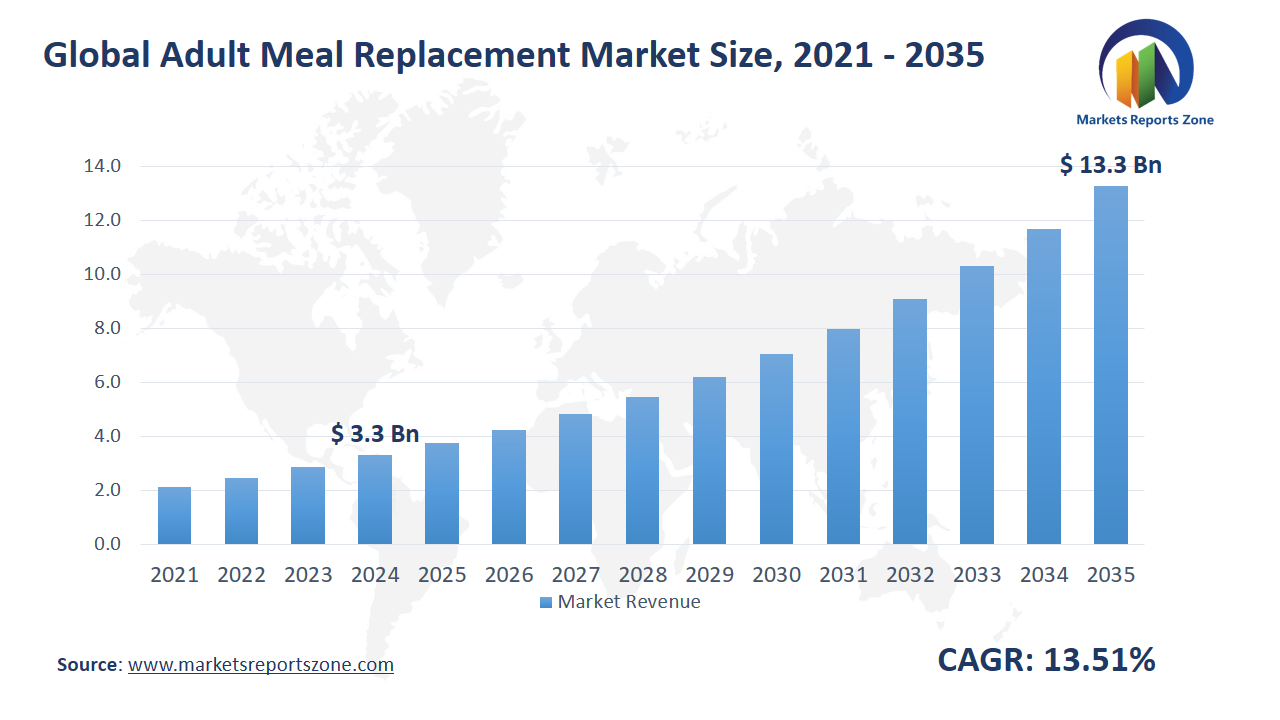
Global Adult Meal Replacement Market Size is expected to reach USD 13.28 Billion by 2035 from USD 3.29 Billion in 2024, with a CAGR of around 13.51% between 2024 and 2035. The global adult meal replacement market is being driven by two strong factors: rising health consciousness and busy lifestyles. Nutritional awareness has increased, especially among young professionals and aging adults. People are seeking convenient ways to manage weight and maintain balanced diets. In cities like London, meal replacement shakes are being consumed during office breaks instead of traditional lunches. In New York, fitness enthusiasts use protein-rich bars post workout. Another driver is the demand from elderly populations who face difficulty preparing meals. For example, in senior care homes across Japan, liquid meal replacements are routinely served for easier digestion and nutrient absorption. However, a major restraint is consumer skepticism about artificial ingredients and long-term health impact. Many still prefer natural foods over processed meal substitutes. Yet, opportunities are also emerging. One lies in plant-based innovations. In Berlin, vegan meal replacement brands are expanding quickly due to ethical consumer trends. Another opportunity is e-commerce growth. In India, direct-to-consumer startups are offering personalized meal kits based on fitness goals and dietary needs. This has allowed brands to build loyal customer bases rapidly. As lifestyles change globally, meal replacements are being adopted for both convenience and wellness, signaling a growing yet evolving market landscape.
Driver: Busy Lives Fuel Quick Nutrition
Modern fast-paced routines have become a major driver for the growing adoption of adult meal replacements. With longer work hours, commuting stress, and limited time for cooking, traditional meals are being skipped or replaced. Meal replacement products offer a convenient, quick, and often nutritious solution. In cities like Toronto, working parents have started using ready-to-drink nutritional shakes in the morning to avoid skipping breakfast. In Singapore, corporate employees grab meal bars between meetings to maintain energy without taking long lunch breaks. This trend is also visible among freelancers and gig workers in places like Manila, where unpredictable schedules make sit-down meals difficult. In Australia, a software developer shared his routine of drinking a high-protein shake while coding late at night, allowing him to stay focused without ordering junk food. Even college students in dorms now rely on powdered meal drinks that require only water and a shaker. These products are not only consumed out of necessity but are also seen as smart choices for health-conscious individuals who lack time to cook. As time becomes more valuable, demand for portable, on-the-go nutrition is expected to rise further, making convenience a key force behind the adult meal replacement market's steady growth.
Key Insights:
- The adoption rate of adult meal replacement products among health-conscious adults is estimated to be around 28%, driven by increasing awareness of weight management and nutrition.
- Leading companies have invested over USD 150 million in product innovation and marketing campaigns in 2024 to expand their adult meal replacement portfolios.
- Approximately 1.2 billion units of adult meal replacement products, including shakes, bars, and powders, were sold globally in 2024.
- The penetration rate of adult meal replacements in the fitness and wellness industry is estimated at 35%, reflecting their use as convenient nutrition solutions.
- In the U.S., adults aged 35 to 64 represent the largest consumer segment, accounting for over 45% of total adult meal replacement product consumption.
- Online sales channels contributed to nearly 30% of adult meal replacement product distribution in 2024, showing rapid growth due to convenience and privacy.
- Plant-based adult meal replacements have seen a 20% year-over-year increase in sales volume, reflecting rising consumer preference for sustainable nutrition options.
- Government health initiatives promoting balanced diets and obesity management have supported increased adoption of adult meal replacements in clinical nutrition programs, with usage rising by 15% in the last two years.
Segment Analysis:
The adult meal replacement market is segmented by type into powders, bars, and beverages, and by application into retail stores and online sales. Each type serves distinct needs. Powders are often chosen by fitness-focused individuals who prefer customizable portions. In Seoul, gym-goers mix protein powder with almond milk for post-workout recovery. Bars appeal to those needing a no-fuss, portable option. In Mexico City, taxi drivers keep meal bars in their vehicles to avoid skipping meals during long shifts. Beverages, especially ready-to-drink bottles, are favored by those with minimal prep time. In Cape Town, busy young professionals grab cold shakes from fridges before their morning commute. On the application side, retail stores remain strong in urban areas. In Paris, supermarkets stock a wide range of flavored bars and shakes near checkout counters, targeting impulse buyers. Meanwhile, online sales are expanding rapidly. In rural parts of Canada, customers are ordering bulk powder tubs and subscription boxes through e-commerce platforms for consistent delivery. The convenience of comparing nutritional facts and customer reviews before purchasing online has driven digital growth. These segments show how adult meal replacements are being embraced differently across lifestyles, with consumers choosing products based on daily routines, nutritional goals, and access to purchasing platforms.
Regional Analysis:
The adult meal replacement market shows diverse trends across North America, Europe, Asia-Pacific, Latin America, and the Middle East & Africa. In North America, consumers are prioritizing wellness and portion control. In Los Angeles, busy creatives opt for plant-based shakes to support clean eating habits. In Europe, sustainability and ethical sourcing play a bigger role. In Amsterdam, eco-conscious consumers choose powdered meal replacements packed in biodegradable containers. Asia-Pacific is witnessing fast growth due to rising urbanization. In Bangkok, office workers are turning to flavored bars as a midday meal fix, avoiding traffic and long queues. Latin America is embracing meal replacements for affordability and practicality. In Lima, working-class families stock powdered mixes to ensure nutritional balance on tight budgets. Meanwhile, in the Middle East & Africa, the market is slowly gaining ground through premium products and health awareness campaigns. In Dubai, gym chains have started selling post-workout drinks with high protein content, creating demand among young adults. Each region shows unique consumption behavior, influenced by culture, lifestyle, and access. However, the common thread remains convenience, nutrition, and a desire to stay fit. This global shift toward quick, functional food is shaping a dynamic future for adult meal replacement products across all regions.
Competitive Scenario:
The adult meal replacement market is being shaped by key companies such as Abbott, Herbalife, Kellogg, Nestle, SlimFast, Glanbia, GlaxoSmithKline, Nature's Bounty, Nutiva, Onnit Labs, Orgain, and Ultimate Superfoods, each contributing innovative products and expanding market reach. Abbott, with its Ensure brand, has focused on nutritionally complete drinks, appealing to both elderly consumers and those recovering from illness. Herbalife continues to lead with its range of protein shakes, aiming at fitness enthusiasts and those looking to manage their weight. Kellogg has ventured into the meal replacement space with offerings like Special K Protein Meal Bars, blending convenience with nutrition. Nestle has diversified with brands like Optifast, targeting weight management solutions through ready-to-drink shakes and powders. SlimFast has gained attention with its line of low-calorie meal replacement shakes and snacks designed for weight loss. Glanbia’s Optimum Nutrition focuses on high-protein meal replacement products for athletes. GlaxoSmithKline’s Boost line continues to provide balanced, calorie-dense options for undernourished populations. Companies like Nature's Bounty and Nutiva have tapped into the demand for organic, plant-based meal replacements, while Onnit Labs and Orgain are catering to the wellness and fitness market. Ultimate Superfoods promotes superfood-based options for a more nutrient-dense approach. Together, these companies are broadening product lines and reaching diverse consumers with evolving dietary needs.
Adult Meal Replacement Market Report Scope
| Report Attribute | Details |
|---|---|
| Market Size Value in 2024 | USD 3.29 Billion |
| Revenue Forecast in 2035 | USD 13.28 Billion |
| Growth Rate | CAGR of 13.51% from 2025 to 2035 |
| Historic Period | 2021 - 2024 |
| Forecasted Period | 2025 - 2035 |
| Report Coverage | Revenue forecast, company ranking, competitive landscape, growth factors, and trends |
| Regions Covered | North America; Europe; Asia Pacific; Latin America; Middle East & Africa |
| Countries Covered | U.S.; Canada; Mexico, UK; Germany; France; Spain; Italy; Russia; China; Japan; India; South Korea; Australia; Southeast Asia; Brazil; Argentina; Saudi Arabia; UAE; South Africa |
| Key companies profiled | Abbott; Herbalife; Kellogg; Nestle; SlimFast; Glanbia; GlaxoSmithKline; Nature's Bounty; Nutiva; Onnit Labs; Orgain; Ultimate Superfoods |
| Customization | Free report customization (equivalent up to 8 analysts working days) with purchase. Addition or alteration to country, regional & segment scope. |
The Global Adult Meal Replacement Market report is segmented as follows:
By Type,
- Powder
- Bars
- Beverages
By Application,
- Retail Stores
- Online Sales
By Region,
- North America
- U.S.
- Canada
- Mexico
- Europe
- UK
- Germany
- France
- Spain
- Italy
- Russia
- Rest of Europe
- Asia Pacific
- China
- Japan
- India
- South Korea
- Australia
- Southeast Asia
- Rest of Asia Pacific
- Latin America
- Brazil
- Argentina
- Rest of Latin America
- Middle East & Africa
- Saudi Arabia
- UAE
- South Africa
- Rest of Middle East and Africa
Key Market Players,
- Abbott
- Herbalife
- Kellogg
- Nestle
- SlimFast
- Glanbia
- GlaxoSmithKline
- Nature's Bounty
- Nutiva
- Onnit Labs
- Orgain
- Ultimate Superfoods
Frequently Asked Questions
Research Objectives
- Proliferation and maturation of trade in the global Adult Meal Replacement Market.
- The market share of the global Adult Meal Replacement Market, supply and demand ratio, growth revenue, supply chain analysis, and business overview.
- Current and future market trends that are influencing the growth opportunities and growth rate of the global Adult Meal Replacement Market.
- Feasibility study, new market insights, company profiles, investment return, market size of the global Adult Meal Replacement Market.
Chapter 1 Adult Meal Replacement Market Executive Summary
- 1.1 Adult Meal Replacement Market Research Scope
- 1.2 Adult Meal Replacement Market Estimates and Forecast (2021-2035)
- 1.2.1 Global Adult Meal Replacement Market Value and Growth Rate (2021-2035)
- 1.2.2 Global Adult Meal Replacement Market Price Trend (2021-2035)
- 1.3 Global Adult Meal Replacement Market Value Comparison, by Type (2021-2035)
- 1.3.1 Powder
- 1.3.2 Bars
- 1.3.3 Beverages
- 1.4 Global Adult Meal Replacement Market Value Comparison, by Application (2021-2035)
- 1.4.1 Retail Stores
- 1.4.2 Online Sales
Chapter 2 Research Methodology
- 2.1 Introduction
- 2.2 Data Capture Sources
- 2.2.1 Primary Sources
- 2.2.2 Secondary Sources
- 2.3 Market Size Estimation
- 2.4 Market Forecast
- 2.5 Assumptions and Limitations
Chapter 3 Market Dynamics
- 3.1 Market Trends
- 3.2 Opportunities and Drivers
- 3.3 Challenges
- 3.4 Market Restraints
- 3.5 Porter's Five Forces Analysis
Chapter 4 Supply Chain Analysis and Marketing Channels
- 4.1 Adult Meal Replacement Supply Chain Analysis
- 4.2 Marketing Channels
- 4.3 Adult Meal Replacement Suppliers List
- 4.4 Adult Meal Replacement Distributors List
- 4.5 Adult Meal Replacement Customers
Chapter 5 COVID-19 & Russia?Ukraine War Impact Analysis
- 5.1 COVID-19 Impact Analysis on Adult Meal Replacement Market
- 5.2 Russia-Ukraine War Impact Analysis on Adult Meal Replacement Market
Chapter 6 Adult Meal Replacement Market Estimate and Forecast by Region
- 6.1 Global Adult Meal Replacement Market Value by Region: 2021 VS 2023 VS 2035
- 6.2 Global Adult Meal Replacement Market Scenario by Region (2021-2023)
- 6.2.1 Global Adult Meal Replacement Market Value Share by Region (2021-2023)
- 6.3 Global Adult Meal Replacement Market Forecast by Region (2024-2035)
- 6.3.1 Global Adult Meal Replacement Market Value Forecast by Region (2024-2035)
- 6.4 Geographic Market Analysis: Market Facts and Figures
- 6.4.1 North America Adult Meal Replacement Market Estimates and Projections (2021-2035)
- 6.4.2 Europe Adult Meal Replacement Market Estimates and Projections (2021-2035)
- 6.4.3 Asia Pacific Adult Meal Replacement Market Estimates and Projections (2021-2035)
- 6.4.4 Latin America Adult Meal Replacement Market Estimates and Projections (2021-2035)
- 6.4.5 Middle East & Africa Adult Meal Replacement Market Estimates and Projections (2021-2035)
Chapter 7 Global Adult Meal Replacement Competition Landscape by Players
- 7.1 Global Top Adult Meal Replacement Players by Value (2021-2023)
- 7.2 Adult Meal Replacement Headquarters and Sales Region by Company
- 7.3 Company Recent Developments, Mergers & Acquisitions, and Expansion Plans
Chapter 8 Global Adult Meal Replacement Market, by Type
- 8.1 Global Adult Meal Replacement Market Value, by Type (2021-2035)
- 8.1.1 Powder
- 8.1.2 Bars
- 8.1.3 Beverages
Chapter 9 Global Adult Meal Replacement Market, by Application
- 9.1 Global Adult Meal Replacement Market Value, by Application (2021-2035)
- 9.1.1 Retail Stores
- 9.1.2 Online Sales
Chapter 10 North America Adult Meal Replacement Market
- 10.1 Overview
- 10.2 North America Adult Meal Replacement Market Value, by Country (2021-2035)
- 10.2.1 U.S.
- 10.2.2 Canada
- 10.2.3 Mexico
- 10.3 North America Adult Meal Replacement Market Value, by Type (2021-2035)
- 10.3.1 Powder
- 10.3.2 Bars
- 10.3.3 Beverages
- 10.4 North America Adult Meal Replacement Market Value, by Application (2021-2035)
- 10.4.1 Retail Stores
- 10.4.2 Online Sales
Chapter 11 Europe Adult Meal Replacement Market
- 11.1 Overview
- 11.2 Europe Adult Meal Replacement Market Value, by Country (2021-2035)
- 11.2.1 UK
- 11.2.2 Germany
- 11.2.3 France
- 11.2.4 Spain
- 11.2.5 Italy
- 11.2.6 Russia
- 11.2.7 Rest of Europe
- 11.3 Europe Adult Meal Replacement Market Value, by Type (2021-2035)
- 11.3.1 Powder
- 11.3.2 Bars
- 11.3.3 Beverages
- 11.4 Europe Adult Meal Replacement Market Value, by Application (2021-2035)
- 11.4.1 Retail Stores
- 11.4.2 Online Sales
Chapter 12 Asia Pacific Adult Meal Replacement Market
- 12.1 Overview
- 12.2 Asia Pacific Adult Meal Replacement Market Value, by Country (2021-2035)
- 12.2.1 China
- 12.2.2 Japan
- 12.2.3 India
- 12.2.4 South Korea
- 12.2.5 Australia
- 12.2.6 Southeast Asia
- 12.2.7 Rest of Asia Pacific
- 12.3 Asia Pacific Adult Meal Replacement Market Value, by Type (2021-2035)
- 12.3.1 Powder
- 12.3.2 Bars
- 12.3.3 Beverages
- 12.4 Asia Pacific Adult Meal Replacement Market Value, by Application (2021-2035)
- 12.4.1 Retail Stores
- 12.4.2 Online Sales
Chapter 13 Latin America Adult Meal Replacement Market
- 13.1 Overview
- 13.2 Latin America Adult Meal Replacement Market Value, by Country (2021-2035)
- 13.2.1 Brazil
- 13.2.2 Argentina
- 13.2.3 Rest of Latin America
- 13.3 Latin America Adult Meal Replacement Market Value, by Type (2021-2035)
- 13.3.1 Powder
- 13.3.2 Bars
- 13.3.3 Beverages
- 13.4 Latin America Adult Meal Replacement Market Value, by Application (2021-2035)
- 13.4.1 Retail Stores
- 13.4.2 Online Sales
Chapter 14 Middle East & Africa Adult Meal Replacement Market
- 14.1 Overview
- 14.2 Middle East & Africa Adult Meal Replacement Market Value, by Country (2021-2035)
- 14.2.1 Saudi Arabia
- 14.2.2 UAE
- 14.2.3 South Africa
- 14.2.4 Rest of Middle East & Africa
- 14.3 Middle East & Africa Adult Meal Replacement Market Value, by Type (2021-2035)
- 14.3.1 Powder
- 14.3.2 Bars
- 14.3.3 Beverages
- 14.4 Middle East & Africa Adult Meal Replacement Market Value, by Application (2021-2035)
- 14.4.1 Retail Stores
- 14.4.2 Online Sales
Chapter 15 Company Profiles and Market Share Analysis: (Business Overview, Market Share Analysis, Products/Services Offered, Recent Developments)
- 15.1 Abbott
- 15.2 Herbalife
- 15.3 Kellogg
- 15.4 Nestle
- 15.5 SlimFast
- 15.6 Glanbia
- 15.7 GlaxoSmithKline
- 15.8 Nature's Bounty
- 15.9 Nutiva
- 15.10 Onnit Labs
- 15.11 Orgain
- 15.12 Ultimate Superfoods

Report ID:
234
Published Date:
April 2026
Trusted by more than 10,500 organizations globally



Infaluble Methodology
Customization
Analyst Support
Targeted Market View