Global Aircraft Composites Market, By Type (Carbon Fiber, Glass Fiber, Aramid Fiber), By Application, and By Region - Trends and Forecast Analysis, 2021-2035
Publish Date: 2026-04-29 | Format: PDF | Category: Healthcare and Pharmaceutical | Pages: 334
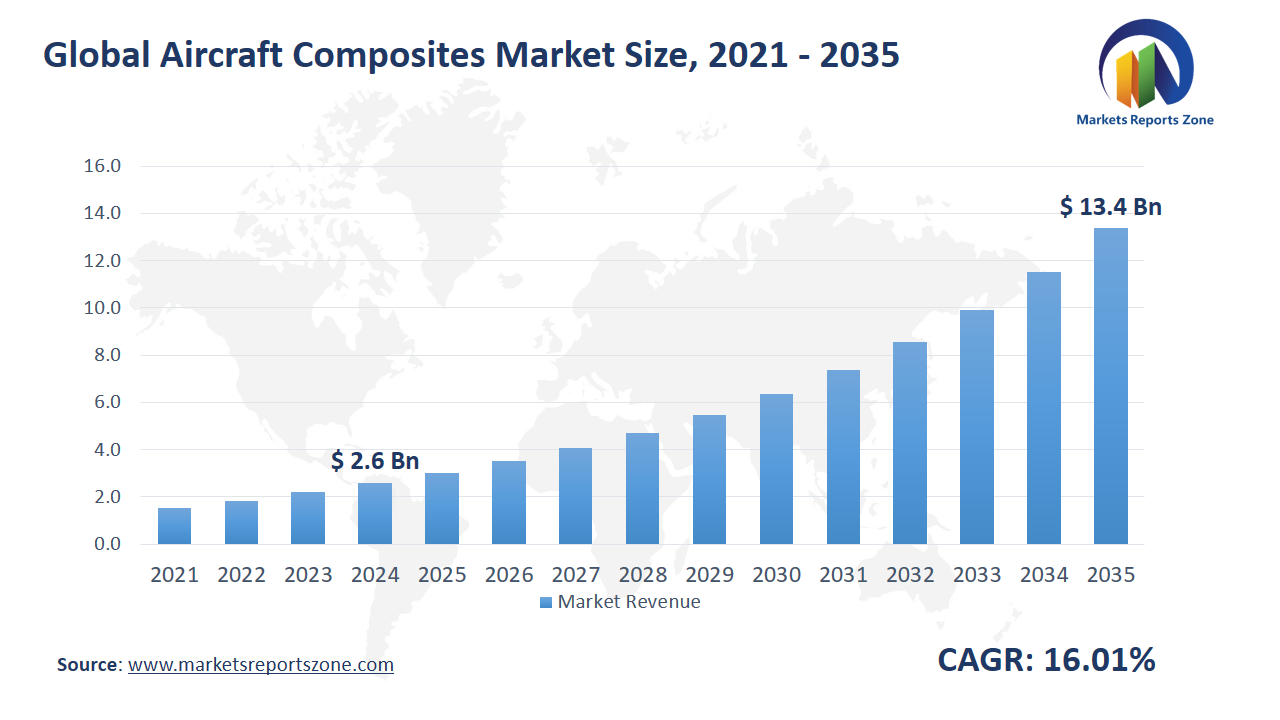
Global Aircraft Composites Market Size is expected to reach USD 13.39 Billion by 2035 from USD 2.61 Billion in 2024, with a CAGR of around 16.01% between 2024 and 2035. The global aircraft composites market is being driven by rising demand for lightweight materials and increased production of fuel-efficient aircraft. A strong push toward lowering carbon emissions has been observed across the aviation sector. Greater use of composites like carbon fiber and fiberglass has been promoted by manufacturers such as Boeing and Airbus. Rapid advancements in material technology have also been witnessed, boosting the adoption of next-generation composites. However, the market growth is being restrained by the high cost of advanced composite materials. The manufacturing processes have remained complex and costly, making adoption slower among smaller aircraft producers. Despite these challenges, significant opportunities have been created by the growth of electric aircraft programs. Companies like Joby Aviation and Eviation Aircraft have been heavily investing in electric models that rely on composite structures for better performance. Another opportunity has been offered by the rise of sustainable aviation initiatives. Aircraft recycling programs and the focus on greener material alternatives have gained momentum worldwide. Composite recycling methods are being developed to support a circular economy in aviation. As industry players continue to innovate, the market for aircraft composites is expected to be shaped by environmental concerns and technological evolution in the coming years.
Driver: Lightweight Materials Revolutionize Modern Aviation
A strong demand for lightweight materials has been driving the growth of the global aircraft composites market. Greater fuel efficiency is being targeted by airlines through the use of lighter components. Traditional metals like aluminum are being replaced with composites to reduce aircraft weight without compromising strength. Aircraft such as the Embraer E2 series and the Mitsubishi SpaceJet have been designed with extensive use of advanced composites. Weight reduction has allowed these models to achieve better fuel economy and lower operational costs. At the same time, longer flight ranges have been enabled without increasing fuel consumption. Airlines are focusing on fleet upgrades to modern composite-rich aircraft to cut maintenance expenses and improve performance. Lightweight materials are also helping new supersonic aircraft projects such as Boom Supersonic’s Overture achieve higher speed targets with better efficiency. Interiors of aircraft are being fitted with composite seats, panels, and overhead bins to further trim down weight. Even regional and private jet manufacturers are increasingly adopting composites to stay competitive. The drive toward reducing weight is expected to continue as environmental regulations tighten. Through advanced engineering and smarter material use, a new generation of lighter, faster, and greener aircraft is steadily being brought to the skies.
Key Insights:
- The percentage of composite materials used by structural weight in commercial aircraft has increased from around 3%-5% in earlier decades to approximately 19%-20% in recent years.
- Leading aircraft models such as the Boeing 787 Dreamliner and Airbus A350 now feature over 50% of their structures made from composite materials.
- In 2023, NASA awarded $50 million in funding to 14 organizations for the Hi-Rate Composite Aircraft Manufacturing project, with a total planned investment of $184 million from NASA and $136 million from partner organizations through 2028.
- In 2025, the U.S. government announced a $48 million federal grant for the American Aerospace Materials Manufacturing Center to develop advanced thermoplastic composite materials for aircraft.
- Foreign direct investment in the U.S. aerospace composites sector surpassed $20 billion by the end of 2023, supporting innovation and job creation in advanced composite manufacturing.
- In North America, the United States accounted for 85.1% of the region’s aerospace composites market share, reflecting its leadership in adoption and production.
Segment Analysis:
The aircraft composites market has been segmented by type and application, with each area showing distinct growth patterns. Carbon fiber is being widely used for its high strength-to-weight ratio, helping to build lighter and more durable aircraft structures. Newer models like the Gulfstream G700 have incorporated carbon fiber extensively in fuselage and wing designs to enhance performance. Glass fiber is being preferred for secondary structures where cost efficiency is critical, such as radomes and cabin insulation panels. It has been increasingly adopted by manufacturers of regional aircraft and helicopters to strike a balance between weight and affordability. Aramid fiber is being utilized for its excellent impact resistance, particularly in cargo linings and military aircraft parts, where durability is crucial. By application, composites are being used heavily in aircraft interiors to create lighter seats, partitions, and sidewalls, helping airlines like Delta and Lufthansa improve fuel efficiency while upgrading cabin aesthetics. For exteriors, composite materials are being used in critical areas such as wings, tail sections, and engine nacelles. Business jets like the Dassault Falcon 10X have embraced exterior composites to achieve superior aerodynamic performance. As innovation accelerates, both type and application segments are expected to be reshaped by evolving demands for efficiency, sustainability, and passenger comfort.
Regional Analysis:
North America has been leading the aircraft composites market due to strong investments in aerospace innovation and the presence of major players. New aircraft programs like Lockheed Martin’s X-59 have been advancing the use of composites across the region. In Europe, a strong focus on sustainability has been driving composite adoption, with companies like Rolls-Royce exploring composite fan blades for next-generation engines. Asia Pacific has been witnessing rapid growth fueled by rising air travel demand and manufacturing expansion. China’s COMAC C919 program has been using composite materials to compete globally and reduce aircraft weight. In the Middle East, investments in aviation hubs like Dubai and Qatar have been boosting demand for advanced aircraft featuring lightweight structures, with new fleet expansions from airlines such as Qatar Airways relying on composite-rich planes. Latin America has been gradually adopting composites in smaller and regional aircraft, with companies like Embraer integrating more composite components into jets like the Praetor series. Across all these regions, growing environmental awareness, fuel-saving needs, and demand for advanced aviation technology are reshaping strategies. As new projects are launched and fleets are modernized, the global footprint of aircraft composites is expected to deepen, bringing lighter, more efficient aircraft into service across every major market.
Competitive Scenario:
Leading companies in the aircraft composites market are advancing technologies to meet the growing demand for lightweight, efficient, and sustainable aerospace solutions. Toray Industries has developed a high-speed thermal welding technology for carbon fiber reinforced plastics (CFRP), enabling faster production and weight savings in aircraft manufacturing. Additionally, Toray's rapid integrated molding technology for CFRP mobility components allows for the fabrication of large panels in a single press shot, significantly reducing production time. Hexcel Corporation has been selected to supply carbon fiber prepreg for Dassault's Falcon 10X program, highlighting its role in producing strong, durable, and lightweight materials for next-generation aircraft. Mitsubishi Chemical Group has developed a carbon fiber-based ceramic matrix composite (C/SiC) capable of withstanding temperatures up to 1,500°C, targeting applications in the space industry. Solvay has introduced FusePly™, a breakthrough composite bonding technology that enhances the reliability and performance of bonded composite parts, reducing the need for mechanical fasteners. Furthermore, Solvay's collaboration with Spirit AeroSystems aims to accelerate the adoption of composites in future aircraft through advanced manufacturing concepts. These developments reflect a concerted effort by industry leaders to innovate and meet the evolving requirements of the aerospace sector.
Aircraft Composites Market Report Scope
| Report Attribute | Details |
|---|---|
| Market Size Value in 2024 | USD 2.61 Billion |
| Revenue Forecast in 2035 | USD 13.39 Billion |
| Growth Rate | CAGR of 16.01% from 2025 to 2035 |
| Historic Period | 2021 - 2024 |
| Forecasted Period | 2025 - 2035 |
| Report Coverage | Revenue forecast, company ranking, competitive landscape, growth factors, and trends |
| Regions Covered | North America; Europe; Asia Pacific; Latin America; Middle East & Africa |
| Countries Covered | U.S.; Canada; Mexico, UK; Germany; France; Spain; Italy; Russia; China; Japan; India; South Korea; Australia; Southeast Asia; Brazil; Argentina; Saudi Arabia; UAE; South Africa |
| Key companies profiled | Toray Industries; Teijin Limited; Koninklijke Ten Cate bv; Hexcel Corporation; Royal DSM; SGL Group; Mitsubishi Chemical; Materion Aerospace Metal Composites; Renegade Materials; Quantum Composites; Solvay |
| Customization | Free report customization (equivalent up to 8 analysts working days) with purchase. Addition or alteration to country, regional & segment scope. |
The Global Aircraft Composites Market report is segmented as follows:
By Type,
- Carbon Fiber
- Glass Fiber
- Aramid Fiber
By Application,
- Interior
- Exterior
By Region,
- North America
- U.S.
- Canada
- Mexico
- Europe
- UK
- Germany
- France
- Spain
- Italy
- Russia
- Rest of Europe
- Asia Pacific
- China
- Japan
- India
- South Korea
- Australia
- Southeast Asia
- Rest of Asia Pacific
- Latin America
- Brazil
- Argentina
- Rest of Latin America
- Middle East & Africa
- Saudi Arabia
- UAE
- South Africa
- Rest of Middle East and Africa
Key Market Players,
- Toray Industries
- Teijin Limited
- Koninklijke Ten Cate bv
- Hexcel Corporation
- Royal DSM
- SGL Group
- Mitsubishi Chemical
- Materion Aerospace Metal Composites
- Renegade Materials
- Quantum Composites
- Solvay
Frequently Asked Questions
Research Objectives
- Proliferation and maturation of trade in the global Aircraft Composites Market.
- The market share of the global Aircraft Composites Market, supply and demand ratio, growth revenue, supply chain analysis, and business overview.
- Current and future market trends that are influencing the growth opportunities and growth rate of the global Aircraft Composites Market.
- Feasibility study, new market insights, company profiles, investment return, market size of the global Aircraft Composites Market.
Chapter 1 Aircraft Composites Market Executive Summary
- 1.1 Aircraft Composites Market Research Scope
- 1.2 Aircraft Composites Market Estimates and Forecast (2021-2035)
- 1.2.1 Global Aircraft Composites Market Value and Growth Rate (2021-2035)
- 1.2.2 Global Aircraft Composites Market Price Trend (2021-2035)
- 1.3 Global Aircraft Composites Market Value Comparison, by Type (2021-2035)
- 1.3.1 Carbon Fiber
- 1.3.2 Glass Fiber
- 1.3.3 Aramid Fiber
- 1.4 Global Aircraft Composites Market Value Comparison, by Application (2021-2035)
- 1.4.1 Interior
- 1.4.2 Exterior
Chapter 2 Research Methodology
- 2.1 Introduction
- 2.2 Data Capture Sources
- 2.2.1 Primary Sources
- 2.2.2 Secondary Sources
- 2.3 Market Size Estimation
- 2.4 Market Forecast
- 2.5 Assumptions and Limitations
Chapter 3 Market Dynamics
- 3.1 Market Trends
- 3.2 Opportunities and Drivers
- 3.3 Challenges
- 3.4 Market Restraints
- 3.5 Porter's Five Forces Analysis
Chapter 4 Supply Chain Analysis and Marketing Channels
- 4.1 Aircraft Composites Supply Chain Analysis
- 4.2 Marketing Channels
- 4.3 Aircraft Composites Suppliers List
- 4.4 Aircraft Composites Distributors List
- 4.5 Aircraft Composites Customers
Chapter 5 COVID-19 & Russia?Ukraine War Impact Analysis
- 5.1 COVID-19 Impact Analysis on Aircraft Composites Market
- 5.2 Russia-Ukraine War Impact Analysis on Aircraft Composites Market
Chapter 6 Aircraft Composites Market Estimate and Forecast by Region
- 6.1 Global Aircraft Composites Market Value by Region: 2021 VS 2023 VS 2035
- 6.2 Global Aircraft Composites Market Scenario by Region (2021-2023)
- 6.2.1 Global Aircraft Composites Market Value Share by Region (2021-2023)
- 6.3 Global Aircraft Composites Market Forecast by Region (2024-2035)
- 6.3.1 Global Aircraft Composites Market Value Forecast by Region (2024-2035)
- 6.4 Geographic Market Analysis: Market Facts and Figures
- 6.4.1 North America Aircraft Composites Market Estimates and Projections (2021-2035)
- 6.4.2 Europe Aircraft Composites Market Estimates and Projections (2021-2035)
- 6.4.3 Asia Pacific Aircraft Composites Market Estimates and Projections (2021-2035)
- 6.4.4 Latin America Aircraft Composites Market Estimates and Projections (2021-2035)
- 6.4.5 Middle East & Africa Aircraft Composites Market Estimates and Projections (2021-2035)
Chapter 7 Global Aircraft Composites Competition Landscape by Players
- 7.1 Global Top Aircraft Composites Players by Value (2021-2023)
- 7.2 Aircraft Composites Headquarters and Sales Region by Company
- 7.3 Company Recent Developments, Mergers & Acquisitions, and Expansion Plans
Chapter 8 Global Aircraft Composites Market, by Type
- 8.1 Global Aircraft Composites Market Value, by Type (2021-2035)
- 8.1.1 Carbon Fiber
- 8.1.2 Glass Fiber
- 8.1.3 Aramid Fiber
Chapter 9 Global Aircraft Composites Market, by Application
- 9.1 Global Aircraft Composites Market Value, by Application (2021-2035)
- 9.1.1 Interior
- 9.1.2 Exterior
Chapter 10 North America Aircraft Composites Market
- 10.1 Overview
- 10.2 North America Aircraft Composites Market Value, by Country (2021-2035)
- 10.2.1 U.S.
- 10.2.2 Canada
- 10.2.3 Mexico
- 10.3 North America Aircraft Composites Market Value, by Type (2021-2035)
- 10.3.1 Carbon Fiber
- 10.3.2 Glass Fiber
- 10.3.3 Aramid Fiber
- 10.4 North America Aircraft Composites Market Value, by Application (2021-2035)
- 10.4.1 Interior
- 10.4.2 Exterior
Chapter 11 Europe Aircraft Composites Market
- 11.1 Overview
- 11.2 Europe Aircraft Composites Market Value, by Country (2021-2035)
- 11.2.1 UK
- 11.2.2 Germany
- 11.2.3 France
- 11.2.4 Spain
- 11.2.5 Italy
- 11.2.6 Russia
- 11.2.7 Rest of Europe
- 11.3 Europe Aircraft Composites Market Value, by Type (2021-2035)
- 11.3.1 Carbon Fiber
- 11.3.2 Glass Fiber
- 11.3.3 Aramid Fiber
- 11.4 Europe Aircraft Composites Market Value, by Application (2021-2035)
- 11.4.1 Interior
- 11.4.2 Exterior
Chapter 12 Asia Pacific Aircraft Composites Market
- 12.1 Overview
- 12.2 Asia Pacific Aircraft Composites Market Value, by Country (2021-2035)
- 12.2.1 China
- 12.2.2 Japan
- 12.2.3 India
- 12.2.4 South Korea
- 12.2.5 Australia
- 12.2.6 Southeast Asia
- 12.2.7 Rest of Asia Pacific
- 12.3 Asia Pacific Aircraft Composites Market Value, by Type (2021-2035)
- 12.3.1 Carbon Fiber
- 12.3.2 Glass Fiber
- 12.3.3 Aramid Fiber
- 12.4 Asia Pacific Aircraft Composites Market Value, by Application (2021-2035)
- 12.4.1 Interior
- 12.4.2 Exterior
Chapter 13 Latin America Aircraft Composites Market
- 13.1 Overview
- 13.2 Latin America Aircraft Composites Market Value, by Country (2021-2035)
- 13.2.1 Brazil
- 13.2.2 Argentina
- 13.2.3 Rest of Latin America
- 13.3 Latin America Aircraft Composites Market Value, by Type (2021-2035)
- 13.3.1 Carbon Fiber
- 13.3.2 Glass Fiber
- 13.3.3 Aramid Fiber
- 13.4 Latin America Aircraft Composites Market Value, by Application (2021-2035)
- 13.4.1 Interior
- 13.4.2 Exterior
Chapter 14 Middle East & Africa Aircraft Composites Market
- 14.1 Overview
- 14.2 Middle East & Africa Aircraft Composites Market Value, by Country (2021-2035)
- 14.2.1 Saudi Arabia
- 14.2.2 UAE
- 14.2.3 South Africa
- 14.2.4 Rest of Middle East & Africa
- 14.3 Middle East & Africa Aircraft Composites Market Value, by Type (2021-2035)
- 14.3.1 Carbon Fiber
- 14.3.2 Glass Fiber
- 14.3.3 Aramid Fiber
- 14.4 Middle East & Africa Aircraft Composites Market Value, by Application (2021-2035)
- 14.4.1 Interior
- 14.4.2 Exterior
Chapter 15 Company Profiles and Market Share Analysis: (Business Overview, Market Share Analysis, Products/Services Offered, Recent Developments)
- 15.1 Toray Industries
- 15.2 Teijin Limited
- 15.3 Koninklijke Ten Cate bv
- 15.4 Hexcel Corporation
- 15.5 Royal DSM
- 15.6 SGL Group
- 15.7 Mitsubishi Chemical
- 15.8 Materion Aerospace Metal Composites
- 15.9 Renegade Materials
- 15.10 Quantum Composites
- 15.11 Solvay

Report ID:
233
Published Date:
April 2026
Trusted by more than 10,500 organizations globally



Infaluble Methodology
Customization
Analyst Support
Targeted Market View