Global Automobile Brakes Market, By Type (Brake Rotors, Brake Boosters, Brake Pads), By Application, and By Region - Trends and Forecast Analysis, 2021-2035
Publish Date: 2025-04-05 | Format: PDF | Category: Automotive | Pages: 309
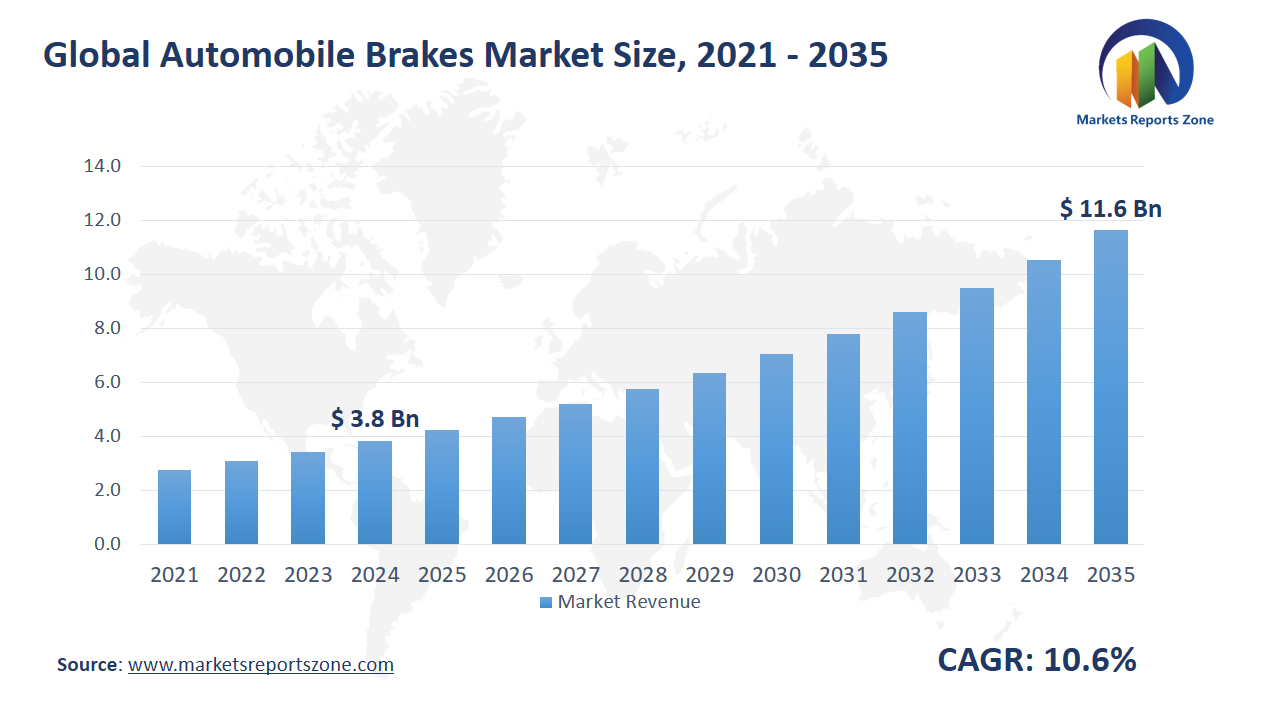
Global Automobile Brakes Market Size is expected to reach USD 11.67 Billion by 2035 from USD 3.84 Billion in 2024, with a CAGR of around 10.6% between 2024 and 2035. The Global Automobile Brakes Market is being driven by the increasing demand for vehicle safety and advancements in brake technology. As safety regulations tighten globally, manufacturers are investing in high-performance braking systems to meet stricter standards. For example, the introduction of advanced driver-assistance systems (ADAS) in vehicles has driven the demand for more responsive and reliable brake systems. Another driver is the growing trend of electric vehicles (EVs). EVs require specialized braking systems, such as regenerative braking, which has boosted market growth. However, a significant restraint is the high cost of advanced brake materials and technologies. This has made it challenging for manufacturers to keep prices competitive while incorporating cutting-edge features. Despite this, opportunities are emerging in the growing automotive aftermarket. As vehicles age, the demand for replacement brakes and maintenance services is rising, particularly in developing regions. Additionally, the push for sustainable transportation offers an opportunity for the development of eco-friendly brake systems. Companies are exploring materials like carbon composites and ceramics to reduce the environmental impact of brake systems. These opportunities, combined with technological innovations, will continue to shape the future of the Global Automobile Brakes Market.
Driver: EVs Driving Braking System Innovation
The rise of electric vehicles (EVs) has become a key driver for innovation in automobile braking systems. Unlike traditional vehicles, EVs require braking systems that support regenerative braking, a technology that converts kinetic energy back into electricity to recharge the battery. This system reduces wear on traditional brake pads and extends the lifespan of the braking components. For example, Tesla’s Model S features a regenerative braking system that significantly improves energy efficiency while also enhancing braking performance. The demand for EVs has led manufacturers to develop new materials and designs for brakes that are lighter, more efficient, and capable of handling the unique challenges posed by electric drivetrains. In addition to regenerative braking, EVs are increasingly incorporating advanced brake technologies, such as electronic braking systems (EBS), which offer smoother, more responsive braking. Companies like BMW and Audi are adopting such systems in their EV models, ensuring that their brakes are optimized for both energy efficiency and safety. As the EV market continues to grow, automakers are investing heavily in next-generation brake technologies, aiming to meet the specific needs of electric vehicles while maintaining high standards of performance and sustainability.
Key Insights:
- Adoption rate of regenerative braking systems in electric vehicles has surpassed 75% in major EV manufacturers.
- Over USD 3 billion in investments has been allocated by leading automotive companies toward the development of advanced braking technologies in the past two years.
- Approximately 50 million units of brake pads are sold annually in the global automotive market, with a growing percentage attributed to electric vehicle models.
- Penetration rate of electronic brake systems in new vehicle models is now at around 35%, especially in mid-to-high-end vehicles.
- The global automotive braking system market saw over 10% growth in demand for lightweight materials like carbon composites for brake components in the last year.
- Government-funded infrastructure projects in Europe have seen a collective investment of USD 500 million toward improving road safety and braking technology in public transport.
- In the aftermarket sector, the number of replacement brake parts sold has increased by 8% annually, with a significant portion driven by EV and hybrid vehicle maintenance.
- Companies like Bosch and Continental have reported annual production of over 25 million brake systems, with a steady increase due to the rise in demand for electric and hybrid vehicles.
Segment Analysis:
The automotive braking system market is driven by diverse segments including brake rotors, brake boosters, and brake pads, each catering to different vehicle types. Brake rotors, an essential component in all types of vehicles, are critical for converting kinetic energy into heat during braking. In passenger cars, rotors are made from lightweight materials to ensure efficient braking performance and fuel economy. Brake boosters, which amplify the force applied to the brake pedal, are widely used in light commercial and heavy commercial vehicles, where larger brake force is required. For example, in delivery trucks, brake boosters ensure that braking is quick and effective, even when the vehicle is fully loaded. Brake pads, another crucial component, experience high wear and tear. In passenger cars, the demand for high-performance brake pads is increasing due to more stringent safety regulations. In light commercial vehicles, high-quality pads are essential for maintaining long-term performance under various load conditions. Heavy commercial vehicles, especially trucks, require specialized brake systems to handle the weight and size of the vehicles. Brake pads for these vehicles are designed for durability and reliability, ensuring safety even on long-haul routes. As safety and performance standards continue to rise, each of these segments is advancing, offering tailored solutions to meet the specific needs of different vehicle categories.
Regional Analysis:
The automotive brake systems market is seeing varied growth across regions, driven by different needs and infrastructure. In North America, the focus is on advanced braking technologies, with the U.S. and Canada investing heavily in safety features for both passenger and commercial vehicles. For example, automated emergency braking systems are increasingly standard in new cars. Europe is embracing stricter environmental and safety regulations, prompting innovations in brake materials and efficiency. Countries like Germany are leading in the adoption of regenerative braking systems, especially in electric vehicles. The Asia-Pacific region is witnessing rapid expansion, particularly in China, where the growing demand for both passenger cars and commercial vehicles is pushing for advancements in braking systems. India is also experiencing growth in the light commercial vehicle segment, driving the need for high-performance brake components. The Middle East, with its increasing urbanization and infrastructure development, is focusing on efficient braking solutions for both luxury vehicles and heavy-duty trucks, especially in cities like Dubai and Riyadh. Latin America is seeing moderate growth, with countries like Brazil improving their automotive infrastructure and demanding better braking performance for buses and trucks. Finally, in Africa, brake systems are gaining attention due to the expansion of road networks and the growing demand for commercial vehicles in regions like South Africa. Each region’s needs shape how the market evolves.
Competitive Scenario:
The automotive brake components market is evolving with significant contributions from companies like Centric Parts, Brake Parts Inc., and Brembo SpA, each innovating to meet the growing demand for safety and performance. Centric Parts and Brake Parts Inc. are focusing on expanding their product portfolios with high-performance brake pads, rotors, and complete brake kits for both passenger cars and commercial vehicles. Brembo SpA continues to lead with cutting-edge braking technologies, offering ceramic and carbon-ceramic brake solutions that are becoming increasingly popular in sports cars and luxury vehicles. SGL Group and Surface Transforms Plc are contributing to the development of advanced carbon-carbon brake components, particularly in the aerospace and high-performance automotive sectors. Akebono Brake Corporation is enhancing its brake pad formulations to provide better durability and reduce noise, which is especially important for electric vehicles. Fusion Brakes and Sicom (MS Production) are targeting the aftermarket sector, providing cost-effective yet high-quality solutions for various vehicle types. Companies like Rotora and Brakes International are offering customized solutions for racing and off-road vehicles, focusing on durability under extreme conditions. Bosch Auto Parts and Nasco Aircraft Brake continue to expand their presence in the commercial vehicle and aerospace markets, respectively, by improving brake systems’ efficiency. Alcon Components Limited is focusing on precision engineering for high-end vehicles, solidifying its position in the premium segment of the market. These companies are driving the development of innovative brake systems to cater to diverse automotive needs.
Automobile Brakes Market Report Scope
| Report Attribute | Details |
|---|---|
| Market Size Value in 2024 | USD 3.84 Billion |
| Revenue Forecast in 2035 | USD 11.67 Billion |
| Growth Rate | CAGR of 10.6% from 2025 to 2035 |
| Historic Period | 2021 - 2024 |
| Forecasted Period | 2025 - 2035 |
| Report Coverage | Revenue forecast, company ranking, competitive landscape, growth factors, and trends |
| Regions Covered | North America; Europe; Asia Pacific; Latin America; Middle East & Africa |
| Countries Covered | U.S.; Canada; Mexico, UK; Germany; France; Spain; Italy; Russia; China; Japan; India; South Korea; Australia; Southeast Asia; Brazil; Argentina; Saudi Arabia; UAE; South Africa |
| Key companies profiled | Centric Parts; Brake Parts Inc.; winhere brake parts; ATTC; Brembo SpA; SGL Group; Surface Transforms Plc; Akebono Brake Corporation; Fusion Brakes; Sicom (MS Production); Rotora; Brakes International; Bosch Auto Parts; Nasco Aircraft Brake; NewTek Automotive USA; Alcon Components Limited |
| Customization | Free report customization (equivalent up to 8 analysts working days) with purchase. Addition or alteration to country, regional & segment scope. |
The Global Automobile Brakes Market report is segmented as follows:
By Type,
- Brake Rotors
- Brake Boosters
- Brake Pads
By Application,
- Passenger Car (PC)
- Light Commercial Vehicle (LCV)
- Heavy Commercial Vehicle (HCV)
- Truck
By Region,
- North America
- U.S.
- Canada
- Mexico
- Europe
- UK
- Germany
- France
- Spain
- Italy
- Russia
- Rest of Europe
- Asia Pacific
- China
- Japan
- India
- South Korea
- Australia
- Southeast Asia
- Rest of Asia Pacific
- Latin America
- Brazil
- Argentina
- Rest of Latin America
- Middle East & Africa
- Saudi Arabia
- UAE
- South Africa
- Rest of Middle East and Africa
Key Market Players,
- Centric Parts
- Brake Parts Inc.
- winhere brake parts
- ATTC
- Brembo SpA
- SGL Group
- Surface Transforms Plc
- Akebono Brake Corporation
- Fusion Brakes
- Sicom (MS Production)
- Rotora
- Brakes International
- Bosch Auto Parts
- Nasco Aircraft Brake
- NewTek Automotive USA
- Alcon Components Limited
Frequently Asked Questions
Research Objectives
- Proliferation and maturation of trade in the global Automobile Brakes Market.
- The market share of the global Automobile Brakes Market, supply and demand ratio, growth revenue, supply chain analysis, and business overview.
- Current and future market trends that are influencing the growth opportunities and growth rate of the global Automobile Brakes Market.
- Feasibility study, new market insights, company profiles, investment return, market size of the global Automobile Brakes Market.
Chapter 1 Automobile Brakes Market Executive Summary
- 1.1 Automobile Brakes Market Research Scope
- 1.2 Automobile Brakes Market Estimates and Forecast (2021-2035)
- 1.2.1 Global Automobile Brakes Market Value and Growth Rate (2021-2035)
- 1.2.2 Global Automobile Brakes Market Price Trend (2021-2035)
- 1.3 Global Automobile Brakes Market Value Comparison, by Type (2021-2035)
- 1.3.1 Brake Rotors
- 1.3.2 Brake Boosters
- 1.3.3 Brake Pads
- 1.4 Global Automobile Brakes Market Value Comparison, by Application (2021-2035)
- 1.4.1 Passenger Car (PC)
- 1.4.2 Light Commercial Vehicle (LCV)
- 1.4.3 Heavy Commercial Vehicle (HCV)
- 1.4.4 Truck
Chapter 2 Research Methodology
- 2.1 Introduction
- 2.2 Data Capture Sources
- 2.2.1 Primary Sources
- 2.2.2 Secondary Sources
- 2.3 Market Size Estimation
- 2.4 Market Forecast
- 2.5 Assumptions and Limitations
Chapter 3 Market Dynamics
- 3.1 Market Trends
- 3.2 Opportunities and Drivers
- 3.3 Challenges
- 3.4 Market Restraints
- 3.5 Porter's Five Forces Analysis
Chapter 4 Supply Chain Analysis and Marketing Channels
- 4.1 Automobile Brakes Supply Chain Analysis
- 4.2 Marketing Channels
- 4.3 Automobile Brakes Suppliers List
- 4.4 Automobile Brakes Distributors List
- 4.5 Automobile Brakes Customers
Chapter 5 COVID-19 & Russia?Ukraine War Impact Analysis
- 5.1 COVID-19 Impact Analysis on Automobile Brakes Market
- 5.2 Russia-Ukraine War Impact Analysis on Automobile Brakes Market
Chapter 6 Automobile Brakes Market Estimate and Forecast by Region
- 6.1 Global Automobile Brakes Market Value by Region: 2021 VS 2023 VS 2035
- 6.2 Global Automobile Brakes Market Scenario by Region (2021-2023)
- 6.2.1 Global Automobile Brakes Market Value Share by Region (2021-2023)
- 6.3 Global Automobile Brakes Market Forecast by Region (2024-2035)
- 6.3.1 Global Automobile Brakes Market Value Forecast by Region (2024-2035)
- 6.4 Geographic Market Analysis: Market Facts and Figures
- 6.4.1 North America Automobile Brakes Market Estimates and Projections (2021-2035)
- 6.4.2 Europe Automobile Brakes Market Estimates and Projections (2021-2035)
- 6.4.3 Asia Pacific Automobile Brakes Market Estimates and Projections (2021-2035)
- 6.4.4 Latin America Automobile Brakes Market Estimates and Projections (2021-2035)
- 6.4.5 Middle East & Africa Automobile Brakes Market Estimates and Projections (2021-2035)
Chapter 7 Global Automobile Brakes Competition Landscape by Players
- 7.1 Global Top Automobile Brakes Players by Value (2021-2023)
- 7.2 Automobile Brakes Headquarters and Sales Region by Company
- 7.3 Company Recent Developments, Mergers & Acquisitions, and Expansion Plans
Chapter 8 Global Automobile Brakes Market, by Type
- 8.1 Global Automobile Brakes Market Value, by Type (2021-2035)
- 8.1.1 Brake Rotors
- 8.1.2 Brake Boosters
- 8.1.3 Brake Pads
Chapter 9 Global Automobile Brakes Market, by Application
- 9.1 Global Automobile Brakes Market Value, by Application (2021-2035)
- 9.1.1 Passenger Car (PC)
- 9.1.2 Light Commercial Vehicle (LCV)
- 9.1.3 Heavy Commercial Vehicle (HCV)
- 9.1.4 Truck
Chapter 10 North America Automobile Brakes Market
- 10.1 Overview
- 10.2 North America Automobile Brakes Market Value, by Country (2021-2035)
- 10.2.1 U.S.
- 10.2.2 Canada
- 10.2.3 Mexico
- 10.3 North America Automobile Brakes Market Value, by Type (2021-2035)
- 10.3.1 Brake Rotors
- 10.3.2 Brake Boosters
- 10.3.3 Brake Pads
- 10.4 North America Automobile Brakes Market Value, by Application (2021-2035)
- 10.4.1 Passenger Car (PC)
- 10.4.2 Light Commercial Vehicle (LCV)
- 10.4.3 Heavy Commercial Vehicle (HCV)
- 10.4.4 Truck
Chapter 11 Europe Automobile Brakes Market
- 11.1 Overview
- 11.2 Europe Automobile Brakes Market Value, by Country (2021-2035)
- 11.2.1 UK
- 11.2.2 Germany
- 11.2.3 France
- 11.2.4 Spain
- 11.2.5 Italy
- 11.2.6 Russia
- 11.2.7 Rest of Europe
- 11.3 Europe Automobile Brakes Market Value, by Type (2021-2035)
- 11.3.1 Brake Rotors
- 11.3.2 Brake Boosters
- 11.3.3 Brake Pads
- 11.4 Europe Automobile Brakes Market Value, by Application (2021-2035)
- 11.4.1 Passenger Car (PC)
- 11.4.2 Light Commercial Vehicle (LCV)
- 11.4.3 Heavy Commercial Vehicle (HCV)
- 11.4.4 Truck
Chapter 12 Asia Pacific Automobile Brakes Market
- 12.1 Overview
- 12.2 Asia Pacific Automobile Brakes Market Value, by Country (2021-2035)
- 12.2.1 China
- 12.2.2 Japan
- 12.2.3 India
- 12.2.4 South Korea
- 12.2.5 Australia
- 12.2.6 Southeast Asia
- 12.2.7 Rest of Asia Pacific
- 12.3 Asia Pacific Automobile Brakes Market Value, by Type (2021-2035)
- 12.3.1 Brake Rotors
- 12.3.2 Brake Boosters
- 12.3.3 Brake Pads
- 12.4 Asia Pacific Automobile Brakes Market Value, by Application (2021-2035)
- 12.4.1 Passenger Car (PC)
- 12.4.2 Light Commercial Vehicle (LCV)
- 12.4.3 Heavy Commercial Vehicle (HCV)
- 12.4.4 Truck
Chapter 13 Latin America Automobile Brakes Market
- 13.1 Overview
- 13.2 Latin America Automobile Brakes Market Value, by Country (2021-2035)
- 13.2.1 Brazil
- 13.2.2 Argentina
- 13.2.3 Rest of Latin America
- 13.3 Latin America Automobile Brakes Market Value, by Type (2021-2035)
- 13.3.1 Brake Rotors
- 13.3.2 Brake Boosters
- 13.3.3 Brake Pads
- 13.4 Latin America Automobile Brakes Market Value, by Application (2021-2035)
- 13.4.1 Passenger Car (PC)
- 13.4.2 Light Commercial Vehicle (LCV)
- 13.4.3 Heavy Commercial Vehicle (HCV)
- 13.4.4 Truck
Chapter 14 Middle East & Africa Automobile Brakes Market
- 14.1 Overview
- 14.2 Middle East & Africa Automobile Brakes Market Value, by Country (2021-2035)
- 14.2.1 Saudi Arabia
- 14.2.2 UAE
- 14.2.3 South Africa
- 14.2.4 Rest of Middle East & Africa
- 14.3 Middle East & Africa Automobile Brakes Market Value, by Type (2021-2035)
- 14.3.1 Brake Rotors
- 14.3.2 Brake Boosters
- 14.3.3 Brake Pads
- 14.4 Middle East & Africa Automobile Brakes Market Value, by Application (2021-2035)
- 14.4.1 Passenger Car (PC)
- 14.4.2 Light Commercial Vehicle (LCV)
- 14.4.3 Heavy Commercial Vehicle (HCV)
- 14.4.4 Truck
Chapter 15 Company Profiles and Market Share Analysis: (Business Overview, Market Share Analysis, Products/Services Offered, Recent Developments)
- 15.1 Centric Parts
- 15.2 Brake Parts Inc.
- 15.3 winhere brake parts
- 15.4 ATTC
- 15.5 Brembo SpA
- 15.6 SGL Group
- 15.7 Surface Transforms Plc
- 15.8 Akebono Brake Corporation
- 15.9 Fusion Brakes
- 15.10 Sicom (MS Production)
- 15.11 Rotora
- 15.12 Brakes International
- 15.13 Bosch Auto Parts
- 15.14 Nasco Aircraft Brake
- 15.15 NewTek Automotive USA
- 15.16 Alcon Components Limited

Report ID:
115
Published Date:
April 2025
Trusted by more than 10,500 organizations globally



Infaluble Methodology
Customization
Analyst Support
Targeted Market View