Global Car DVRs Market, By Type (Single Channel, Dual Channel), By Application, and By Region - Trends and Forecast Analysis, 2021-2035
Publish Date: 2025-04-08 | Format: PDF | Category: Automotive | Pages: 331
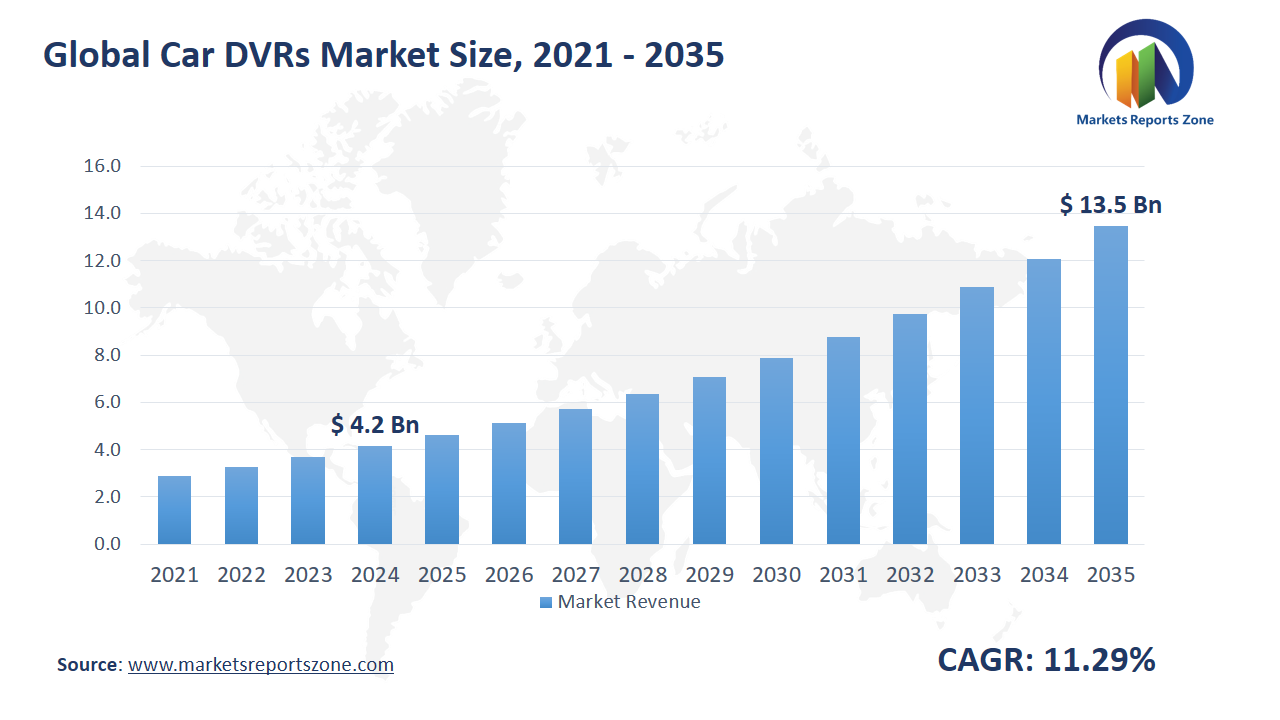
Global Car DVRs Market Size is expected to reach USD 13.49 Billion by 2035 from USD 4.15 Billion in 2024, with a CAGR of around 11.29% between 2024 and 2035. The global car DVRs market has been driven by rising concerns over road safety and increasing cases of on-road disputes. DVRs have been widely used to record accidents, support insurance claims, and provide evidence during legal conflicts. Fleet owners have installed DVRs to monitor driver behavior and improve accountability. At the same time, growth in ride-hailing and logistics services has further pushed demand for continuous in-vehicle video monitoring. However, data privacy concerns and complex regulations have acted as restraints in certain countries. In some regions, users have faced legal restrictions on in-cabin recording and external footage sharing. Despite these challenges, the rise in connected vehicle ecosystems has opened new opportunities for DVR integration with telematics and GPS. For example, logistics companies have used DVRs combined with route optimization systems to enhance delivery tracking and reduce fuel costs. Another key opportunity lies in the growing use of advanced driver monitoring systems, where DVRs are linked with fatigue detection or AI-based event analysis. In regions with high accident rates, governments have encouraged the adoption of DVRs in commercial fleets. As technology becomes more compact and cloud-enabled, car DVRs have evolved from simple recorders to multifunctional safety and management tools, transforming how vehicles are monitored on roads.
Driver: Rising Disputes Drive DVR Demand
The surge in road conflicts and false claims has made car DVRs a vital part of modern driving. With traffic becoming denser and accident blame harder to assign, real-time video evidence has gained immense value. Drivers across cities like Mumbai and Los Angeles have begun using dash-mounted DVRs to record their journeys, ensuring a clear record in case of incidents. In one instance, a driver in a multi-car pileup was able to avoid legal trouble thanks to clear footage from their DVR proving they had been rear-ended. Commercial drivers have especially relied on DVRs to protect themselves from unjust blame during deliveries or passenger transport. In places where aggressive driving and insurance fraud are common, DVRs have helped bring accountability back to the road. Taxi operators in regions like Nairobi have installed simple DVR systems to track both road behavior and passenger disputes. This increased sense of control and fairness has made DVRs a preferred solution, even among private car owners. By providing a neutral eye in heated situations, DVRs have shifted from optional gadgets to essential tools. As more users seek clarity and protection behind the wheel, the demand for car DVRs has only strengthened across all vehicle segments.
Key Insights:
- Over 70% of newly registered taxis in South Korea were equipped with in-vehicle DVRs by the end of last year.
- A major global automotive electronics manufacturer invested $450 million to expand production of AI-integrated DVR systems for commercial vehicles.
- More than 25 million car DVR units were sold globally in a single year, driven largely by fleet demand and urban vehicle users.
- Around 60% of logistics companies in Germany have installed DVRs in their fleets to enhance driver monitoring and route recording.
- In India, over 55% of long-haul trucks operating on national highways have adopted DVR systems for insurance and safety compliance.
- One of the largest ride-hailing firms in Latin America retrofitted over 80,000 vehicles with front and rear DVRs to improve rider and driver safety.
- In Japan, school transportation providers reached a 68% DVR adoption rate in response to safety guidelines introduced for public carriers.
- A European car brand reported that over 40% of its premium vehicle models now come pre-fitted with integrated DVR systems linked to cloud storage.
Segment Analysis:
The Car DVR market has been segmented by type into single channel and dual channel systems, and by application into passenger cars, light commercial vehicles, and heavy commercial vehicles. Single channel DVRs, which record from the front view only, have been widely used in personal vehicles due to their affordability and simplicity. They have been commonly chosen by daily commuters and small families for basic accident recording. Dual channel DVRs, offering front and rear view recording, have gained popularity among users seeking enhanced coverage. These systems have been favored by professional drivers and long-distance travelers for better protection against tailgating incidents and rear-end collisions. In terms of application, passenger cars have remained the dominant segment, driven by rising awareness of road safety among private owners. Light commercial vehicles such as delivery vans have used DVRs to monitor driver behavior and ensure timely deliveries. Heavy commercial vehicles have increasingly adopted DVRs to comply with safety regulations and reduce liability in accidents. Logistics companies operating cross-country freight services have equipped their trucks with dual channel systems for complete route monitoring. In urban areas, food delivery fleets and mobile repair units have integrated DVRs to ensure vehicle tracking and customer service accountability. These trends have shaped the demand across segments.
Regional Analysis:
The Car DVR market has evolved uniquely across key regions, influenced by local transportation needs, safety concerns, and infrastructure development. In North America, DVRs have been widely adopted by school districts to monitor student transport, with many school buses now equipped with multi-angle recording systems for incident reviews. Europe has emphasized data transparency and road safety, leading to DVR installations in postal service vans and municipal vehicles to track routes and ensure regulatory compliance. In Asia-Pacific, rapid urban expansion and rising traffic congestion have pushed demand, with ride-hailing services and food delivery bikes increasingly using compact DVRs for real-time monitoring. In the Middle East and Africa, DVRs have gained traction in armored vehicles and high-value cargo transport to provide security against theft and route deviations in desert and high-risk zones. Latin America has seen DVR usage grow among intercity bus operators and tourism vans, helping companies protect passengers and assets while navigating long, often poorly maintained roads. Each region has adopted DVR technology based on its unique challenges—whether it's legal liability, public safety, or operational control. This diverse adoption landscape has reflected the flexibility of DVR systems to adapt to different environments and vehicle categories around the world.
Competitive Scenario:
The Car DVR market has seen active participation from a mix of established automotive giants and consumer electronics brands, each shaping the landscape with innovation and competitive offerings. Companies like Delphi, Continental, and Valeo have focused on integrating DVRs into broader advanced driver assistance systems, enhancing vehicle safety with built-in cameras, sensors, and AI-driven analytics. Consumer-oriented brands such as Garmin, Thinkware, and BlackVue have introduced compact, high-resolution dashcams with cloud connectivity and voice control, appealing to tech-savvy drivers. Spy Tec and RoadHawk have targeted fleet operators with GPS-enabled systems for real-time tracking and incident analysis. Eken, WickedHD, and Old Shark have carved a niche in the budget segment by offering affordable, reliable DVRs for everyday users. KDLINKS and Transcend have emphasized image clarity and night vision, responding to growing demand for low-light performance. Blackbox Guard and Papago have added emergency SOS and G-sensor features to increase functionality. Clarion has collaborated with vehicle OEMs to provide factory-fitted DVR units in new models. Recent developments include dual-camera 4K models, driver fatigue alerts, and seamless smartphone integration, highlighting a shift towards intelligent, connected safety tools. This dynamic ecosystem of players continues to drive innovation, making DVRs more accessible, smarter, and better aligned with evolving consumer and commercial needs.
Car DVRs Market Report Scope
| Report Attribute | Details |
|---|---|
| Market Size Value in 2024 | USD 4.15 Billion |
| Revenue Forecast in 2035 | USD 13.49 Billion |
| Growth Rate | CAGR of 11.29% from 2025 to 2035 |
| Historic Period | 2021 - 2024 |
| Forecasted Period | 2025 - 2035 |
| Report Coverage | Revenue forecast, company ranking, competitive landscape, growth factors, and trends |
| Regions Covered | North America; Europe; Asia Pacific; Latin America; Middle East & Africa |
| Countries Covered | U.S.; Canada; Mexico, UK; Germany; France; Spain; Italy; Russia; China; Japan; India; South Korea; Australia; Southeast Asia; Brazil; Argentina; Saudi Arabia; UAE; South Africa |
| Key companies profiled | Delphi; Continental; Blackbox Guard; BlackVue; Garmin; Papago; Spy Tec; Thinkware; WickedHD; Valeo; Clarion; Eken; RoadHawk; Transcend; Old Shark; KDLINKS |
| Customization | Free report customization (equivalent up to 8 analysts working days) with purchase. Addition or alteration to country, regional & segment scope. |
The Global Car DVRs Market report is segmented as follows:
By Type,
- Single Channel
- Dual Channel
By Application,
- Passenger Car (PC)
- Light Commercial Vehicle (LCV)
- Heavy Commercial Vehicle (HCV)
By Region,
- North America
- U.S.
- Canada
- Mexico
- Europe
- UK
- Germany
- France
- Spain
- Italy
- Russia
- Rest of Europe
- Asia Pacific
- China
- Japan
- India
- South Korea
- Australia
- Southeast Asia
- Rest of Asia Pacific
- Latin America
- Brazil
- Argentina
- Rest of Latin America
- Middle East & Africa
- Saudi Arabia
- UAE
- South Africa
- Rest of Middle East and Africa
Key Market Players,
- Delphi
- Continental
- Blackbox Guard
- BlackVue
- Garmin
- Papago
- Spy Tec
- Thinkware
- WickedHD
- Valeo
- Clarion
- Eken
- RoadHawk
- Transcend
- Old Shark
- KDLINKS
Frequently Asked Questions
Research Objectives
- Proliferation and maturation of trade in the global Car DVRs Market.
- The market share of the global Car DVRs Market, supply and demand ratio, growth revenue, supply chain analysis, and business overview.
- Current and future market trends that are influencing the growth opportunities and growth rate of the global Car DVRs Market.
- Feasibility study, new market insights, company profiles, investment return, market size of the global Car DVRs Market.
Chapter 1 Car DVRs Market Executive Summary
- 1.1 Car DVRs Market Research Scope
- 1.2 Car DVRs Market Estimates and Forecast (2021-2035)
- 1.2.1 Global Car DVRs Market Value and Growth Rate (2021-2035)
- 1.2.2 Global Car DVRs Market Price Trend (2021-2035)
- 1.3 Global Car DVRs Market Value Comparison, by Type (2021-2035)
- 1.3.1 Single Channel
- 1.3.2 Dual Channel
- 1.4 Global Car DVRs Market Value Comparison, by Application (2021-2035)
- 1.4.1 Passenger Car (PC)
- 1.4.2 Light Commercial Vehicle (LCV)
- 1.4.3 Heavy Commercial Vehicle (HCV)
Chapter 2 Research Methodology
- 2.1 Introduction
- 2.2 Data Capture Sources
- 2.2.1 Primary Sources
- 2.2.2 Secondary Sources
- 2.3 Market Size Estimation
- 2.4 Market Forecast
- 2.5 Assumptions and Limitations
Chapter 3 Market Dynamics
- 3.1 Market Trends
- 3.2 Opportunities and Drivers
- 3.3 Challenges
- 3.4 Market Restraints
- 3.5 Porter's Five Forces Analysis
Chapter 4 Supply Chain Analysis and Marketing Channels
- 4.1 Car DVRs Supply Chain Analysis
- 4.2 Marketing Channels
- 4.3 Car DVRs Suppliers List
- 4.4 Car DVRs Distributors List
- 4.5 Car DVRs Customers
Chapter 5 COVID-19 & Russia?Ukraine War Impact Analysis
- 5.1 COVID-19 Impact Analysis on Car DVRs Market
- 5.2 Russia-Ukraine War Impact Analysis on Car DVRs Market
Chapter 6 Car DVRs Market Estimate and Forecast by Region
- 6.1 Global Car DVRs Market Value by Region: 2021 VS 2023 VS 2035
- 6.2 Global Car DVRs Market Scenario by Region (2021-2023)
- 6.2.1 Global Car DVRs Market Value Share by Region (2021-2023)
- 6.3 Global Car DVRs Market Forecast by Region (2024-2035)
- 6.3.1 Global Car DVRs Market Value Forecast by Region (2024-2035)
- 6.4 Geographic Market Analysis: Market Facts and Figures
- 6.4.1 North America Car DVRs Market Estimates and Projections (2021-2035)
- 6.4.2 Europe Car DVRs Market Estimates and Projections (2021-2035)
- 6.4.3 Asia Pacific Car DVRs Market Estimates and Projections (2021-2035)
- 6.4.4 Latin America Car DVRs Market Estimates and Projections (2021-2035)
- 6.4.5 Middle East & Africa Car DVRs Market Estimates and Projections (2021-2035)
Chapter 7 Global Car DVRs Competition Landscape by Players
- 7.1 Global Top Car DVRs Players by Value (2021-2023)
- 7.2 Car DVRs Headquarters and Sales Region by Company
- 7.3 Company Recent Developments, Mergers & Acquisitions, and Expansion Plans
Chapter 8 Global Car DVRs Market, by Type
- 8.1 Global Car DVRs Market Value, by Type (2021-2035)
- 8.1.1 Single Channel
- 8.1.2 Dual Channel
Chapter 9 Global Car DVRs Market, by Application
- 9.1 Global Car DVRs Market Value, by Application (2021-2035)
- 9.1.1 Passenger Car (PC)
- 9.1.2 Light Commercial Vehicle (LCV)
- 9.1.3 Heavy Commercial Vehicle (HCV)
Chapter 10 North America Car DVRs Market
- 10.1 Overview
- 10.2 North America Car DVRs Market Value, by Country (2021-2035)
- 10.2.1 U.S.
- 10.2.2 Canada
- 10.2.3 Mexico
- 10.3 North America Car DVRs Market Value, by Type (2021-2035)
- 10.3.1 Single Channel
- 10.3.2 Dual Channel
- 10.4 North America Car DVRs Market Value, by Application (2021-2035)
- 10.4.1 Passenger Car (PC)
- 10.4.2 Light Commercial Vehicle (LCV)
- 10.4.3 Heavy Commercial Vehicle (HCV)
Chapter 11 Europe Car DVRs Market
- 11.1 Overview
- 11.2 Europe Car DVRs Market Value, by Country (2021-2035)
- 11.2.1 UK
- 11.2.2 Germany
- 11.2.3 France
- 11.2.4 Spain
- 11.2.5 Italy
- 11.2.6 Russia
- 11.2.7 Rest of Europe
- 11.3 Europe Car DVRs Market Value, by Type (2021-2035)
- 11.3.1 Single Channel
- 11.3.2 Dual Channel
- 11.4 Europe Car DVRs Market Value, by Application (2021-2035)
- 11.4.1 Passenger Car (PC)
- 11.4.2 Light Commercial Vehicle (LCV)
- 11.4.3 Heavy Commercial Vehicle (HCV)
Chapter 12 Asia Pacific Car DVRs Market
- 12.1 Overview
- 12.2 Asia Pacific Car DVRs Market Value, by Country (2021-2035)
- 12.2.1 China
- 12.2.2 Japan
- 12.2.3 India
- 12.2.4 South Korea
- 12.2.5 Australia
- 12.2.6 Southeast Asia
- 12.2.7 Rest of Asia Pacific
- 12.3 Asia Pacific Car DVRs Market Value, by Type (2021-2035)
- 12.3.1 Single Channel
- 12.3.2 Dual Channel
- 12.4 Asia Pacific Car DVRs Market Value, by Application (2021-2035)
- 12.4.1 Passenger Car (PC)
- 12.4.2 Light Commercial Vehicle (LCV)
- 12.4.3 Heavy Commercial Vehicle (HCV)
Chapter 13 Latin America Car DVRs Market
- 13.1 Overview
- 13.2 Latin America Car DVRs Market Value, by Country (2021-2035)
- 13.2.1 Brazil
- 13.2.2 Argentina
- 13.2.3 Rest of Latin America
- 13.3 Latin America Car DVRs Market Value, by Type (2021-2035)
- 13.3.1 Single Channel
- 13.3.2 Dual Channel
- 13.4 Latin America Car DVRs Market Value, by Application (2021-2035)
- 13.4.1 Passenger Car (PC)
- 13.4.2 Light Commercial Vehicle (LCV)
- 13.4.3 Heavy Commercial Vehicle (HCV)
Chapter 14 Middle East & Africa Car DVRs Market
- 14.1 Overview
- 14.2 Middle East & Africa Car DVRs Market Value, by Country (2021-2035)
- 14.2.1 Saudi Arabia
- 14.2.2 UAE
- 14.2.3 South Africa
- 14.2.4 Rest of Middle East & Africa
- 14.3 Middle East & Africa Car DVRs Market Value, by Type (2021-2035)
- 14.3.1 Single Channel
- 14.3.2 Dual Channel
- 14.4 Middle East & Africa Car DVRs Market Value, by Application (2021-2035)
- 14.4.1 Passenger Car (PC)
- 14.4.2 Light Commercial Vehicle (LCV)
- 14.4.3 Heavy Commercial Vehicle (HCV)
Chapter 15 Company Profiles and Market Share Analysis: (Business Overview, Market Share Analysis, Products/Services Offered, Recent Developments)
- 15.1 Delphi
- 15.2 Continental
- 15.3 Blackbox Guard
- 15.4 BlackVue
- 15.5 Garmin
- 15.6 Papago
- 15.7 Spy Tec
- 15.8 Thinkware
- 15.9 WickedHD
- 15.10 Valeo
- 15.11 Clarion
- 15.12 Eken
- 15.13 RoadHawk
- 15.14 Transcend
- 15.15 Old Shark
- 15.16 KDLINKS

Report ID:
107
Published Date:
April 2025
Trusted by more than 10,500 organizations globally



Infaluble Methodology
Customization
Analyst Support
Targeted Market View