Global Cartilage Regeneration Tchnology Market, By Type (Autologous Chondrocyte Implantation), By Application, and By Region - Trends and Forecast Analysis, 2021-2035
Publish Date: 2026-04-29 | Format: PDF | Category: Healthcare and Pharmaceutical | Pages: 308
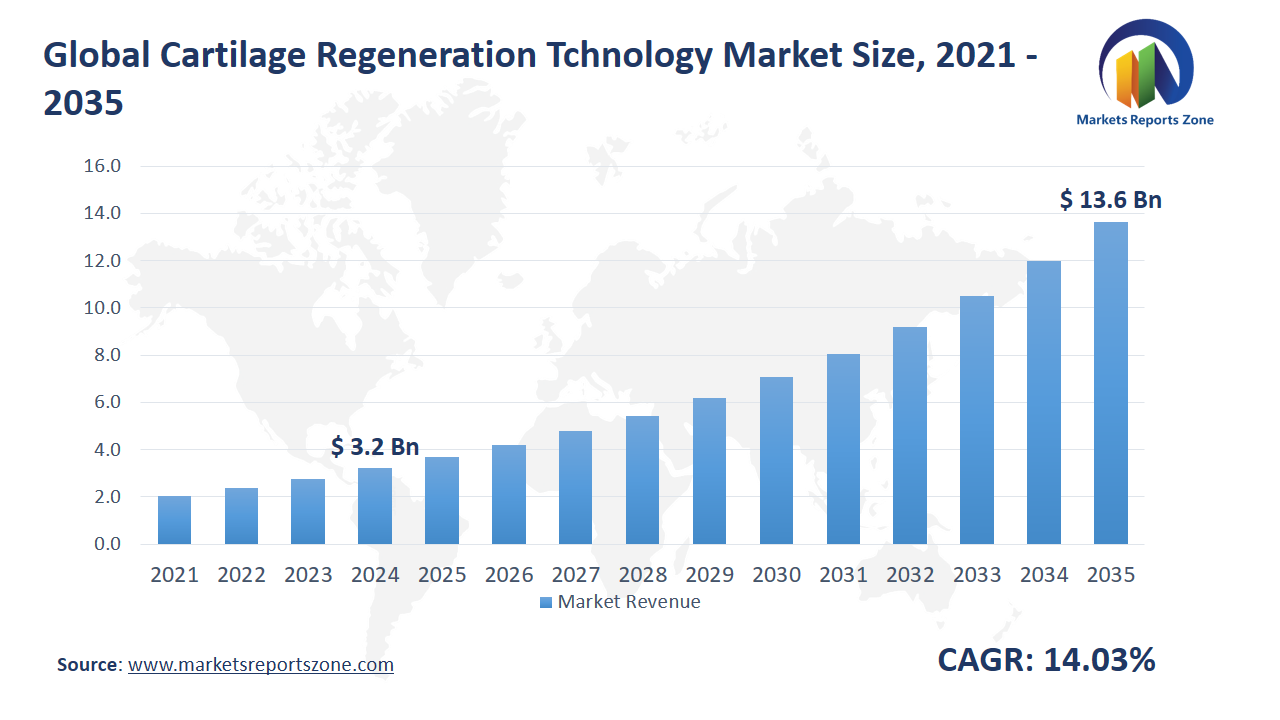
Global Cartilage Regeneration Tchnology Market Size is expected to reach USD 13.68 Billion by 2035 from USD 3.22 Billion in 2024, with a CAGR of around 14.03% between 2024 and 2035. The global cartilage regeneration technology market has been driven by increased sports injuries and rising demand for minimally invasive treatments. A growing number of knee and joint injuries among athletes and active adults has been observed, pushing the adoption of regenerative procedures. Aging populations have also been targeted, as joint deterioration has become more common with age. However, high treatment costs and limited insurance coverage have been noted as key restraints, making access difficult for many patients. Despite this, significant opportunities have been created through advancements in stem cell therapy and biomaterials. New therapies have been developed to promote faster healing and more natural cartilage repair. A notable example has been seen in athletes undergoing stem cell injections to return to training sooner. Additionally, partnerships between biotech firms and orthopedic centers have been formed, allowing cutting-edge solutions to reach clinical settings. Customized scaffolds and 3D-printed implants have been adopted in hospitals for complex cases, improving patient outcomes. Regulatory approvals for new regenerative products have also been granted in several countries, expanding the global reach of these solutions. As awareness has grown and technology has matured, more investment has been attracted. The market has been steadily shaped by innovation, patient needs, and clinical collaboration.
Driver: Sports Injuries Fuel Market Growth
A steady rise in sports-related injuries has strongly driven the cartilage regeneration technology market. As more people have embraced active lifestyles and competitive sports, joint damage—especially to knees, hips, and ankles—has become more frequent. Injuries like meniscal tears, ligament strains, and cartilage wear have often required advanced treatments beyond traditional surgery. Cartilage regeneration solutions have been chosen to help restore joint function with less recovery time. In professional sports, injuries have been handled with urgent care, and regenerative therapies have become part of standard recovery plans. For instance, football players suffering from cartilage damage have been treated with autologous chondrocyte implantation to return to play without long-term pain. In youth sports, teenagers injured during high-intensity training have undergone microfracture surgery supported by regenerative gels to speed up healing. Fitness influencers and gym enthusiasts have also adopted these solutions to avoid long breaks in their routines. Even amateur runners with knee pain have been advised regenerative options to maintain their active habits. These increasing incidents have created a strong need for faster, more effective, and less invasive healing methods. As awareness has improved and success rates have been observed, cartilage regeneration has been accepted as a preferred solution in the sports injury segment.
Key Insights:
- Over 32.5 million adults in the U.S. are potential candidates for cartilage regeneration procedures.
- Zimmer Biomet invested USD 120 million in orthopedic R&D, including cartilage regeneration, in 2023.
- Stryker reported over 15,000 cartilage repair units sold globally in 2022.
- The FDA approved 3 new cartilage regeneration therapies between 2021 and 2024.
- 23 specialized centers in Europe perform more than 850 cartilage regeneration surgeries annually.
- Johnson & Johnson allocated USD 150 million to regenerative medicine research in 2024.
- In Japan, over 2,000 patients received autologous cartilage cell implants in 2023.
- The penetration rate of cartilage regeneration procedures in orthopedic surgeries reached 8% in Germany in 2024.
Segment Analysis:
Autologous chondrocyte implantation (ACI) has been widely adopted for treating cartilage defects due to its ability to use a patient’s own cells, reducing the risk of rejection and infection. This technique has been favored in cases where other treatments have failed or when patients wish to avoid joint replacement. In real-world scenarios, middle-aged individuals with persistent joint pain from untreated injuries have opted for ACI after experiencing limited relief from physical therapy. Among applications, the knee segment has dominated due to the high frequency of cartilage damage in this joint. Everyday activities like climbing stairs or prolonged standing have often aggravated knee conditions, prompting many to seek regenerative solutions. For example, a construction worker struggling with chronic knee pain underwent ACI and was able to return to physically demanding work within months. The ankle segment, though smaller, has shown rising interest, especially among dancers and athletes where ankle flexibility and strength are essential. A ballet dancer with cartilage wear from intense rehearsals received ACI for her ankle and resumed training after a steady recovery. These segments have been shaped by growing awareness, patient preference for natural repair, and successful real-life outcomes, making them key areas of focus in cartilage regeneration technology.
Regional Analysis:
North America has led the cartilage regeneration technology market due to advanced healthcare systems and early adoption of innovative treatments. Patients in the U.S. have increasingly chosen regenerative procedures over joint replacement, especially those in physically demanding jobs or active lifestyles. For instance, a firefighter in Texas with knee damage opted for regenerative therapy to avoid surgery and quickly return to duty. In Europe, government support and well-established orthopedic centers have encouraged the use of cartilage restoration techniques. A retired footballer in Germany underwent ankle regeneration to improve mobility and enjoy a pain-free retirement. The Asia-Pacific region has seen rapid growth, driven by rising healthcare awareness and improving infrastructure. A tech professional in India chose minimally invasive cartilage treatment to continue daily commutes without discomfort. In the Middle East and Africa, adoption has been slower but gaining pace through medical tourism and rising sports culture. A young athlete in the UAE sought cartilage repair abroad and returned to train within months. Latin America has witnessed growing interest as access to specialized care has expanded. In Brazil, a dancer with chronic joint pain underwent treatment through a private clinic and resumed performance. These regional trends have been influenced by lifestyle, accessibility, cultural attitudes, and rising demand for non-invasive joint care.
Competitive Scenario:
In the evolving cartilage regeneration landscape, companies like Aesculap Biologics, Arthro Kinetics, Orthocell, Johnson & Johnson, and CartiHeal have been pivotal. Aesculap Biologics has advanced autologous chondrocyte implantation techniques, enhancing patient-specific treatments. Arthro Kinetics has focused on developing biodegradable scaffolds that support natural cartilage growth. Orthocell, based in Australia, has made strides with its CelGro collagen scaffold, aiding in soft tissue regeneration. Johnson & Johnson, through its subsidiary DePuy Synthes, has integrated regenerative solutions into its orthopedic portfolio, emphasizing minimally invasive procedures. CartiHeal's Agili-C implant, made from aragonite derived from coral, has been noteworthy; it facilitates cartilage and bone regeneration without the need for donor tissue. The implant has been absorbed by the body, allowing natural tissue to replace it over time. In a recent case, a patient at UC Davis Health underwent surgery using the Agili-C implant to address knee cartilage damage, resulting in improved mobility and reduced pain. Such innovations have underscored the industry's commitment to enhancing patient outcomes through biologically integrated solutions. As these companies continue to refine their technologies, the focus remains on providing effective, less invasive treatments for cartilage-related ailments.
Cartilage Regeneration Tchnology Market Report Scope
| Report Attribute | Details |
|---|---|
| Market Size Value in 2024 | USD 3.22 Billion |
| Revenue Forecast in 2035 | USD 13.68 Billion |
| Growth Rate | CAGR of 14.03% from 2025 to 2035 |
| Historic Period | 2021 - 2024 |
| Forecasted Period | 2025 - 2035 |
| Report Coverage | Revenue forecast, company ranking, competitive landscape, growth factors, and trends |
| Regions Covered | North America; Europe; Asia Pacific; Latin America; Middle East & Africa |
| Countries Covered | U.S.; Canada; Mexico, UK; Germany; France; Spain; Italy; Russia; China; Japan; India; South Korea; Australia; Southeast Asia; Brazil; Argentina; Saudi Arabia; UAE; South Africa |
| Key companies profiled | Aesculap Biologics; Arthro Kinetics; Orthocell; Johnson & Johnson; CartiHeal, Ltd |
| Customization | Free report customization (equivalent up to 8 analysts working days) with purchase. Addition or alteration to country, regional & segment scope. |
The Global Cartilage Regeneration Tchnology Market report is segmented as follows:
By Type,
- Autologous Chondrocyte Implantation
By Application,
- Knee
- Ankle
By Region,
- North America
- U.S.
- Canada
- Mexico
- Europe
- UK
- Germany
- France
- Spain
- Italy
- Russia
- Rest of Europe
- Asia Pacific
- China
- Japan
- India
- South Korea
- Australia
- Southeast Asia
- Rest of Asia Pacific
- Latin America
- Brazil
- Argentina
- Rest of Latin America
- Middle East & Africa
- Saudi Arabia
- UAE
- South Africa
- Rest of Middle East and Africa
Key Market Players,
- Aesculap Biologics
- Arthro Kinetics
- Orthocell
- Johnson & Johnson
- CartiHeal, Ltd
Frequently Asked Questions
Research Objectives
- Proliferation and maturation of trade in the global Cartilage Regeneration Tchnology Market.
- The market share of the global Cartilage Regeneration Tchnology Market, supply and demand ratio, growth revenue, supply chain analysis, and business overview.
- Current and future market trends that are influencing the growth opportunities and growth rate of the global Cartilage Regeneration Tchnology Market.
- Feasibility study, new market insights, company profiles, investment return, market size of the global Cartilage Regeneration Tchnology Market.
Chapter 1 Cartilage Regeneration Tchnology Market Executive Summary
- 1.1 Cartilage Regeneration Tchnology Market Research Scope
- 1.2 Cartilage Regeneration Tchnology Market Estimates and Forecast (2021-2035)
- 1.2.1 Global Cartilage Regeneration Tchnology Market Value and Growth Rate (2021-2035)
- 1.2.2 Global Cartilage Regeneration Tchnology Market Price Trend (2021-2035)
- 1.3 Global Cartilage Regeneration Tchnology Market Value Comparison, by Type (2021-2035)
- 1.3.1 Autologous Chondrocyte Implantation
- 1.4 Global Cartilage Regeneration Tchnology Market Value Comparison, by Application (2021-2035)
- 1.4.1 Knee
- 1.4.2 Ankle
Chapter 2 Research Methodology
- 2.1 Introduction
- 2.2 Data Capture Sources
- 2.2.1 Primary Sources
- 2.2.2 Secondary Sources
- 2.3 Market Size Estimation
- 2.4 Market Forecast
- 2.5 Assumptions and Limitations
Chapter 3 Market Dynamics
- 3.1 Market Trends
- 3.2 Opportunities and Drivers
- 3.3 Challenges
- 3.4 Market Restraints
- 3.5 Porter's Five Forces Analysis
Chapter 4 Supply Chain Analysis and Marketing Channels
- 4.1 Cartilage Regeneration Tchnology Supply Chain Analysis
- 4.2 Marketing Channels
- 4.3 Cartilage Regeneration Tchnology Suppliers List
- 4.4 Cartilage Regeneration Tchnology Distributors List
- 4.5 Cartilage Regeneration Tchnology Customers
Chapter 5 COVID-19 & Russia?Ukraine War Impact Analysis
- 5.1 COVID-19 Impact Analysis on Cartilage Regeneration Tchnology Market
- 5.2 Russia-Ukraine War Impact Analysis on Cartilage Regeneration Tchnology Market
Chapter 6 Cartilage Regeneration Tchnology Market Estimate and Forecast by Region
- 6.1 Global Cartilage Regeneration Tchnology Market Value by Region: 2021 VS 2023 VS 2035
- 6.2 Global Cartilage Regeneration Tchnology Market Scenario by Region (2021-2023)
- 6.2.1 Global Cartilage Regeneration Tchnology Market Value Share by Region (2021-2023)
- 6.3 Global Cartilage Regeneration Tchnology Market Forecast by Region (2024-2035)
- 6.3.1 Global Cartilage Regeneration Tchnology Market Value Forecast by Region (2024-2035)
- 6.4 Geographic Market Analysis: Market Facts and Figures
- 6.4.1 North America Cartilage Regeneration Tchnology Market Estimates and Projections (2021-2035)
- 6.4.2 Europe Cartilage Regeneration Tchnology Market Estimates and Projections (2021-2035)
- 6.4.3 Asia Pacific Cartilage Regeneration Tchnology Market Estimates and Projections (2021-2035)
- 6.4.4 Latin America Cartilage Regeneration Tchnology Market Estimates and Projections (2021-2035)
- 6.4.5 Middle East & Africa Cartilage Regeneration Tchnology Market Estimates and Projections (2021-2035)
Chapter 7 Global Cartilage Regeneration Tchnology Competition Landscape by Players
- 7.1 Global Top Cartilage Regeneration Tchnology Players by Value (2021-2023)
- 7.2 Cartilage Regeneration Tchnology Headquarters and Sales Region by Company
- 7.3 Company Recent Developments, Mergers & Acquisitions, and Expansion Plans
Chapter 8 Global Cartilage Regeneration Tchnology Market, by Type
- 8.1 Global Cartilage Regeneration Tchnology Market Value, by Type (2021-2035)
- 8.1.1 Autologous Chondrocyte Implantation
Chapter 9 Global Cartilage Regeneration Tchnology Market, by Application
- 9.1 Global Cartilage Regeneration Tchnology Market Value, by Application (2021-2035)
- 9.1.1 Knee
- 9.1.2 Ankle
Chapter 10 North America Cartilage Regeneration Tchnology Market
- 10.1 Overview
- 10.2 North America Cartilage Regeneration Tchnology Market Value, by Country (2021-2035)
- 10.2.1 U.S.
- 10.2.2 Canada
- 10.2.3 Mexico
- 10.3 North America Cartilage Regeneration Tchnology Market Value, by Type (2021-2035)
- 10.3.1 Autologous Chondrocyte Implantation
- 10.4 North America Cartilage Regeneration Tchnology Market Value, by Application (2021-2035)
- 10.4.1 Knee
- 10.4.2 Ankle
Chapter 11 Europe Cartilage Regeneration Tchnology Market
- 11.1 Overview
- 11.2 Europe Cartilage Regeneration Tchnology Market Value, by Country (2021-2035)
- 11.2.1 UK
- 11.2.2 Germany
- 11.2.3 France
- 11.2.4 Spain
- 11.2.5 Italy
- 11.2.6 Russia
- 11.2.7 Rest of Europe
- 11.3 Europe Cartilage Regeneration Tchnology Market Value, by Type (2021-2035)
- 11.3.1 Autologous Chondrocyte Implantation
- 11.4 Europe Cartilage Regeneration Tchnology Market Value, by Application (2021-2035)
- 11.4.1 Knee
- 11.4.2 Ankle
Chapter 12 Asia Pacific Cartilage Regeneration Tchnology Market
- 12.1 Overview
- 12.2 Asia Pacific Cartilage Regeneration Tchnology Market Value, by Country (2021-2035)
- 12.2.1 China
- 12.2.2 Japan
- 12.2.3 India
- 12.2.4 South Korea
- 12.2.5 Australia
- 12.2.6 Southeast Asia
- 12.2.7 Rest of Asia Pacific
- 12.3 Asia Pacific Cartilage Regeneration Tchnology Market Value, by Type (2021-2035)
- 12.3.1 Autologous Chondrocyte Implantation
- 12.4 Asia Pacific Cartilage Regeneration Tchnology Market Value, by Application (2021-2035)
- 12.4.1 Knee
- 12.4.2 Ankle
Chapter 13 Latin America Cartilage Regeneration Tchnology Market
- 13.1 Overview
- 13.2 Latin America Cartilage Regeneration Tchnology Market Value, by Country (2021-2035)
- 13.2.1 Brazil
- 13.2.2 Argentina
- 13.2.3 Rest of Latin America
- 13.3 Latin America Cartilage Regeneration Tchnology Market Value, by Type (2021-2035)
- 13.3.1 Autologous Chondrocyte Implantation
- 13.4 Latin America Cartilage Regeneration Tchnology Market Value, by Application (2021-2035)
- 13.4.1 Knee
- 13.4.2 Ankle
Chapter 14 Middle East & Africa Cartilage Regeneration Tchnology Market
- 14.1 Overview
- 14.2 Middle East & Africa Cartilage Regeneration Tchnology Market Value, by Country (2021-2035)
- 14.2.1 Saudi Arabia
- 14.2.2 UAE
- 14.2.3 South Africa
- 14.2.4 Rest of Middle East & Africa
- 14.3 Middle East & Africa Cartilage Regeneration Tchnology Market Value, by Type (2021-2035)
- 14.3.1 Autologous Chondrocyte Implantation
- 14.4 Middle East & Africa Cartilage Regeneration Tchnology Market Value, by Application (2021-2035)
- 14.4.1 Knee
- 14.4.2 Ankle
Chapter 15 Company Profiles and Market Share Analysis: (Business Overview, Market Share Analysis, Products/Services Offered, Recent Developments)
- 15.1 Aesculap Biologics
- 15.2 Arthro Kinetics
- 15.3 Orthocell
- 15.4 Johnson & Johnson
- 15.5 CartiHeal, Ltd

Report ID:
223
Published Date:
April 2026
Trusted by more than 10,500 organizations globally



Infaluble Methodology
Customization
Analyst Support
Targeted Market View