
Global Copper(II) Hydroxide Market - Size and Forecast Analysis, 2021-2035
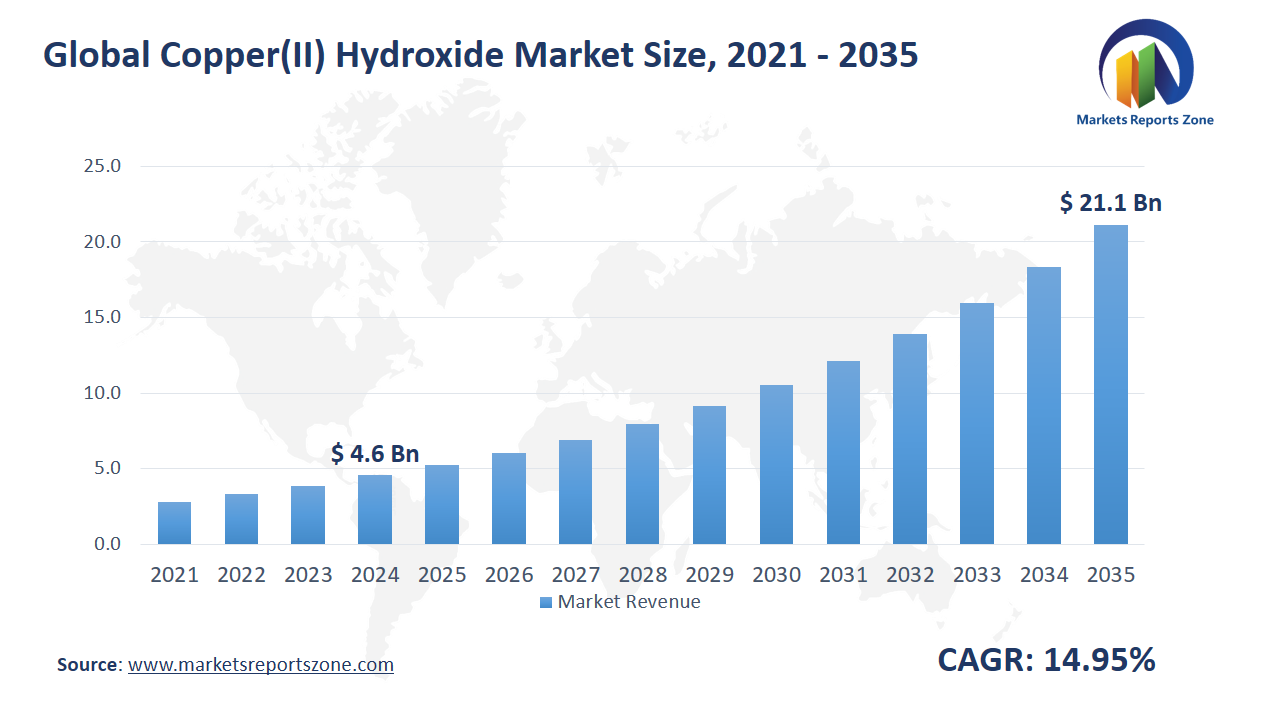
Global Copper(II) Hydroxide Market Size is expected to reach USD 21.13 Billion by 2035 from USD 4.56 Billion in 2024, with a CAGR of around 14.95% between 2024 and 2035. The growth of the global Copper(II) Hydroxide market has been driven by rising agricultural demand and increased usage in fungicide formulations. Strong adoption in crop protection has been observed due to its effectiveness against fungal infections in fruits and vegetables. Expansion in industrial applications has also contributed, with the compound being used in ceramics, batteries, and catalysts. However, growth has been restrained by environmental concerns and strict regulations regarding chemical residues. Regulatory restrictions have been enforced in several countries to limit heavy metal contamination. Despite these challenges, significant opportunities have been identified. Increased focus on organic farming and sustainable agriculture has created a demand for low-toxicity fungicides, where Copper(II) Hydroxide has been widely accepted. For instance, organic vineyards in Europe have increasingly used this compound to manage downy mildew without synthetic chemicals. Another key opportunity has been found in the energy storage sector. Its role in battery electrode development has been explored, especially in small-scale renewable energy systems. Experimental batteries in Asia have included Copper(II) Hydroxide for enhanced capacity and safety. As new applications continue to emerge and sustainable practices are promoted, a steady market expansion can be expected. Broad usage across agriculture and industry has helped maintain global relevance of the compound.
Driver: Crop Protection Driving Market Growth
The increasing use of Copper(II) Hydroxide in crop protection has been a key driver of market expansion. Its role as an effective fungicide has been well-established in modern agriculture. Farmers have relied on it to control a wide range of fungal diseases, including blights, leaf spots, and mildews that affect high-value crops. It has been widely applied in tropical regions where humidity accelerates fungal growth. In banana plantations across Central America, Copper(II) Hydroxide has been sprayed regularly to prevent Sigatoka disease, which can devastate entire harvests. Similarly, tomato growers in southern India have used it to reduce early blight infections, ensuring better yields and quality. Its ability to offer protection without promoting resistance has made it a preferred choice over synthetic alternatives. It has also been blended into multi-action crop protection products, offering broader disease control. Due to its relatively low cost and reliable performance, small and medium-sized farms have continued its use season after season. With global demand for fresh produce rising and pressure to minimize crop losses increasing, Copper(II) Hydroxide has maintained strong relevance. The consistent need for dependable, broad-spectrum plant protection has firmly positioned it as a staple in agricultural disease management strategies.
Key Insights:
- Over 65% of copper-based fungicides used globally contain Copper(II) Hydroxide as a primary active ingredient.
- Adoption in fruit and vegetable farming has reached nearly 72% in regions with high fungal disease prevalence.
- In 2023, a leading agrochemical company invested $130 million in upgrading Copper(II) Hydroxide production facilities.
- Government-supported agricultural programs in Southeast Asia allocated over $85 million for copper-based fungicide subsidies last year.
- Approximately 45,000 metric tons of Copper(II) Hydroxide were distributed globally for agricultural use in 2022.
- Penetration in the organic farming sector stood at 38%, driven by regulatory approval for limited use in organic systems.
- Industrial use in battery and ceramics applications accounted for roughly 19% of the total annual Copper(II) Hydroxide consumption.
- A major crop protection manufacturer reported a 14% year-over-year increase in unit sales of Copper(II) Hydroxide-based products.
Segment Analysis:
The Copper(II) Hydroxide market has been segmented by type and application, each showing distinct usage patterns and growth behavior. Type I has been preferred for agricultural use due to its fine particle size and high dispersion rate, offering quick and even coverage on crops. It has been widely used in large-scale soybean and citrus plantations across South America, where fungal infections are frequent and require fast action. Type II, with its coarser formulation and slower release properties, has found increased adoption in industrial sectors. It has been incorporated into ceramic glazing processes and also explored in wastewater treatment systems for its reactive properties. In terms of application, Application I, related to crop protection, has continued to dominate due to strong demand from food production sectors. For example, in African cocoa farms, Application I products have been applied consistently to protect against black pod disease. Meanwhile, Application II, including industrial and material science uses, has grown steadily with increasing demand for eco-safe materials. Research labs in Europe have experimented with Application II compounds for antimicrobial coatings in public infrastructure. As demand diversifies across industries, both types and applications of Copper(II) Hydroxide have been positioned to serve distinct yet overlapping market needs effectively.
Regional Analysis:
The global Copper(II) Hydroxide market shows varied dynamics across key regions, shaped by local agricultural needs and industrial growth. In North America, widespread use in vegetable and nut farming has driven demand, with growers in California using it to control bacterial spot in almond orchards. In Europe, strict environmental policies have influenced selective adoption, but organic vineyards in Italy and Spain have continued using it within permissible limits for sustainable farming. Asia-Pacific has witnessed strong growth, especially in China and India, where it has been widely used in rice and chili cultivation to combat leaf blight and bacterial wilt. In Latin America, the compound has seen high usage in tropical fruit farming, with pineapple and mango growers in Brazil applying it during humid seasons to prevent fungal spread. The Middle East and Africa region has shown emerging demand, particularly in Egypt and South Africa, where it has been used to protect tomato and citrus crops from early and late blight. Additionally, industrial use has gained attention in urban centers for applications in ceramics and water treatment. Each region has adopted Copper(II) Hydroxide in ways that reflect local climate, crop types, and regulatory frameworks, supporting its global relevance across both agricultural and industrial sectors.
Competitive Scenario:
The Copper(II) Hydroxide market has been shaped by active participation from both global and regional players, each contributing to innovation, supply chain expansion, and application diversification. DuPont has focused on advancing formulation technologies to improve product efficacy and reduce environmental impact, particularly in agricultural use. ADAMA Agricultural Solutions has expanded its reach in developing markets by introducing crop protection products tailored for local farming needs. In China, companies like Zhejiang Heben Pesticide & Chemicals and Zhejiang Johon Industry have ramped up production capacities to meet rising domestic demand, especially in rice and vegetable cultivation. Shanghai Huating Chemicals Factory and Kangtai Chemical have invested in refining processes to enhance product purity for industrial-grade applications. JIAXING DEDA RESOURCE REGENERATION has developed sustainable production methods using recycled copper sources, aligning with green manufacturing trends. SHANDONG LUBA CHEMICAL and CHENGXIN INDUSTRY have expanded distribution networks across Southeast Asia. Jiangsu Xuzhou Shennong Chemicals and LIYANG DONGJIAO CHEMICAL PLANT have launched customized solutions for local crops. Chinasun Specialty Products has focused on R&D for next-generation formulations with better stability. Wujiang Canwell(Kaiwei) Chemical Technology has collaborated with universities to explore new industrial applications. These developments reflect a strong industry-wide push toward innovation, efficiency, and sustainability in the Copper(II) Hydroxide market.
Copper(II) Hydroxide Market Report Scope
| Report Attribute | Details |
|---|---|
| Market Size Value in 2024 | USD 4.56 Billion |
| Revenue Forecast in 2035 | USD 21.13 Billion |
| Growth Rate | CAGR of 14.95% from 2025 to 2035 |
| Historic Period | 2021 - 2024 |
| Forecasted Period | 2025 - 2035 |
| Report Coverage | Revenue forecast, company ranking, competitive landscape, growth factors, and trends |
| Regions Covered | North America; Europe; Asia Pacific; Latin America; Middle East & Africa |
| Countries Covered | U.S.; Canada; Mexico, UK; Germany; France; Spain; Italy; Russia; China; Japan; India; South Korea; Australia; Southeast Asia; Brazil; Argentina; Saudi Arabia; UAE; South Africa |
| Key companies profiled | DuPont; S. K. Chemical Industries; Zhejiang Heben Pesticide & Chemicals; Zhejiang Johon Industry; Shanghai Huating Chemicals Factory; JIAXING DEDA RESOURCE REGENERATION; SHANDONG LUBA CHEMICAL; ADAMA Agricultural Solutions; Jiangsu Xuzhou Shennong Chemicals; Chinasun Specialty Products; Wujiang Canwell(Kaiwei) Chemical Technology; Kangtai Chemical; CHENGXIN INDUSTRY; LIYANG DONGJIAO CHEMICAL PLANT; SHANDONG SHUOJIA CHEMICAL |
| Customization | Free report customization (equivalent up to 8 analysts working days) with purchase. Addition or alteration to country, regional & segment scope. |
The Global Copper(II) Hydroxide Market report is segmented as follows:
By Type,
- Type I
- Type II
By Application,
- Application I
- Application II
By Region,
- North America
- U.S.
- Canada
- Mexico
- Europe
- UK
- Germany
- France
- Spain
- Italy
- Russia
- Rest of Europe
- Asia Pacific
- China
- Japan
- India
- South Korea
- Australia
- Southeast Asia
- Rest of Asia Pacific
- Latin America
- Brazil
- Argentina
- Rest of Latin America
- Middle East & Africa
- Saudi Arabia
- UAE
- South Africa
- Rest of Middle East and Africa
Key Market Players,
- DuPont
- S. K. Chemical Industries
- Zhejiang Heben Pesticide & Chemicals
- Zhejiang Johon Industry
- Shanghai Huating Chemicals Factory
- JIAXING DEDA RESOURCE REGENERATION
- SHANDONG LUBA CHEMICAL
- ADAMA Agricultural Solutions
- Jiangsu Xuzhou Shennong Chemicals
- Chinasun Specialty Products
- Wujiang Canwell(Kaiwei) Chemical Technology
- Kangtai Chemical
- CHENGXIN INDUSTRY
- LIYANG DONGJIAO CHEMICAL PLANT
- SHANDONG SHUOJIA CHEMICAL
Frequently Asked Questions
How big is the Copper(II) Hydroxide market?
Global Copper(II) Hydroxide Market Size was valued at USD 4.56 Billion in 2024 and is projected to reach at USD 21.13 Billion in 2035.
What is the Copper(II) Hydroxide market growth?
Global Copper(II) Hydroxide Market is expected to grow at a CAGR of around 14.95% during the forecasted year.
Which region has the largest market share in Copper(II) Hydroxide market?
North America, Asia Pacific and Europe are major regions in the global Copper(II) Hydroxide Market.
Who are the key players in Copper(II) Hydroxide market?
Key players analyzed in the global Copper(II) Hydroxide Market are DuPont; S. K. Chemical Industries; Zhejiang Heben Pesticide & Chemicals; Zhejiang Johon Industry; Shanghai Huating Chemicals Factory; JIAXING DEDA RESOURCE REGENERATION; SHANDONG LUBA CHEMICAL; ADAMA Agricultural Solutions; Jiangsu Xuzhou Shennong Chemicals; Chinasun Specialty Products; Wujiang Canwell(Kaiwei) Chemical Technology; Kangtai Chemical; CHENGXIN INDUSTRY; LIYANG DONGJIAO CHEMICAL PLANT; SHANDONG SHUOJIA CHEMICAL and so on.