Global Dental Facebows Market, By Type (Arcon, Non-arcon), By Application, and By Region - Trends and Forecast Analysis, 2021-2035
Publish Date: 2025-04-22 | Format: PDF | Category: Chemical and Material | Pages: 355
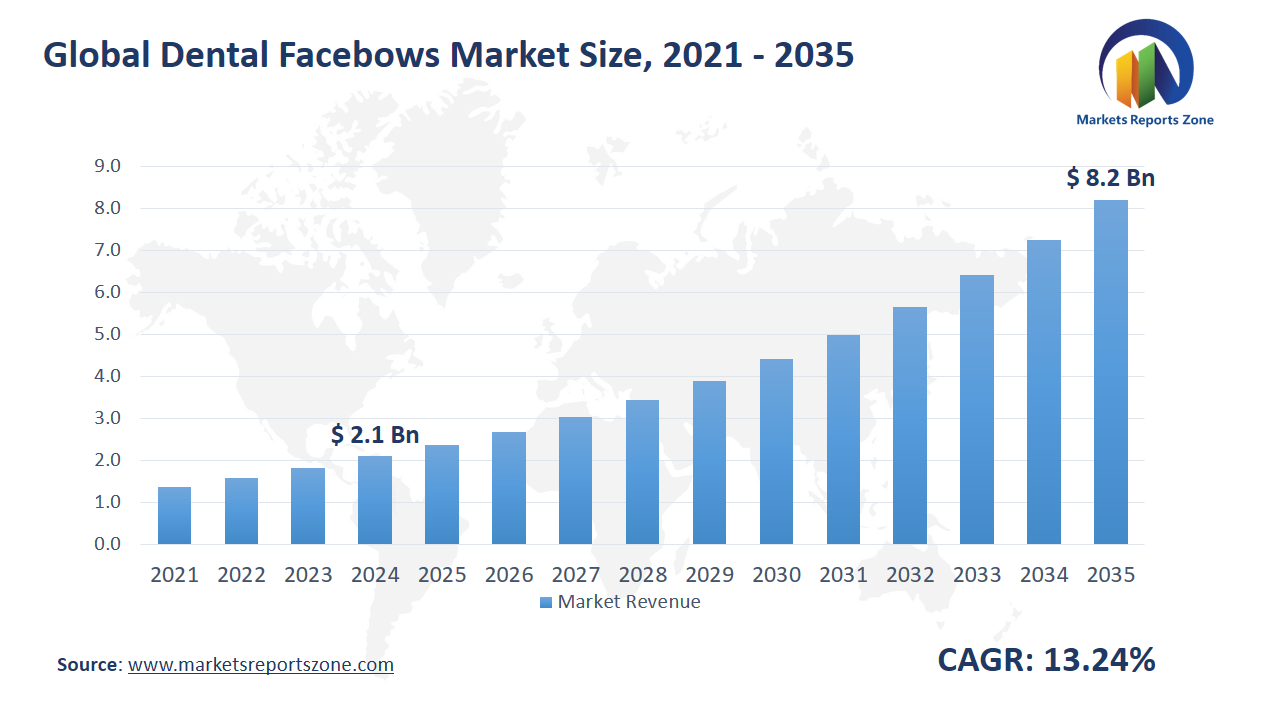
Global Dental Facebows Market Size is expected to reach USD 8.22 Billion by 2035 from USD 2.09 Billion in 2024, with a CAGR of around 13.24% between 2024 and 2035. The global dental facebows market is being driven by rising demand for precise dental prosthetics and the growing adoption of advanced diagnostic tools in dental clinics. With the rise in cosmetic dentistry, accuracy in jaw relation recording has been prioritized. A dental clinic in Canada recently introduced digital facebows to improve prosthetic fitting and reduce adjustment time. Another major driver has been the increase in dental education and training centers that are equipping students with advanced tools, including facebows, to ensure practical readiness. However, the high cost of digital and semi-adjustable facebows has acted as a restraint, especially for small practices in developing countries. Still, strong opportunities are being seen in emerging markets where public health programs are expanding dental care accessibility. A government dental outreach initiative in Brazil began using basic facebows in mobile dental units to provide better prosthetics in rural communities. Another opportunity lies in technological integration, where facebows are being connected with CAD/CAM systems to allow seamless digital workflows. A dental tech company in South Korea recently partnered with a clinic chain to implement 3D facebow mapping, reducing manual errors. These developments are shaping the future of dentistry by enhancing precision, improving patient outcomes, and opening new doors for innovation and outreach.
Driver: Precision Prosthetics Drive Market Demand
The growing need for precise dental prosthetics has strongly driven the demand for dental facebows. As patients increasingly seek comfort, functionality, and natural aesthetics, dentists are turning to tools that enhance accuracy during prosthetic creation. Facebows play a crucial role in capturing the spatial relationship between the maxilla and the temporomandibular joint, ensuring better alignment of dental restorations. In a private dental studio in Germany, facebows were integrated into the workflow to address recurring issues with ill-fitting crowns and bridges. After implementation, chairside adjustment time was reduced significantly, and patient satisfaction improved. In another case, a prosthodontist in Singapore used facebows for a patient with severe jaw asymmetry, resulting in a customized set of dentures that improved both bite and facial balance. These tools have also become essential in full-mouth reconstructions, where minor misalignments can lead to long-term discomfort. Dental labs now often request facebow records alongside impressions to ensure higher precision during manufacturing. As demand for high-quality prosthetics rises across both cosmetic and restorative dentistry, the adoption of dental facebows is expected to grow further. This trend highlights how accuracy and patient comfort are becoming central in modern dental practices, leading to better clinical results and reduced follow-up treatments.
Key Insights:
- The adoption rate of dental facebows in university dental programs has reached approximately 65% worldwide.
- Over 120,000 units of dental facebows were sold globally in the last recorded year, primarily to clinics and dental schools.
- A government-backed dental modernization program in Japan invested $18 million to equip public clinics with updated facebow systems.
- Penetration of dental facebows in cosmetic dentistry practices stands at around 52%, with growth seen in urban centers.
- A European dental equipment manufacturer reported exporting over 40,000 facebow units to Southeast Asia within a 12-month period.
- In a public oral health initiative, $5 million was allocated by the health ministry in Brazil to supply facebows for training in rural dental colleges.
- Penetration rate in private dental laboratories using facebow records for prosthetic fabrication has increased to 48%.
- A U.S.-based dental technology firm invested $10 million to develop a digital facebow line integrated with intraoral scanners.
Segment Analysis:
The dental facebows market is segmented by type into Arcon and Non-arcon, each serving different clinical preferences and workflow styles. Arcon facebows, which mimic the natural hinge of the jaw more closely, are often favored by prosthodontists and specialists aiming for anatomical accuracy. A dental lab in Spain began using Arcon models in full-arch restorations to better replicate patient-specific jaw movement, leading to fewer adjustments post-installation. Non-arcon facebows, though mechanically simpler, are widely used in general dentistry due to their ease of use and affordability. A private clinic in the Philippines integrated Non-arcon models for daily prosthetic work, improving productivity in high-volume settings. By application, dental clinics represent a major user base as practitioners seek efficient, precise tools for crown and bridge cases. In South Africa, a mid-sized dental chain rolled out facebows across all its branches to streamline prosthetic procedures and reduce rework. Hospitals, on the other hand, tend to use facebows for complex or multidisciplinary cases. A teaching hospital in the UAE incorporated facebows in its oral surgery unit to prepare for corrective jaw surgeries with improved bite registration. Each segment reflects the evolving demand for accuracy, ease, and patient-focused outcomes in restorative and rehabilitative dental care worldwide.
Regional Analysis:
North America has seen widespread adoption of dental facebows, driven by advanced dental infrastructure and a growing cosmetic dentistry trend. A dental chain in California integrated digital facebows into its workflow, reducing turnaround time for prosthetic fittings. In Europe, strong support from dental associations and a focus on precision tools have made facebows a common fixture in prosthodontic practices. A clinic in Italy began offering full-mouth reconstructions with Arcon facebows, receiving positive feedback for improved patient comfort. The Asia-Pacific region is showing rapid growth due to expanding dental education and increasing demand for restorative care. A dental college in India introduced hands-on training with facebows to enhance student competence in prosthetic fabrication. In Latin America, public health investments have started equipping rural clinics with basic facebow models. A municipal clinic in Chile used them to improve denture fittings for elderly patients, leading to better function and satisfaction. The Middle East and Africa region, though still developing in terms of infrastructure, is witnessing gradual adoption in private hospitals and academic institutions. A private hospital in Kenya added facebows to its oral rehabilitation unit to improve surgical planning. Across all regions, the emphasis remains on improving accuracy, patient outcomes, and professional training in modern dental care.
Competitive Scenario:
The competitive landscape of the dental facebows market is shaped by innovation, product upgrades, and strategic collaborations among leading manufacturers. Whip Mix has expanded its product line with digital-compatible facebows, streamlining prosthetic workflows in modern clinics. Song Young International has focused on supplying affordable, user-friendly models for emerging markets. Bio-Art has emphasized design improvements for greater comfort and efficiency during fittings. Amann Girrbach recently integrated its facebow technology with CAD/CAM systems, allowing seamless data transfer for digital restorations. Dentatus has maintained its presence through compact and portable options tailored for mobile dental units. Ivoclar Vivadent continues to offer premium facebow systems used in academic settings and high-end practices. Zirkonzahn introduced a modular facebow system that allows better customization for complex cases. P.P.M. SRL (Fast Protec) has gained attention with lightweight, fast-adjusting facebows, which are increasingly favored in dental labs. SCHULER-DENTAL GmbH & Co. KG and Kavo have concentrated on ergonomic features and precision engineering, making them popular among prosthodontists. SAM Präzisionstechnik remains known for its high-accuracy Arcon systems used in full-arch rehabilitation. Shofu Dental GmbH has expanded distribution partnerships to strengthen its global reach. Together, these companies drive the evolution of the facebow market through a blend of tradition and technological progress.
Dental Facebows Market Report Scope
| Report Attribute | Details |
|---|---|
| Market Size Value in 2024 | USD 2.09 Billion |
| Revenue Forecast in 2035 | USD 8.22 Billion |
| Growth Rate | CAGR of 13.24% from 2025 to 2035 |
| Historic Period | 2021 - 2024 |
| Forecasted Period | 2025 - 2035 |
| Report Coverage | Revenue forecast, company ranking, competitive landscape, growth factors, and trends |
| Regions Covered | North America; Europe; Asia Pacific; Latin America; Middle East & Africa |
| Countries Covered | U.S.; Canada; Mexico, UK; Germany; France; Spain; Italy; Russia; China; Japan; India; South Korea; Australia; Southeast Asia; Brazil; Argentina; Saudi Arabia; UAE; South Africa |
| Key companies profiled | Whip Mix; Song Young International; Bio-Art; Amann Girrbach; Dentatus; Ivoclar Vivadent; Zirkonzahn; P.P.M. SRL (Fast Protec); SCHULER-DENTAL GmbH & Co. KG; Kavo; SAM Prazisionstechnik; Shofu Dental GmbH |
| Customization | Free report customization (equivalent up to 8 analysts working days) with purchase. Addition or alteration to country, regional & segment scope. |
The Global Dental Facebows Market report is segmented as follows:
By Type,
- Arcon
- Non-arcon
By Application,
- Dental clinic
- Hospital
By Region,
- North America
- U.S.
- Canada
- Mexico
- Europe
- UK
- Germany
- France
- Spain
- Italy
- Russia
- Rest of Europe
- Asia Pacific
- China
- Japan
- India
- South Korea
- Australia
- Southeast Asia
- Rest of Asia Pacific
- Latin America
- Brazil
- Argentina
- Rest of Latin America
- Middle East & Africa
- Saudi Arabia
- UAE
- South Africa
- Rest of Middle East and Africa
Key Market Players,
- Whip Mix
- Song Young International
- Bio-Art
- Amann Girrbach
- Dentatus
- Ivoclar Vivadent
- Zirkonzahn
- P.P.M. SRL (Fast Protec)
- SCHULER-DENTAL GmbH & Co. KG
- Kavo
- SAM Prazisionstechnik
- Shofu Dental GmbH
Frequently Asked Questions
Research Objectives
- Proliferation and maturation of trade in the global Dental Facebows Market.
- The market share of the global Dental Facebows Market, supply and demand ratio, growth revenue, supply chain analysis, and business overview.
- Current and future market trends that are influencing the growth opportunities and growth rate of the global Dental Facebows Market.
- Feasibility study, new market insights, company profiles, investment return, market size of the global Dental Facebows Market.
Chapter 1 Dental Facebows Market Executive Summary
- 1.1 Dental Facebows Market Research Scope
- 1.2 Dental Facebows Market Estimates and Forecast (2021-2035)
- 1.2.1 Global Dental Facebows Market Value and Growth Rate (2021-2035)
- 1.2.2 Global Dental Facebows Market Price Trend (2021-2035)
- 1.3 Global Dental Facebows Market Value Comparison, by Type (2021-2035)
- 1.3.1 Arcon
- 1.3.2 Non-arcon
- 1.4 Global Dental Facebows Market Value Comparison, by Application (2021-2035)
- 1.4.1 Dental clinic
- 1.4.2 Hospital
Chapter 2 Research Methodology
- 2.1 Introduction
- 2.2 Data Capture Sources
- 2.2.1 Primary Sources
- 2.2.2 Secondary Sources
- 2.3 Market Size Estimation
- 2.4 Market Forecast
- 2.5 Assumptions and Limitations
Chapter 3 Market Dynamics
- 3.1 Market Trends
- 3.2 Opportunities and Drivers
- 3.3 Challenges
- 3.4 Market Restraints
- 3.5 Porter's Five Forces Analysis
Chapter 4 Supply Chain Analysis and Marketing Channels
- 4.1 Dental Facebows Supply Chain Analysis
- 4.2 Marketing Channels
- 4.3 Dental Facebows Suppliers List
- 4.4 Dental Facebows Distributors List
- 4.5 Dental Facebows Customers
Chapter 5 COVID-19 & Russia?Ukraine War Impact Analysis
- 5.1 COVID-19 Impact Analysis on Dental Facebows Market
- 5.2 Russia-Ukraine War Impact Analysis on Dental Facebows Market
Chapter 6 Dental Facebows Market Estimate and Forecast by Region
- 6.1 Global Dental Facebows Market Value by Region: 2021 VS 2023 VS 2035
- 6.2 Global Dental Facebows Market Scenario by Region (2021-2023)
- 6.2.1 Global Dental Facebows Market Value Share by Region (2021-2023)
- 6.3 Global Dental Facebows Market Forecast by Region (2024-2035)
- 6.3.1 Global Dental Facebows Market Value Forecast by Region (2024-2035)
- 6.4 Geographic Market Analysis: Market Facts and Figures
- 6.4.1 North America Dental Facebows Market Estimates and Projections (2021-2035)
- 6.4.2 Europe Dental Facebows Market Estimates and Projections (2021-2035)
- 6.4.3 Asia Pacific Dental Facebows Market Estimates and Projections (2021-2035)
- 6.4.4 Latin America Dental Facebows Market Estimates and Projections (2021-2035)
- 6.4.5 Middle East & Africa Dental Facebows Market Estimates and Projections (2021-2035)
Chapter 7 Global Dental Facebows Competition Landscape by Players
- 7.1 Global Top Dental Facebows Players by Value (2021-2023)
- 7.2 Dental Facebows Headquarters and Sales Region by Company
- 7.3 Company Recent Developments, Mergers & Acquisitions, and Expansion Plans
Chapter 8 Global Dental Facebows Market, by Type
- 8.1 Global Dental Facebows Market Value, by Type (2021-2035)
- 8.1.1 Arcon
- 8.1.2 Non-arcon
Chapter 9 Global Dental Facebows Market, by Application
- 9.1 Global Dental Facebows Market Value, by Application (2021-2035)
- 9.1.1 Dental clinic
- 9.1.2 Hospital
Chapter 10 North America Dental Facebows Market
- 10.1 Overview
- 10.2 North America Dental Facebows Market Value, by Country (2021-2035)
- 10.2.1 U.S.
- 10.2.2 Canada
- 10.2.3 Mexico
- 10.3 North America Dental Facebows Market Value, by Type (2021-2035)
- 10.3.1 Arcon
- 10.3.2 Non-arcon
- 10.4 North America Dental Facebows Market Value, by Application (2021-2035)
- 10.4.1 Dental clinic
- 10.4.2 Hospital
Chapter 11 Europe Dental Facebows Market
- 11.1 Overview
- 11.2 Europe Dental Facebows Market Value, by Country (2021-2035)
- 11.2.1 UK
- 11.2.2 Germany
- 11.2.3 France
- 11.2.4 Spain
- 11.2.5 Italy
- 11.2.6 Russia
- 11.2.7 Rest of Europe
- 11.3 Europe Dental Facebows Market Value, by Type (2021-2035)
- 11.3.1 Arcon
- 11.3.2 Non-arcon
- 11.4 Europe Dental Facebows Market Value, by Application (2021-2035)
- 11.4.1 Dental clinic
- 11.4.2 Hospital
Chapter 12 Asia Pacific Dental Facebows Market
- 12.1 Overview
- 12.2 Asia Pacific Dental Facebows Market Value, by Country (2021-2035)
- 12.2.1 China
- 12.2.2 Japan
- 12.2.3 India
- 12.2.4 South Korea
- 12.2.5 Australia
- 12.2.6 Southeast Asia
- 12.2.7 Rest of Asia Pacific
- 12.3 Asia Pacific Dental Facebows Market Value, by Type (2021-2035)
- 12.3.1 Arcon
- 12.3.2 Non-arcon
- 12.4 Asia Pacific Dental Facebows Market Value, by Application (2021-2035)
- 12.4.1 Dental clinic
- 12.4.2 Hospital
Chapter 13 Latin America Dental Facebows Market
- 13.1 Overview
- 13.2 Latin America Dental Facebows Market Value, by Country (2021-2035)
- 13.2.1 Brazil
- 13.2.2 Argentina
- 13.2.3 Rest of Latin America
- 13.3 Latin America Dental Facebows Market Value, by Type (2021-2035)
- 13.3.1 Arcon
- 13.3.2 Non-arcon
- 13.4 Latin America Dental Facebows Market Value, by Application (2021-2035)
- 13.4.1 Dental clinic
- 13.4.2 Hospital
Chapter 14 Middle East & Africa Dental Facebows Market
- 14.1 Overview
- 14.2 Middle East & Africa Dental Facebows Market Value, by Country (2021-2035)
- 14.2.1 Saudi Arabia
- 14.2.2 UAE
- 14.2.3 South Africa
- 14.2.4 Rest of Middle East & Africa
- 14.3 Middle East & Africa Dental Facebows Market Value, by Type (2021-2035)
- 14.3.1 Arcon
- 14.3.2 Non-arcon
- 14.4 Middle East & Africa Dental Facebows Market Value, by Application (2021-2035)
- 14.4.1 Dental clinic
- 14.4.2 Hospital
Chapter 15 Company Profiles and Market Share Analysis: (Business Overview, Market Share Analysis, Products/Services Offered, Recent Developments)
- 15.1 Whip Mix
- 15.2 Song Young International
- 15.3 Bio-Art
- 15.4 Amann Girrbach
- 15.5 Dentatus
- 15.6 Ivoclar Vivadent
- 15.7 Zirkonzahn
- 15.8 P.P.M. SRL (Fast Protec)
- 15.9 SCHULER-DENTAL GmbH & Co. KG
- 15.10 Kavo
- 15.11 SAM Prazisionstechnik
- 15.12 Shofu Dental GmbH

Report ID:
187
Published Date:
April 2025
Trusted by more than 10,500 organizations globally



Infaluble Methodology
Customization
Analyst Support
Targeted Market View