Global Disease Risk and Health DNA Test Market, By Type (Celiac Disease, Parkinson Disease, Alzheimer Disease), By Application, and By Region - Trends and Forecast Analysis, 2021-2035
Publish Date: 2025-04-23 | Format: PDF | Category: Chemical and Material | Pages: 359
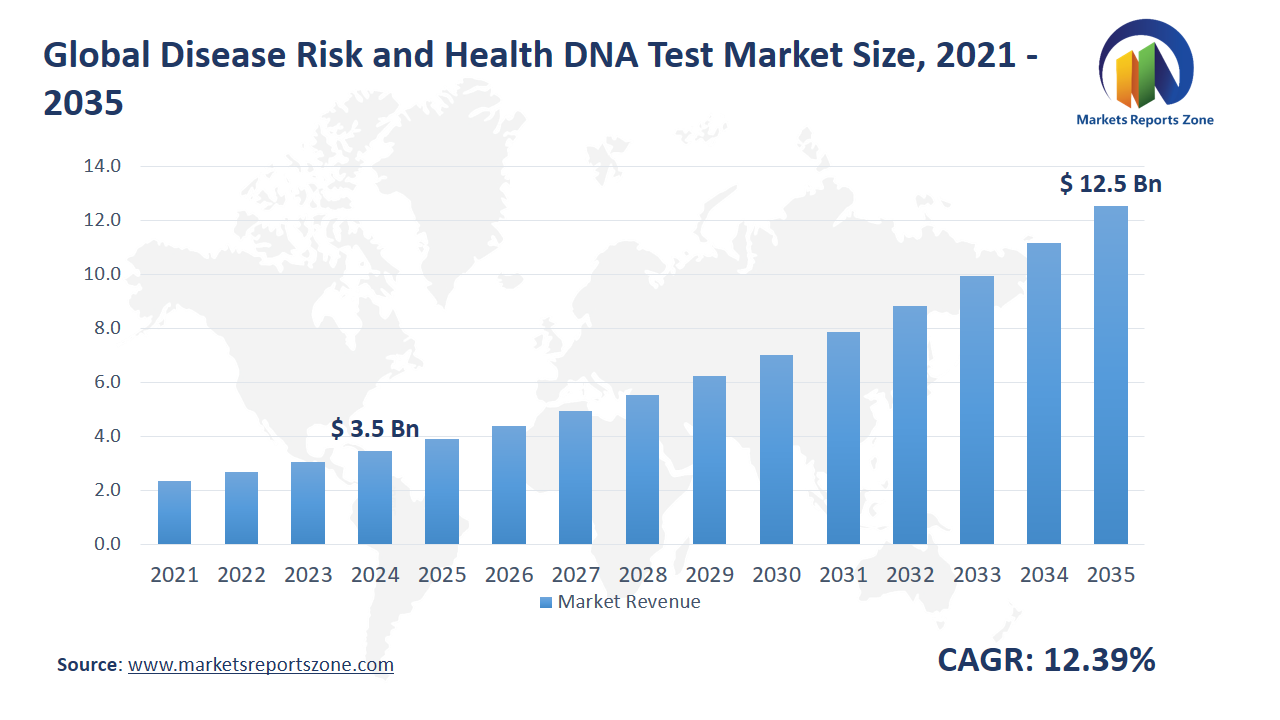
Global Disease Risk and Health DNA Test Market Size is expected to reach USD 12.58 Billion by 2035 from USD 3.47 Billion in 2024, with a CAGR of around 12.39% between 2024 and 2035. The growth of the global disease risk and health DNA test market is being driven by rising awareness of preventive healthcare and increasing demand for personalized medicine. More people are being encouraged to understand genetic predispositions, and lifestyle adjustments are being adopted early. Personalized treatment plans are also being created based on genetic insights. For instance, genetic testing is being used by physicians to determine cancer risk in patients. Additionally, such tests are being promoted by wellness companies to offer tailored diet plans. However, concerns regarding data privacy and genetic discrimination have acted as key restraints. Many consumers have avoided tests due to fear of misuse of genetic information. Despite this, huge opportunities have been created by the growing adoption of direct-to-consumer testing kits. At-home DNA tests are being used by individuals without medical prescriptions. This trend has been especially seen during post-pandemic wellness trends. Furthermore, rapid advancements in AI and bioinformatics are being used to enhance test accuracy and interpretation. Platforms are being developed to make results more user-friendly and actionable. For example, machine learning models are being trained to predict risk scores more precisely. As a result, wider applications in chronic disease management and preventive care are being explored globally.
Driver: Preventive Healthcare Awareness on Rise
Preventive healthcare has been prioritized more than ever. A growing shift is being observed where health issues are being addressed before they occur. People are being encouraged to learn about their genetic makeup to take early steps. DNA testing is being used to identify inherited risk factors for diseases like diabetes, Alzheimer’s, and certain heart conditions. Once risks are known, lifestyle changes are being made proactively. For example, individuals who discover a genetic tendency for high cholesterol are beginning regular workouts and switching to heart-friendly diets. In another case, a woman who learned about her elevated risk of breast cancer through genetic testing scheduled frequent screenings and made informed health decisions with her doctor. Corporate wellness programs are also including genetic testing to help employees manage stress and sleep disorders better. More gyms, health coaches, and wellness apps are recommending DNA tests to offer custom health advice. As a result, people are becoming more engaged in their health journeys. Preventive healthcare is no longer limited to yearly checkups; it is being supported with science-driven insights. This trend is not only reducing long-term medical costs but also improving quality of life. The future of health is being built on awareness, prevention, and personalized choices.
Key Insights:
- Over 30% of adults in the U.S. have used at-home genetic health tests for disease risk screening.
- More than 12 million DNA test kits were sold globally through direct-to-consumer channels in a single year.
- A major biotechnology company invested over USD 300 million to expand its genomic testing infrastructure across North America.
- Government healthcare programs in several countries allocated over USD 1.5 billion to support genetic screening initiatives in public hospitals.
- Adoption of genetic testing in oncology clinics has crossed 45% in developed healthcare systems.
- Over 40% of personalized nutrition platforms now integrate genetic data to tailor dietary recommendations.
- Genomic data processing units saw a 60% year-over-year growth in demand from healthcare AI developers.
- Penetration of health DNA tests in corporate wellness programs has reached over 25% in the U.S. and parts of Europe.
Segment Analysis:
The disease-specific segmentation of the health DNA test market is showing unique patterns in consumer behavior and clinical use. For Celiac disease, genetic testing is being used to confirm gluten intolerance in individuals with long-standing digestive issues. Many patients who have suffered years of misdiagnosis are now finding clarity through these tests. In the case of Parkinson’s disease, families with a history of neurological disorders are turning to DNA testing to assess future risk. Early interventions, including changes in physical therapy routines and lifestyle, are being adopted based on results. Alzheimer’s disease testing is also gaining momentum, especially among those with aging parents who had cognitive decline. People in their 30s and 40s are using genetic tests to plan ahead and adopt brain-health strategies early. On the application side, the online segment is growing faster due to convenience and privacy. At-home DNA kits are being ordered through health platforms and delivered directly to users, who then access their results via secure digital dashboards. Meanwhile, the offline segment is still relevant in hospitals, clinics, and diagnostic labs where tests are recommended by physicians. In many urban health centers, offline consultations are being paired with genetic screening to create personalized wellness plans for patients.
Regional Analysis:
The global disease risk and health DNA test market is showing varied growth across regions. In North America, widespread awareness and insurance coverage have supported adoption, with many families using DNA tests to assess hereditary risks like colon cancer. In Europe, strong regulations have ensured ethical testing practices, and government-backed health programs are using genetic screening for early diagnosis of rare diseases in children. Asia-Pacific is seeing rapid growth due to rising middle-class income and increased interest in health tech. In countries like Japan and South Korea, tech-savvy consumers are integrating DNA test results with fitness apps to monitor health more closely. Meanwhile, in Latin America, urban populations are embracing preventive healthcare, and private clinics are offering bundled wellness packages that include genetic testing. In one case, a family in Brazil used health DNA testing to detect inherited cholesterol issues and began treatment early. The Middle East & Africa region, though developing, is witnessing adoption in premium healthcare centers where genetic screening is being introduced for prenatal care and chronic disease prevention. In Dubai, wellness resorts are offering DNA-based detox and fitness plans. Each region is embracing DNA testing based on its cultural priorities, infrastructure, and health awareness, making the market globally diverse and dynamic.
Competitive Scenario:
The landscape of the disease risk and health DNA test market is being shaped by a wide range of players, from global giants to region-specific specialists. Companies like 23andMe, Ancestry.com, and MyHeritage, originally known for ancestry testing, have expanded into health-focused DNA services, offering insights on disease predisposition alongside family lineage. LabCorp and Quest Diagnostics are leveraging their diagnostic infrastructure to deliver physician-recommended genetic tests with clinical accuracy. Myriad Genetics and Invitae are focusing on comprehensive panels for cancer, cardiovascular, and neurological risk assessments. Startups like Color Genomics and Pathway Genomics are making health DNA testing more accessible through affordable at-home kits and digital platforms. African Ancestry and Mapmygenome are customizing tests based on ethnic-specific health traits, addressing gaps in genomic data diversity. Meanwhile, companies like Gene By Gene and Full Genomes are offering full sequencing services for those seeking deeper insights. Recent developments include AI-powered interpretation tools by IntelliGenetics and expansion of prenatal and pediatric panels by Ambry Genetics. Living DNA and EasyDNA have entered new markets with localized health reports. Chinese firms like 23 Mofang and Shuwen Health Sciences are pushing innovation in Asia, while Canadian DNA Services and DNA Services of America focus on regional outreach. Together, these companies are transforming personalized health management globally.
Disease Risk and Health DNA Test Market Report Scope
| Report Attribute | Details |
|---|---|
| Market Size Value in 2024 | USD 3.47 Billion |
| Revenue Forecast in 2035 | USD 12.58 Billion |
| Growth Rate | CAGR of 12.39% from 2025 to 2035 |
| Historic Period | 2021 - 2024 |
| Forecasted Period | 2025 - 2035 |
| Report Coverage | Revenue forecast, company ranking, competitive landscape, growth factors, and trends |
| Regions Covered | North America; Europe; Asia Pacific; Latin America; Middle East & Africa |
| Countries Covered | U.S.; Canada; Mexico, UK; Germany; France; Spain; Italy; Russia; China; Japan; India; South Korea; Australia; Southeast Asia; Brazil; Argentina; Saudi Arabia; UAE; South Africa |
| Key companies profiled | 23andMe; MyHeritage; LabCorp; Myriad Genetics; Ancestry.com; Quest Diagnostics; Gene By Gene; DNA Diagnostics Center; Invitae; IntelliGenetics; Ambry Genetics; Living DNA; EasyDNA; Pathway Genomics; Centrillion Technology; Xcode; Color Genomics; Anglia DNA Services; African Ancestry; Canadian DNA Services; DNA Family Check; Alpha Biolaboratories; Test Me DNA; 23 Mofang; Genetic Health; DNA Services of America; Shuwen Health Sciences; Mapmygenome; Full Genomes |
| Customization | Free report customization (equivalent up to 8 analysts working days) with purchase. Addition or alteration to country, regional & segment scope. |
The Global Disease Risk and Health DNA Test Market report is segmented as follows:
By Type,
- Celiac Disease
- Parkinson Disease
- Alzheimer Disease
By Application,
- Online
- Offline
By Region,
- North America
- U.S.
- Canada
- Mexico
- Europe
- UK
- Germany
- France
- Spain
- Italy
- Russia
- Rest of Europe
- Asia Pacific
- China
- Japan
- India
- South Korea
- Australia
- Southeast Asia
- Rest of Asia Pacific
- Latin America
- Brazil
- Argentina
- Rest of Latin America
- Middle East & Africa
- Saudi Arabia
- UAE
- South Africa
- Rest of Middle East and Africa
Key Market Players,
- 23andMe
- MyHeritage
- LabCorp
- Myriad Genetics
- Ancestry.com
- Quest Diagnostics
- Gene By Gene
- DNA Diagnostics Center
- Invitae
- IntelliGenetics
- Ambry Genetics
- Living DNA
- EasyDNA
- Pathway Genomics
- Centrillion Technology
- Xcode
- Color Genomics
- Anglia DNA Services
- African Ancestry
- Canadian DNA Services
- DNA Family Check
- Alpha Biolaboratories
- Test Me DNA
- 23 Mofang
- Genetic Health
- DNA Services of America
- Shuwen Health Sciences
- Mapmygenome
- Full Genomes
Frequently Asked Questions
Research Objectives
- Proliferation and maturation of trade in the global Disease Risk and Health DNA Test Market.
- The market share of the global Disease Risk and Health DNA Test Market, supply and demand ratio, growth revenue, supply chain analysis, and business overview.
- Current and future market trends that are influencing the growth opportunities and growth rate of the global Disease Risk and Health DNA Test Market.
- Feasibility study, new market insights, company profiles, investment return, market size of the global Disease Risk and Health DNA Test Market.
Chapter 1 Disease Risk and Health DNA Test Market Executive Summary
- 1.1 Disease Risk and Health DNA Test Market Research Scope
- 1.2 Disease Risk and Health DNA Test Market Estimates and Forecast (2021-2035)
- 1.2.1 Global Disease Risk and Health DNA Test Market Value and Growth Rate (2021-2035)
- 1.2.2 Global Disease Risk and Health DNA Test Market Price Trend (2021-2035)
- 1.3 Global Disease Risk and Health DNA Test Market Value Comparison, by Type (2021-2035)
- 1.3.1 Celiac Disease
- 1.3.2 Parkinson Disease
- 1.3.3 Alzheimer Disease
- 1.4 Global Disease Risk and Health DNA Test Market Value Comparison, by Application (2021-2035)
- 1.4.1 Online
- 1.4.2 Offline
Chapter 2 Research Methodology
- 2.1 Introduction
- 2.2 Data Capture Sources
- 2.2.1 Primary Sources
- 2.2.2 Secondary Sources
- 2.3 Market Size Estimation
- 2.4 Market Forecast
- 2.5 Assumptions and Limitations
Chapter 3 Market Dynamics
- 3.1 Market Trends
- 3.2 Opportunities and Drivers
- 3.3 Challenges
- 3.4 Market Restraints
- 3.5 Porter's Five Forces Analysis
Chapter 4 Supply Chain Analysis and Marketing Channels
- 4.1 Disease Risk and Health DNA Test Supply Chain Analysis
- 4.2 Marketing Channels
- 4.3 Disease Risk and Health DNA Test Suppliers List
- 4.4 Disease Risk and Health DNA Test Distributors List
- 4.5 Disease Risk and Health DNA Test Customers
Chapter 5 COVID-19 & Russia?Ukraine War Impact Analysis
- 5.1 COVID-19 Impact Analysis on Disease Risk and Health DNA Test Market
- 5.2 Russia-Ukraine War Impact Analysis on Disease Risk and Health DNA Test Market
Chapter 6 Disease Risk and Health DNA Test Market Estimate and Forecast by Region
- 6.1 Global Disease Risk and Health DNA Test Market Value by Region: 2021 VS 2023 VS 2035
- 6.2 Global Disease Risk and Health DNA Test Market Scenario by Region (2021-2023)
- 6.2.1 Global Disease Risk and Health DNA Test Market Value Share by Region (2021-2023)
- 6.3 Global Disease Risk and Health DNA Test Market Forecast by Region (2024-2035)
- 6.3.1 Global Disease Risk and Health DNA Test Market Value Forecast by Region (2024-2035)
- 6.4 Geographic Market Analysis: Market Facts and Figures
- 6.4.1 North America Disease Risk and Health DNA Test Market Estimates and Projections (2021-2035)
- 6.4.2 Europe Disease Risk and Health DNA Test Market Estimates and Projections (2021-2035)
- 6.4.3 Asia Pacific Disease Risk and Health DNA Test Market Estimates and Projections (2021-2035)
- 6.4.4 Latin America Disease Risk and Health DNA Test Market Estimates and Projections (2021-2035)
- 6.4.5 Middle East & Africa Disease Risk and Health DNA Test Market Estimates and Projections (2021-2035)
Chapter 7 Global Disease Risk and Health DNA Test Competition Landscape by Players
- 7.1 Global Top Disease Risk and Health DNA Test Players by Value (2021-2023)
- 7.2 Disease Risk and Health DNA Test Headquarters and Sales Region by Company
- 7.3 Company Recent Developments, Mergers & Acquisitions, and Expansion Plans
Chapter 8 Global Disease Risk and Health DNA Test Market, by Type
- 8.1 Global Disease Risk and Health DNA Test Market Value, by Type (2021-2035)
- 8.1.1 Celiac Disease
- 8.1.2 Parkinson Disease
- 8.1.3 Alzheimer Disease
Chapter 9 Global Disease Risk and Health DNA Test Market, by Application
- 9.1 Global Disease Risk and Health DNA Test Market Value, by Application (2021-2035)
- 9.1.1 Online
- 9.1.2 Offline
Chapter 10 North America Disease Risk and Health DNA Test Market
- 10.1 Overview
- 10.2 North America Disease Risk and Health DNA Test Market Value, by Country (2021-2035)
- 10.2.1 U.S.
- 10.2.2 Canada
- 10.2.3 Mexico
- 10.3 North America Disease Risk and Health DNA Test Market Value, by Type (2021-2035)
- 10.3.1 Celiac Disease
- 10.3.2 Parkinson Disease
- 10.3.3 Alzheimer Disease
- 10.4 North America Disease Risk and Health DNA Test Market Value, by Application (2021-2035)
- 10.4.1 Online
- 10.4.2 Offline
Chapter 11 Europe Disease Risk and Health DNA Test Market
- 11.1 Overview
- 11.2 Europe Disease Risk and Health DNA Test Market Value, by Country (2021-2035)
- 11.2.1 UK
- 11.2.2 Germany
- 11.2.3 France
- 11.2.4 Spain
- 11.2.5 Italy
- 11.2.6 Russia
- 11.2.7 Rest of Europe
- 11.3 Europe Disease Risk and Health DNA Test Market Value, by Type (2021-2035)
- 11.3.1 Celiac Disease
- 11.3.2 Parkinson Disease
- 11.3.3 Alzheimer Disease
- 11.4 Europe Disease Risk and Health DNA Test Market Value, by Application (2021-2035)
- 11.4.1 Online
- 11.4.2 Offline
Chapter 12 Asia Pacific Disease Risk and Health DNA Test Market
- 12.1 Overview
- 12.2 Asia Pacific Disease Risk and Health DNA Test Market Value, by Country (2021-2035)
- 12.2.1 China
- 12.2.2 Japan
- 12.2.3 India
- 12.2.4 South Korea
- 12.2.5 Australia
- 12.2.6 Southeast Asia
- 12.2.7 Rest of Asia Pacific
- 12.3 Asia Pacific Disease Risk and Health DNA Test Market Value, by Type (2021-2035)
- 12.3.1 Celiac Disease
- 12.3.2 Parkinson Disease
- 12.3.3 Alzheimer Disease
- 12.4 Asia Pacific Disease Risk and Health DNA Test Market Value, by Application (2021-2035)
- 12.4.1 Online
- 12.4.2 Offline
Chapter 13 Latin America Disease Risk and Health DNA Test Market
- 13.1 Overview
- 13.2 Latin America Disease Risk and Health DNA Test Market Value, by Country (2021-2035)
- 13.2.1 Brazil
- 13.2.2 Argentina
- 13.2.3 Rest of Latin America
- 13.3 Latin America Disease Risk and Health DNA Test Market Value, by Type (2021-2035)
- 13.3.1 Celiac Disease
- 13.3.2 Parkinson Disease
- 13.3.3 Alzheimer Disease
- 13.4 Latin America Disease Risk and Health DNA Test Market Value, by Application (2021-2035)
- 13.4.1 Online
- 13.4.2 Offline
Chapter 14 Middle East & Africa Disease Risk and Health DNA Test Market
- 14.1 Overview
- 14.2 Middle East & Africa Disease Risk and Health DNA Test Market Value, by Country (2021-2035)
- 14.2.1 Saudi Arabia
- 14.2.2 UAE
- 14.2.3 South Africa
- 14.2.4 Rest of Middle East & Africa
- 14.3 Middle East & Africa Disease Risk and Health DNA Test Market Value, by Type (2021-2035)
- 14.3.1 Celiac Disease
- 14.3.2 Parkinson Disease
- 14.3.3 Alzheimer Disease
- 14.4 Middle East & Africa Disease Risk and Health DNA Test Market Value, by Application (2021-2035)
- 14.4.1 Online
- 14.4.2 Offline
Chapter 15 Company Profiles and Market Share Analysis: (Business Overview, Market Share Analysis, Products/Services Offered, Recent Developments)
- 15.1 23andMe
- 15.2 MyHeritage
- 15.3 LabCorp
- 15.4 Myriad Genetics
- 15.5 Ancestry.com
- 15.6 Quest Diagnostics
- 15.7 Gene By Gene
- 15.8 DNA Diagnostics Center
- 15.9 Invitae
- 15.10 IntelliGenetics
- 15.11 Ambry Genetics
- 15.12 Living DNA
- 15.13 EasyDNA
- 15.14 Pathway Genomics
- 15.15 Centrillion Technology
- 15.16 Xcode
- 15.17 Color Genomics
- 15.18 Anglia DNA Services
- 15.19 African Ancestry
- 15.20 Canadian DNA Services
- 15.21 DNA Family Check
- 15.22 Alpha Biolaboratories
- 15.23 Test Me DNA
- 15.24 23 Mofang
- 15.25 Genetic Health
- 15.26 DNA Services of America
- 15.27 Shuwen Health Sciences
- 15.28 Mapmygenome
- 15.29 Full Genomes

Report ID:
189
Published Date:
April 2025
Trusted by more than 10,500 organizations globally



Infaluble Methodology
Customization
Analyst Support
Targeted Market View