Global Hybrid and Electric Vehicles Market, By Type (Hybrid Electric Vehicles, Pure Electric Vehicles), By Application, and By Region - Trends and Forecast Analysis, 2021-2035
Publish Date: 2025-03-19 | Format: PDF | Category: Automotive | Pages: 328
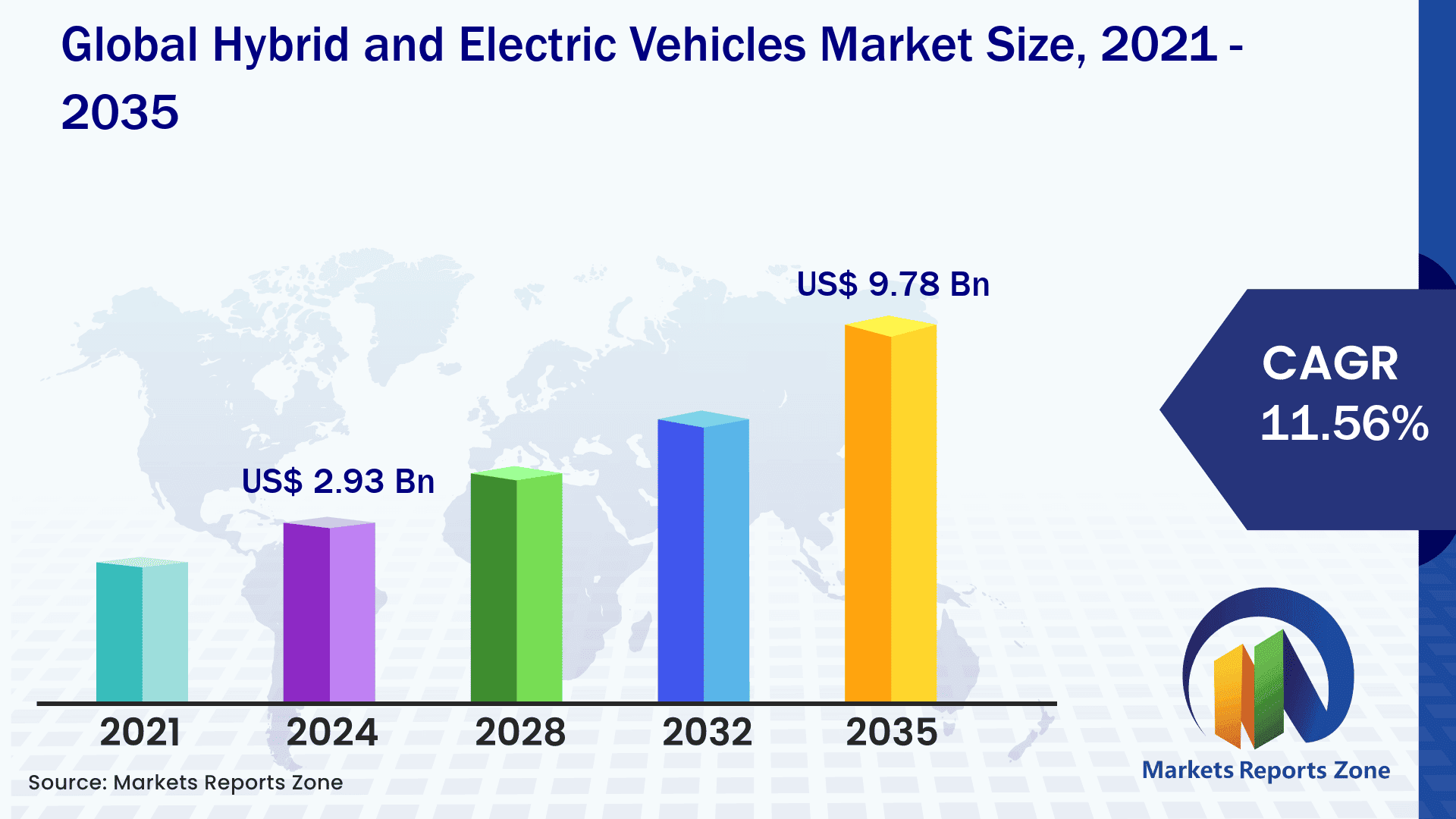
Global Hybrid and Electric Vehicles Market Size is expected to reach USD 9.78 Billion by 2035 from USD 2.93 Billion in 2024, with a CAGR of around 11.56% between 2024 and 2035. The global hybrid and electric vehicles market is growing due to stricter emission regulations and advancements in battery technology. Governments are enforcing policies to reduce carbon footprints, leading automakers to adopt electric powertrains. Brands like Tesla and Nissan are expanding their EV lineups to meet regulatory demands. Battery efficiency improvements are also driving adoption, as longer ranges and faster charging make EVs more practical. Companies like BYD and Rivian are investing in next-generation batteries for better performance. However, high initial costs remain a major restraint. Many consumers hesitate to switch due to the expensive price tags of EVs compared to traditional vehicles. Despite this, significant opportunities exist in expanding charging infrastructure and fleet electrification. More charging stations are being installed worldwide, making EV ownership easier. Firms like Charge Point and ABB are developing ultra-fast chargers to support widespread adoption. The shift towards electric commercial fleets is another opportunity. Companies like Amazon and FedEx are adding electric delivery vans to reduce operational costs and emissions. Automakers are also launching hybrid trucks and buses to meet sustainability goals. With ongoing technological advancements and policy support, hybrid and electric vehicles are expected to dominate the future of mobility, ensuring cleaner transportation worldwide.
Driver: Stricter Emission Laws Boost EV Growth
Governments worldwide are tightening emission regulations, pushing automakers to accelerate hybrid and electric vehicle production. Traditional fuel-powered vehicles contribute significantly to air pollution, leading authorities to impose stricter limits on carbon emissions. Many countries have announced bans on new gasoline and diesel car sales in the coming years, encouraging manufacturers to shift toward electrification. Automakers like Ford and Volkswagen are investing heavily in electric powertrains to comply with evolving emission standards. In the commercial sector, public transport fleets are transitioning to electric buses to meet sustainability goals. Companies like Volvo and Proterra are introducing zero-emission buses in urban areas to reduce pollution levels. Luxury car brands are also adapting, with Mercedes-Benz and Porsche expanding their electric portfolios to align with global regulatory frameworks. Some governments provide incentives, including tax credits and subsidies, making EVs more affordable for consumers. Fleet operators in logistics and ride-hailing services are increasingly adopting electric vehicles to meet emissions compliance and lower fuel costs. As regulatory pressures continue to rise, automakers are accelerating research and development to enhance battery efficiency, vehicle performance, and charging infrastructure. With emissions laws becoming stricter, electric and hybrid vehicles are set to dominate the future of mobility.
Key Insights:
- The adoption of electric vehicles has increased significantly, with some countries surpassing 25% of total new vehicle sales.
- Several governments have allocated billions of dollars in incentives, subsidies, and infrastructure development to promote EV adoption.
- Over 10 million electric and hybrid vehicles were sold globally in the past year, with strong growth expected in the coming years.
- The penetration rate of EVs in urban transportation has reached nearly 40% in some major cities due to clean energy initiatives.
- More than 2 million public charging stations are now operational worldwide, supporting the expanding EV fleet.
- Leading automotive companies have committed over $50 billion in research, development, and manufacturing of hybrid and electric models.
- Tax reductions and direct incentives have lowered EV costs, making them more accessible to consumers and businesses.
- Logistics and public transport operators have shifted more than 30% of their fleets to electric models, reducing emissions and fuel expenses.
Segment Analysis:
The hybrid and electric vehicle market is evolving across different vehicle types and applications, driven by technological advancements and sustainability goals. Hybrid electric vehicles (HEVs) offer a balance between fuel efficiency and electric power, making them popular among consumers transitioning from traditional combustion engines. Automakers like Toyota and Honda continue to expand their HEV models, with cars like the Prius and Accord Hybrid providing lower emissions and better mileage. Pure electric vehicles (EVs), on the other hand, are gaining traction as charging infrastructure improves. Companies like Lucid Motors and Polestar focus on high-performance EVs with extended ranges to attract premium buyers. In terms of application, light vehicles, including passenger cars and small SUVs, dominate the EV market due to increasing consumer demand for cost-effective and eco-friendly transportation. Brands like Mini and Fiat have launched compact EVs tailored for urban commuting. Meanwhile, medium- and heavy-duty vehicles are also transitioning to electric power, especially in logistics and public transport. Tesla’s Semi truck and Daimler’s eCascadia are leading the way in freight electrification, while electric buses from BYD and New Flyer are being adopted for public transit. As innovation continues, both hybrid and pure electric vehicles are shaping the future of mobility across all segments.
Regional Analysis:
The hybrid and electric vehicle market is expanding across all regions, driven by government policies, consumer demand, and advancements in charging infrastructure. North America is witnessing rapid EV adoption, with automakers like General Motors and Rivian increasing production of electric trucks and SUVs to cater to changing consumer preferences. Europe remains a leader in electrification, with brands like Renault and Peugeot rolling out affordable EVs to meet stringent emission regulations. Public transport electrification is also growing, with London and Berlin adding more electric buses to their fleets. Asia-Pacific dominates EV production, with companies like Hyundai and Suzuki investing heavily in electric mobility. Japan continues to lead in hybrid technology, with models like the Toyota Yaris Hybrid gaining popularity. Latin America is seeing a gradual shift, with BYD supplying electric buses to major cities like Santiago and Mexico City to modernize public transport. Startups are also emerging, bringing affordable EVs to urban areas. The Middle East & Africa is embracing EVs in premium and fleet segments, with Dubai deploying electric taxis and South African mining companies using electric trucks for sustainable operations. As global investments rise, each region plays a crucial role in shaping the future of hybrid and electric mobility.
Competitive Scenario:
Major automakers are driving advancements in hybrid and electric vehicles, focusing on innovation, performance, and sustainability. BAIC continues to expand its electric lineup, introducing new models with improved battery technology to cater to growing urban mobility demands. BMW is enhancing its EV portfolio with models like the i4 and iX, integrating high-performance batteries and advanced driving assistance features. BYD is pushing forward with blade battery technology, making its electric cars safer and more efficient while expanding globally in markets like Europe and Latin America. Ford is scaling up EV production with models like the F-150 Lightning and Mustang Mach-E, targeting mainstream and commercial customers. Geely is investing in premium EVs and hybrid systems, developing intelligent features for better efficiency and connectivity. Honda is advancing hybrid technology with the CR-V Hybrid and launching its first dedicated electric vehicles in key global markets. Hyundai-Kia is strengthening its EV presence with the Ioniq and EV6, focusing on ultra-fast charging and extended driving ranges. Tesla continues leading innovation with advancements in autonomous driving and energy-efficient batteries. Toyota, a hybrid pioneer, is diversifying its lineup with plug-in hybrids and fully electric models, ensuring a strong foothold in the evolving mobility landscape.
Hybrid and Electric Vehicles Market Report Scope
| Report Attribute | Details |
|---|---|
| Market Size Value in 2024 | USD 2.93 Billion |
| Revenue Forecast in 2035 | USD 9.78 Billion |
| Growth Rate | CAGR of 11.56% from 2025 to 2035 |
| Historic Period | 2021 - 2024 |
| Forecasted Period | 2025 - 2035 |
| Report Coverage | Revenue forecast, company ranking, competitive landscape, growth factors, and trends |
| Regions Covered | North America; Europe; Asia Pacific; Latin America; Middle East & Africa |
| Countries Covered | U.S.; Canada; Mexico, UK; Germany; France; Spain; Italy; Russia; China; Japan; India; South Korea; Australia; Southeast Asia; Brazil; Argentina; Saudi Arabia; UAE; South Africa |
| Key companies profiled | BAIC; BMW; BYD; Ford; Geely; Honda; Hyundai-Kia; Tesla; Toyota |
| Customization | Free report customization (equivalent up to 8 analysts working days) with purchase. Addition or alteration to country, regional & segment scope. |
The Global Hybrid and Electric Vehicles Market report is segmented as follows:
By Type,
- Hybrid Electric Vehicles
- Pure Electric Vehicles
By Application,
- Light Vehicles
- Medium- and Heavy-Duty Vehicles
By Region,
- North America
- U.S.
- Canada
- Mexico
- Europe
- UK
- Germany
- France
- Spain
- Italy
- Russia
- Rest of Europe
- Asia Pacific
- China
- Japan
- India
- South Korea
- Australia
- Southeast Asia
- Rest of Asia Pacific
- Latin America
- Brazil
- Argentina
- Rest of Latin America
- Middle East & Africa
- Saudi Arabia
- UAE
- South Africa
- Rest of Middle East and Africa
Key Market Players,
- BAIC
- BMW
- BYD
- Ford
- Geely
- Honda
- Hyundai-Kia
- Tesla
- Toyota
Frequently Asked Questions
Research Objectives
- Proliferation and maturation of trade in the global Hybrid and Electric Vehicles Market.
- The market share of the global Hybrid and Electric Vehicles Market, supply and demand ratio, growth revenue, supply chain analysis, and business overview.
- Current and future market trends that are influencing the growth opportunities and growth rate of the global Hybrid and Electric Vehicles Market.
- Feasibility study, new market insights, company profiles, investment return, market size of the global Hybrid and Electric Vehicles Market.
Chapter 1 Hybrid and Electric Vehicles Market Executive Summary
- 1.1 Hybrid and Electric Vehicles Market Research Scope
- 1.2 Hybrid and Electric Vehicles Market Estimates and Forecast (2021-2035)
- 1.2.1 Global Hybrid and Electric Vehicles Market Value and Growth Rate (2021-2035)
- 1.2.2 Global Hybrid and Electric Vehicles Market Price Trend (2021-2035)
- 1.3 Global Hybrid and Electric Vehicles Market Value Comparison, by Type (2021-2035)
- 1.3.1 Hybrid Electric Vehicles
- 1.3.2 Pure Electric Vehicles
- 1.4 Global Hybrid and Electric Vehicles Market Value Comparison, by Application (2021-2035)
- 1.4.1 Light Vehicles
- 1.4.2 Medium- and Heavy-Duty Vehicles
Chapter 2 Research Methodology
- 2.1 Introduction
- 2.2 Data Capture Sources
- 2.2.1 Primary Sources
- 2.2.2 Secondary Sources
- 2.3 Market Size Estimation
- 2.4 Market Forecast
- 2.5 Assumptions and Limitations
Chapter 3 Market Dynamics
- 3.1 Market Trends
- 3.2 Opportunities and Drivers
- 3.3 Challenges
- 3.4 Market Restraints
- 3.5 Porter's Five Forces Analysis
Chapter 4 Supply Chain Analysis and Marketing Channels
- 4.1 Hybrid and Electric Vehicles Supply Chain Analysis
- 4.2 Marketing Channels
- 4.3 Hybrid and Electric Vehicles Suppliers List
- 4.4 Hybrid and Electric Vehicles Distributors List
- 4.5 Hybrid and Electric Vehicles Customers
Chapter 5 COVID-19 & Russia?Ukraine War Impact Analysis
- 5.1 COVID-19 Impact Analysis on Hybrid and Electric Vehicles Market
- 5.2 Russia-Ukraine War Impact Analysis on Hybrid and Electric Vehicles Market
Chapter 6 Hybrid and Electric Vehicles Market Estimate and Forecast by Region
- 6.1 Global Hybrid and Electric Vehicles Market Value by Region: 2021 VS 2023 VS 2035
- 6.2 Global Hybrid and Electric Vehicles Market Scenario by Region (2021-2023)
- 6.2.1 Global Hybrid and Electric Vehicles Market Value Share by Region (2021-2023)
- 6.3 Global Hybrid and Electric Vehicles Market Forecast by Region (2024-2035)
- 6.3.1 Global Hybrid and Electric Vehicles Market Value Forecast by Region (2024-2035)
- 6.4 Geographic Market Analysis: Market Facts and Figures
- 6.4.1 North America Hybrid and Electric Vehicles Market Estimates and Projections (2021-2035)
- 6.4.2 Europe Hybrid and Electric Vehicles Market Estimates and Projections (2021-2035)
- 6.4.3 Asia Pacific Hybrid and Electric Vehicles Market Estimates and Projections (2021-2035)
- 6.4.4 Latin America Hybrid and Electric Vehicles Market Estimates and Projections (2021-2035)
- 6.4.5 Middle East & Africa Hybrid and Electric Vehicles Market Estimates and Projections (2021-2035)
Chapter 7 Global Hybrid and Electric Vehicles Competition Landscape by Players
- 7.1 Global Top Hybrid and Electric Vehicles Players by Value (2021-2023)
- 7.2 Hybrid and Electric Vehicles Headquarters and Sales Region by Company
- 7.3 Company Recent Developments, Mergers & Acquisitions, and Expansion Plans
Chapter 8 Global Hybrid and Electric Vehicles Market, by Type
- 8.1 Global Hybrid and Electric Vehicles Market Value, by Type (2021-2035)
- 8.1.1 Hybrid Electric Vehicles
- 8.1.2 Pure Electric Vehicles
Chapter 9 Global Hybrid and Electric Vehicles Market, by Application
- 9.1 Global Hybrid and Electric Vehicles Market Value, by Application (2021-2035)
- 9.1.1 Light Vehicles
- 9.1.2 Medium- and Heavy-Duty Vehicles
Chapter 10 North America Hybrid and Electric Vehicles Market
- 10.1 Overview
- 10.2 North America Hybrid and Electric Vehicles Market Value, by Country (2021-2035)
- 10.2.1 U.S.
- 10.2.2 Canada
- 10.2.3 Mexico
- 10.3 North America Hybrid and Electric Vehicles Market Value, by Type (2021-2035)
- 10.3.1 Hybrid Electric Vehicles
- 10.3.2 Pure Electric Vehicles
- 10.4 North America Hybrid and Electric Vehicles Market Value, by Application (2021-2035)
- 10.4.1 Light Vehicles
- 10.4.2 Medium- and Heavy-Duty Vehicles
Chapter 11 Europe Hybrid and Electric Vehicles Market
- 11.1 Overview
- 11.2 Europe Hybrid and Electric Vehicles Market Value, by Country (2021-2035)
- 11.2.1 UK
- 11.2.2 Germany
- 11.2.3 France
- 11.2.4 Spain
- 11.2.5 Italy
- 11.2.6 Russia
- 11.2.7 Rest of Europe
- 11.3 Europe Hybrid and Electric Vehicles Market Value, by Type (2021-2035)
- 11.3.1 Hybrid Electric Vehicles
- 11.3.2 Pure Electric Vehicles
- 11.4 Europe Hybrid and Electric Vehicles Market Value, by Application (2021-2035)
- 11.4.1 Light Vehicles
- 11.4.2 Medium- and Heavy-Duty Vehicles
Chapter 12 Asia Pacific Hybrid and Electric Vehicles Market
- 12.1 Overview
- 12.2 Asia Pacific Hybrid and Electric Vehicles Market Value, by Country (2021-2035)
- 12.2.1 China
- 12.2.2 Japan
- 12.2.3 India
- 12.2.4 South Korea
- 12.2.5 Australia
- 12.2.6 Southeast Asia
- 12.2.7 Rest of Asia Pacific
- 12.3 Asia Pacific Hybrid and Electric Vehicles Market Value, by Type (2021-2035)
- 12.3.1 Hybrid Electric Vehicles
- 12.3.2 Pure Electric Vehicles
- 12.4 Asia Pacific Hybrid and Electric Vehicles Market Value, by Application (2021-2035)
- 12.4.1 Light Vehicles
- 12.4.2 Medium- and Heavy-Duty Vehicles
Chapter 13 Latin America Hybrid and Electric Vehicles Market
- 13.1 Overview
- 13.2 Latin America Hybrid and Electric Vehicles Market Value, by Country (2021-2035)
- 13.2.1 Brazil
- 13.2.2 Argentina
- 13.2.3 Rest of Latin America
- 13.3 Latin America Hybrid and Electric Vehicles Market Value, by Type (2021-2035)
- 13.3.1 Hybrid Electric Vehicles
- 13.3.2 Pure Electric Vehicles
- 13.4 Latin America Hybrid and Electric Vehicles Market Value, by Application (2021-2035)
- 13.4.1 Light Vehicles
- 13.4.2 Medium- and Heavy-Duty Vehicles
Chapter 14 Middle East & Africa Hybrid and Electric Vehicles Market
- 14.1 Overview
- 14.2 Middle East & Africa Hybrid and Electric Vehicles Market Value, by Country (2021-2035)
- 14.2.1 Saudi Arabia
- 14.2.2 UAE
- 14.2.3 South Africa
- 14.2.4 Rest of Middle East & Africa
- 14.3 Middle East & Africa Hybrid and Electric Vehicles Market Value, by Type (2021-2035)
- 14.3.1 Hybrid Electric Vehicles
- 14.3.2 Pure Electric Vehicles
- 14.4 Middle East & Africa Hybrid and Electric Vehicles Market Value, by Application (2021-2035)
- 14.4.1 Light Vehicles
- 14.4.2 Medium- and Heavy-Duty Vehicles
Chapter 15 Company Profiles and Market Share Analysis: (Business Overview, Market Share Analysis, Products/Services Offered, Recent Developments)
- 15.1 BAIC
- 15.2 BMW
- 15.3 BYD
- 15.4 Ford
- 15.5 Geely
- 15.6 Honda
- 15.7 Hyundai-Kia
- 15.8 Tesla
- 15.9 Toyota

Report ID:
52
Published Date:
March 2025
Trusted by more than 10,500 organizations globally



Infaluble Methodology
Customization
Analyst Support
Targeted Market View