
Global Medical Robotics and Computer-Assisted Surgery Market - Size and Forecast Analysis, 2021-2035
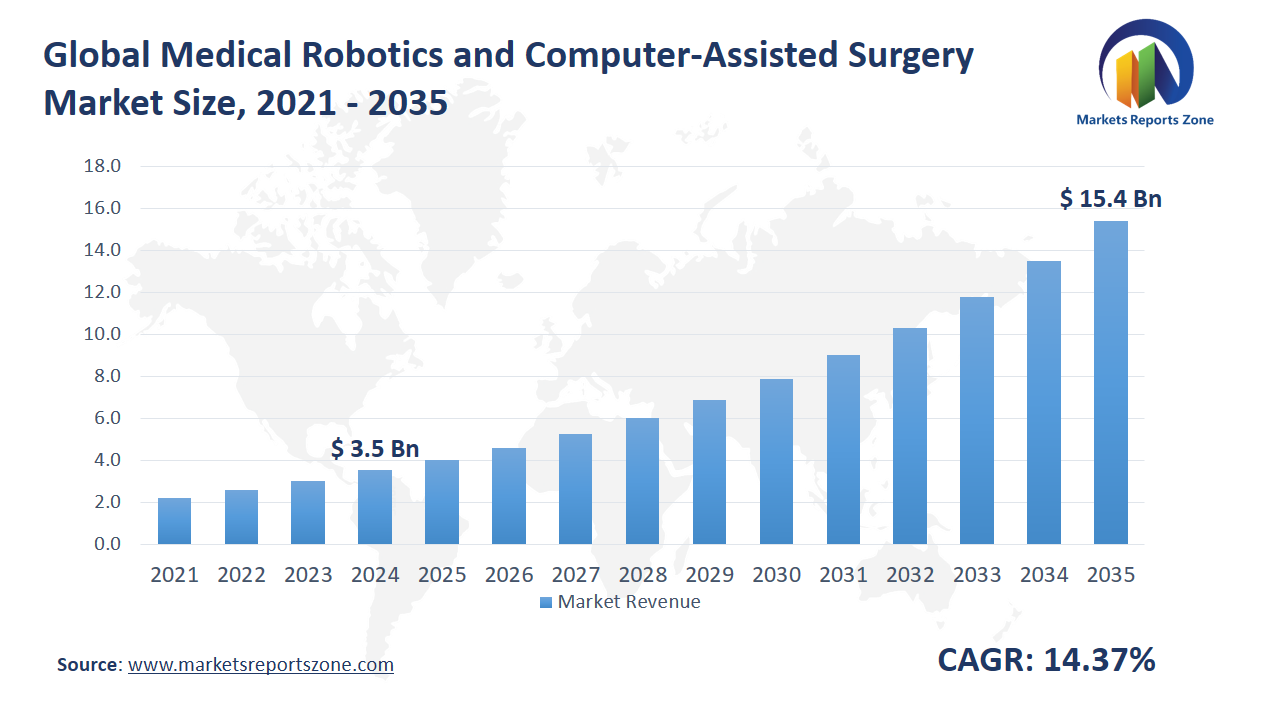
Global Medical Robotics and Computer-Assisted Surgery Market Size is expected to reach USD 15.43 Billion by 2035 from USD 3.52 Billion in 2024, with a CAGR of around 14.37% between 2024 and 2035. The global medical robotics and computer-assisted surgery market is driven by the increasing demand for minimally invasive procedures and technological advancements. As patients seek less traumatic surgery with shorter recovery times, robotic systems like the da Vinci Surgical System have gained popularity for precision and reduced risks. This trend is evident in urological and gynecological surgeries, where robots offer greater accuracy. The integration of artificial intelligence and machine learning also boosts the market, enhancing surgical precision and decision-making. However, the high cost of these advanced systems remains a significant restraint, making adoption challenging for smaller hospitals or clinics. Despite this, two key opportunities exist. First, the growing focus on telemedicine and remote surgeries presents a major opportunity. With robotic surgery, specialists can perform procedures from different locations, reducing travel costs and increasing access to expert care. Second, rising demand for robotic surgery in developing countries creates a potential growth area. In regions like Southeast Asia, where healthcare infrastructure is improving, robotic-assisted surgeries are being introduced in public and private hospitals. As technology becomes more affordable and accessible, the market for medical robotics and computer-assisted surgery continues to expand, offering both challenges and substantial growth prospects.
Driver: Minimally Invasive Surgery Gains Popularity
Minimally invasive surgery (MIS) is one of the key drivers behind the growth of the medical robotics and computer-assisted surgery market. This approach uses smaller incisions, reducing trauma to the body and resulting in quicker recovery times and less postoperative pain for patients. For example, in prostate cancer treatment, robotic-assisted surgery has revolutionized how prostatectomies are performed. Surgeons now use robotic systems to operate through tiny incisions, greatly reducing blood loss and complications compared to traditional open surgeries. This shift has led to fewer hospital stays, with many patients returning home the same day as their surgery. Similarly, in orthopedic surgery, robotic systems are now frequently used in knee and hip replacements. These systems allow for precise placement of implants, improving outcomes and reducing the risk of errors. Another example can be seen in heart surgeries, where robotic assistance has been used for coronary artery bypass grafting (CABG) with minimal disruption to the patient’s body. As patients increasingly demand less invasive options, hospitals have adopted robotic technologies to meet these needs, positioning MIS as a driving force in the medical robotics sector. This trend is expected to continue, with more hospitals incorporating robotic systems to improve surgical outcomes and patient satisfaction.
Key Insights:
The adoption rate of medical robotics in surgical procedures has increased significantly, with robotic-assisted surgeries rising from 0% to 22% in the U.S. between 2012 and 2022.
In 2023, major healthcare companies invested around $1 billion in research and development for advanced medical robotics technologies.
The total number of robotic-assisted surgeries performed globally reached approximately 1.24 million in 2020, reflecting a growing trend towards minimally invasive procedures.
The penetration rate of medical robotics in general surgery applications is estimated to be about 23%, with a projected increase to 87% by 2030.
The average annual growth rate for the adoption of medical robotics has been reported at around 15%, driven by advancements in technology and increasing demand for precision surgeries.
By the end of 2024, the cumulative number of medical facilities equipped with robotic surgery systems worldwide is expected to exceed 5,000.
The use of medical robotics in cardiovascular surgeries accounts for approximately 10% of its total applications, highlighting its expanding role in treating chronic conditions.
Innovations in autonomous surgical robots are expected to increase their market share from 43.8% to 46.9% by 2029, reflecting a shift towards more advanced robotic systems.
Segment Analysis:
The medical robotics market is increasingly dominated by two prominent systems: the DaVinci SI and DaVinci XI, each playing a pivotal role in various surgical applications. The DaVinci SI, with its intuitive design, has been widely adopted for hepatobiliary and pancreatic surgeries. Surgeons use this system for procedures like liver resections, where precision is crucial for minimizing complications. The DaVinci XI, an upgraded version, has seen broader use across urology, gastrointestinal, and thoracic surgeries due to its advanced features and greater flexibility. In urology, robotic-assisted prostatectomies, using the DaVinci XI, offer patients improved outcomes, less pain, and faster recovery compared to traditional open surgery. In gastrointestinal surgery, systems like the DaVinci SI enable delicate operations such as colorectal resections, allowing for enhanced visualization and accuracy. In thoracic surgery, robotic tools are now used for lung resections, reducing incision sizes and ensuring more precise removal of tissue. These technologies are increasingly becoming the gold standard in surgeries where precision and minimally invasive methods are paramount. As the demand for less invasive, high-accuracy surgical procedures grows, the DaVinci systems continue to make significant contributions to the advancement of surgical practices across multiple specialties.
Regional Analysis:
The global medical robotics market is experiencing varying growth dynamics across different regions, shaped by healthcare infrastructure, technological adoption, and patient demands. In North America, advanced healthcare systems and high demand for minimally invasive surgeries have driven the adoption of robotic-assisted surgery, particularly in hospitals across the U.S. In Europe, robotic surgery is gaining traction in countries like Germany and the UK, where hospitals have increasingly adopted the DaVinci systems for procedures like prostatectomies and gallbladder removals. The Asia-Pacific region, with its expanding healthcare access, is seeing a rise in robotic surgeries, particularly in Japan and South Korea, where hospitals have embraced robotic systems for urology and gastrointestinal procedures. Latin America is making gradual progress, with Brazil and Mexico seeing growth in robotic-assisted surgeries, especially in private healthcare facilities where technology is more accessible. In the Middle East & Africa, countries like the UAE and Saudi Arabia are investing heavily in healthcare infrastructure, including robotic surgery systems, aiming to provide high-quality care in their public and private hospitals. As healthcare systems in these regions continue to evolve, the demand for robotic-assisted surgery will continue to rise, driven by the desire for precision, reduced recovery time, and better overall outcomes for patients.
Competitive Scenario:
The medical robotics and computer-assisted surgery market is experiencing significant advancements, propelled by numerous innovative companies. Intuitive Surgical, renowned for its da Vinci Surgical System, continues to lead in robotic-assisted surgeries, enhancing precision and patient outcomes. Simulated Surgical Systems, LLC specializes in simulation-based training, providing platforms that bridge the gap between theoretical knowledge and practical application for surgeons. Mimic Technologies offers robotic simulators, such as the dV-Trainer, enabling surgeons to practice and refine their skills in a virtual environment. Simbionix, a subsidiary of 3D Systems, delivers a comprehensive portfolio of medical simulators, enhancing procedural skills across various specialties. VirtaMed AG combines virtual reality with physical models, offering simulators that provide realistic training experiences for complex procedures. Mazor Robotics, now part of Medtronic, specializes in robotic guidance systems for spine surgery, improving accuracy and patient safety. Verb Surgical, a collaboration between Verily and Johnson & Johnson, is developing a comprehensive surgical platform integrating advanced robotics, visualization, and data analytics to enhance surgical procedures. Auris Surgical Robotics, acquired by Johnson & Johnson, focuses on robotic endoscopic technologies, aiming to improve diagnostics and therapeutic procedures in the lung. Medrobotics offers the Flex® Robotic System, enabling minimally invasive access to hard-to-reach anatomical locations. Restoration Robotics specializes in robotic systems for hair restoration, providing patients with minimally invasive treatment options. Virtual Incision is developing a miniaturized robotic-assisted surgery system, MIRA, designed for general surgery procedures through small incisions. THINK Surgical, Inc. offers the TSolution One Total Knee Application, a robotic system that assists in knee replacement surgeries with high precision. Medtech S.A, acquired by Zimmer Biomet, developed the ROSA® robotic system, assisting in neurosurgical and orthopedic procedures. TransEnterix, now known as Asensus Surgical, offers the Senhance Surgical System, integrating robotics with laparoscopic surgery to enhance precision and control. Titan Medical is developing the SPORT™ Surgical System, a single-port robotic platform aiming to improve minimally invasive surgery. AVRA Medical Robotics focuses on developing robotic systems for minimally invasive surgery, aiming to enhance surgical outcomes and patient recovery. These companies collectively drive innovation in the medical robotics field, striving to improve surgical procedures, enhance patient outcomes, and expand the possibilities of minimally invasive interventions.
Medical Robotics and Computer-Assisted Surgery Market Report Scope
| Report Attribute | Details |
|---|---|
| Market Size Value in 2024 | USD 3.52 Billion |
| Revenue Forecast in 2035 | USD 15.43 Billion |
| Growth Rate | CAGR of 14.37% from 2025 to 2035 |
| Historic Period | 2021 - 2024 |
| Forecasted Period | 2025 - 2035 |
| Report Coverage | Revenue forecast, company ranking, competitive landscape, growth factors, and trends |
| Regions Covered | North America; Europe; Asia Pacific; Latin America; Middle East & Africa |
| Countries Covered | U.S.; Canada; Mexico, UK; Germany; France; Spain; Italy; Russia; China; Japan; India; South Korea; Australia; Southeast Asia; Brazil; Argentina; Saudi Arabia; UAE; South Africa |
| Key companies profiled | Intuitive Surgical; Simulated Surgical Systems, LLC; Mimic Technologies; Simbionix; VirtaMed AG; Mazor Robotics; Verb Surgical; Auris Surgical Robotics; Medrobotics; Restoration Robotics; Virtual Incision; THINK Surgical; Medtech S.A; TransEnterix; Titan Medical; AVRA Medical Robotics |
| Customization | Free report customization (equivalent up to 8 analysts working days) with purchase. Addition or alteration to country, regional & segment scope. |
The Global Medical Robotics and Computer-Assisted Surgery Market report is segmented as follows:
By Type,
- DaVinci SI
- DaVinci XI
By Application,
- Hepatobiliary and pancreatic Surgery
- Urology
- Gastrointestinal Surgery
- Thoracic Surgery
By Region,
- North America
- U.S.
- Canada
- Mexico
- Europe
- UK
- Germany
- France
- Spain
- Italy
- Russia
- Rest of Europe
- Asia Pacific
- China
- Japan
- India
- South Korea
- Australia
- Southeast Asia
- Rest of Asia Pacific
- Latin America
- Brazil
- Argentina
- Rest of Latin America
- Middle East & Africa
- Saudi Arabia
- UAE
- South Africa
- Rest of Middle East and Africa
Key Market Players,
- Intuitive Surgical
- Simulated Surgical Systems, LLC
- Mimic Technologies
- Simbionix
- VirtaMed AG
- Mazor Robotics
- Verb Surgical
- Auris Surgical Robotics
- Medrobotics
- Restoration Robotics
- Virtual Incision
- THINK Surgical
- Medtech S.A
- TransEnterix
- Titan Medical
- AVRA Medical Robotics
Frequently Asked Questions
How big is the Medical Robotics and Computer-Assisted Surgery market?
Global Medical Robotics and Computer-Assisted Surgery Market Size was valued at USD 3.52 Billion in 2024 and is projected to reach at USD 15.43 Billion in 2035.
What is the Medical Robotics and Computer-Assisted Surgery market growth?
Global Medical Robotics and Computer-Assisted Surgery Market is expected to grow at a CAGR of around 14.37% during the forecasted year.
Which region has the largest market share in Medical Robotics and Computer-Assisted Surgery market?
North America, Asia Pacific and Europe are major regions in the global Medical Robotics and Computer-Assisted Surgery Market.
Who are the key players in Medical Robotics and Computer-Assisted Surgery market?
Key players analyzed in the global Medical Robotics and Computer-Assisted Surgery Market are Intuitive Surgical; Simulated Surgical Systems, LLC; Mimic Technologies; Simbionix; VirtaMed AG; Mazor Robotics; Verb Surgical; Auris Surgical Robotics; Medrobotics; Restoration Robotics; Virtual Incision; THINK Surgical; Medtech S.A; TransEnterix; Titan Medical; AVRA Medical Robotics and so on.