Global Real-Time Spectrum Analysis Market - Size and Forecast Analysis, 2021-2035
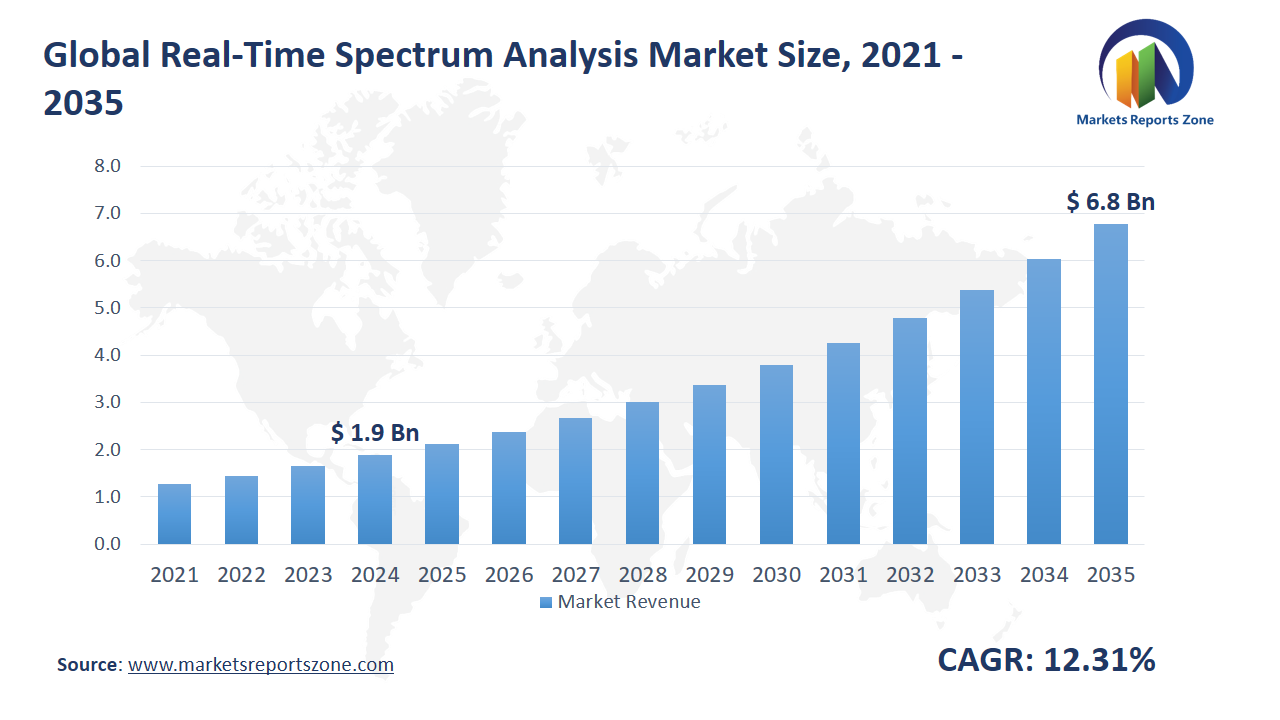
Global Real-Time Spectrum Analysis Market Size is expected to reach USD 6.8 Billion by 2035 from USD 1.89 Billion in 2024, with a CAGR of around 12.31% between 2024 and 2035. The global real-time spectrum analysis market is driven by the rising demand for wireless communication testing and the growing adoption of 5G networks. The need for accurate spectrum monitoring in telecommunications is boosting the use of real-time spectrum analyzers (RTSAs). The expansion of IoT-connected devices is also driving demand, as real-time spectrum analysis is essential for identifying interference and ensuring seamless connectivity. However, high equipment costs act as a major restraint, limiting adoption by smaller companies and research labs. Despite this, significant opportunities exist. The increasing use of real-time spectrum analysis in defense applications is creating growth prospects. Military forces are deploying RTSAs for signal intelligence, radar testing, and electronic warfare, ensuring accurate detection of potential threats. Additionally, the rising demand for automotive radar testing in autonomous vehicles is creating new opportunities. Car manufacturers are using RTSAs to verify radar sensor performance, ensuring accuracy in collision detection and navigation. For instance, in the aerospace industry, RTSAs are being used to monitor and troubleshoot satellite signals, ensuring uninterrupted communication. In broadcasting, spectrum analyzers are helping detect signal distortions in live transmissions, enhancing quality. As wireless technologies continue to evolve, the demand for real-time spectrum analysis is expected to rise across industries.
Driver: 5G Expansion Driving Spectrum Analysis Demand
The rapid expansion of 5G networks is significantly boosting the demand for real-time spectrum analysis. As telecom providers race to deploy 5G infrastructure, the need for precise spectrum monitoring and interference detection is growing. Real-time spectrum analyzers (RTSAs) are essential for testing signal integrity, ensuring consistent coverage, and identifying spectrum anomalies. During 5G deployment, RTSAs are used to measure frequency bands, verify signal quality, and detect signal drift, helping telecom companies optimize performance. In urban areas, where network congestion is common, RTSAs assist in identifying and eliminating interference, improving data speeds and reliability. For example, in smart cities, spectrum analyzers are being used to monitor the performance of 5G-enabled IoT devices, such as connected traffic systems and smart utilities. In the manufacturing sector, RTSAs are deployed to test 5G-based industrial automation systems, ensuring stable wireless communication for robotics and remote monitoring. As more industries adopt 5G-powered applications, the need for real-time spectrum analysis continues to rise. With ongoing 5G network expansion, spectrum analyzers are becoming vital for maintaining signal accuracy, ensuring low latency, and enhancing overall network efficiency across various industries.
Key Insights:
- The adoption rate of Real-Time Spectrum Analysis (RTSA) technology in telecommunications is approximately 60%.
- In 2024, the U.S. Department of Defense invested USD 250 million in advanced spectrum management technologies, including RTSA.
- The total number of RTSA units sold globally in 2023 was estimated to be around 400,000 units.
- The penetration rate of RTSA in the aerospace and defense sector is about 45%.
- In 2023, a consortium of European telecommunications companies announced an investment of USD 100 million to enhance spectrum analysis capabilities across their networks.
- The average annual growth rate for RTSA applications in the automotive industry is projected to be around 8% over the next five years.
- The demand for RTSA solutions in the healthcare sector has increased significantly, with an estimated growth rate of 12% annually due to advancements in medical imaging technologies.
- Government initiatives aimed at improving wireless communication infrastructure are expected to drive a further increase in RTSA adoption by 30% by 2030.
Segment Analysis:
The global real-time spectrum analysis market is segmented by type and application, catering to diverse industry needs. Handheld analyzers are gaining popularity due to their portability and ease of use. These devices are widely used in field testing by telecom engineers to detect signal interference during 5G tower installations. Portable analyzers, offering a balance between mobility and performance, are commonly used in industrial settings. For example, in power plants, portable spectrum analyzers help detect electromagnetic interference in electrical grids, ensuring stable operations. Benchtop analyzers, known for their high accuracy and advanced capabilities, are widely used in research labs and semiconductor testing. In automotive applications, RTSAs are used to test radar sensors in autonomous vehicles, ensuring accurate object detection and collision avoidance. In the IT & telecommunication sector, spectrum analyzers are deployed to monitor network signals, detect unauthorized transmissions, and optimize bandwidth usage. Industrial applications benefit from real-time spectrum analysis by identifying signal distortions in wireless monitoring systems, enhancing production efficiency. In the energy and power sector, analyzers are used to monitor electromagnetic emissions from power lines, preventing potential disruptions. In semiconductor and electronics testing, RTSAs ensure proper signal performance in wireless chips and IoT devices, guaranteeing reliability and precision.
Regional Analysis:
The global real-time spectrum analysis market is expanding across all regions, driven by rising demand for wireless testing and signal monitoring. North America is witnessing strong growth due to the increasing adoption of real-time spectrum analyzers (RTSAs) in defense applications. In the U.S., RTSAs are used by military agencies for real-time surveillance and electronic warfare testing, ensuring accurate threat detection. Europe is experiencing rising demand in the automotive sector, where spectrum analyzers are used to test vehicle-to-vehicle communication systems, ensuring reliable connectivity in autonomous driving projects. The Asia-Pacific region is seeing rapid expansion due to the rollout of 5G networks. In China, RTSAs are being deployed to monitor 5G base station signals, ensuring consistent coverage and performance. Latin America is increasingly adopting spectrum analyzers in broadcasting. For example, TV and radio stations in Brazil use RTSAs to detect and prevent signal interference, ensuring clear and stable transmissions. In the Middle East and Africa, growing investment in renewable energy is driving demand. In solar farms, RTSAs are used to monitor and troubleshoot wireless communication between inverters and control systems, ensuring efficient energy management. As industries adopt advanced wireless technologies, the demand for real-time spectrum analysis continues to grow globally.
Competitive Scenario:
Leading companies in the global real-time spectrum analysis market are driving growth through technological innovation, product launches, and strategic collaborations. Aaronia is enhancing its portfolio by introducing compact and high-performance handheld spectrum analyzers, catering to field engineers requiring portable testing solutions. Agilent is expanding its range of RTSAs with advanced signal processing capabilities, enabling more accurate detection of low-level signals in crowded frequency bands. Anritsu Corporation is focusing on real-time monitoring solutions for 5G networks, helping telecom operators optimize signal quality and coverage. Keysight Technologies is developing multi-channel spectrum analyzers with enhanced bandwidth capacity, allowing faster and more precise signal analysis. Micronix Corporation is launching lightweight spectrum analyzers designed for easy field deployment, targeting industrial and telecom applications. Rohde & Schwarz GmbH & Co. is investing in next-generation analyzers with real-time interference detection, improving efficiency in satellite communication testing. Stanford Research Systems is introducing cost-effective analyzers with high sensitivity, making them accessible for small and mid-sized businesses. Tektronix is expanding its cloud-integrated RTSAs, enabling remote spectrum monitoring and data analysis. Test Equipment Plus and ThinkRF are offering scalable, software-defined spectrum analyzers, providing flexible solutions for dynamic testing environments. These developments are boosting market competitiveness and driving the adoption of real-time spectrum analysis across industries.
Real-Time Spectrum Analysis Market Report Scope
| Report Attribute | Details |
|---|---|
| Market Size Value in 2024 | USD 1.89 Billion |
| Revenue Forecast in 2035 | USD 6.8 Billion |
| Growth Rate | CAGR of 12.31% from 2025 to 2035 |
| Historic Period | 2021 - 2024 |
| Forecasted Period | 2025 - 2035 |
| Report Coverage | Revenue forecast, company ranking, competitive landscape, growth factors, and trends |
| Regions Covered | North America; Europe; Asia Pacific; Latin America; Middle East & Africa |
| Countries Covered | U.S.; Canada; Mexico, UK; Germany; France; Spain; Italy; Russia; China; Japan; India; South Korea; Australia; Southeast Asia; Brazil; Argentina; Saudi Arabia; UAE; South Africa |
| Key companies profiled | Aaronia; Agilent; Anritsu Corporation; Keysight Technologies; Micronix Corporation; Rohde & Schwarz GmbH & Co.; Standford Research Systems; Tektronix; Test Equipment Plus; ThinkRF |
| Customization | Free report customization (equivalent up to 8 analysts working days) with purchase. Addition or alteration to country, regional & segment scope. |
The Global Real-Time Spectrum Analysis Market report is segmented as follows:
By Type,
- Handheld Analyzer
- Portable Analyzer
- Benchtop Analyzer
By Application,
- Automotive
- IT & Telecommunication
- Industrial
- Energy & Power
- Semiconductor & Electronics
By Region,
- North America
- U.S.
- Canada
- Mexico
- Europe
- UK
- Germany
- France
- Spain
- Italy
- Russia
- Rest of Europe
- Asia Pacific
- China
- Japan
- India
- South Korea
- Australia
- Southeast Asia
- Rest of Asia Pacific
- Latin America
- Brazil
- Argentina
- Rest of Latin America
- Middle East & Africa
- Saudi Arabia
- UAE
- South Africa
- Rest of Middle East and Africa
Key Market Players,
- Aaronia
- Agilent
- Anritsu Corporation
- Keysight Technologies
- Micronix Corporation
- Rohde & Schwarz GmbH & Co.
- Standford Research Systems
- Tektronix
- Test Equipment Plus
- ThinkRF
Frequently Asked Questions
How big is the Real-Time Spectrum Analysis Market market?
Global Real-Time Spectrum Analysis Market Size was valued at USD 1.89 Billion in 2024 and is projected to reach at USD 6.8 Billion in 2035.
What is the Real-Time Spectrum Analysis Market market growth?
Global Real-Time Spectrum Analysis Market is expected to grow at a CAGR of around 12.31% during the forecasted year.
Which region has the largest market share in Real-Time Spectrum Analysis Market market?
North America, Asia Pacific and Europe are major regions in the global Real-Time Spectrum Analysis Market.
Who are the key players in Real-Time Spectrum Analysis Market market?
Key players analyzed in the global Real-Time Spectrum Analysis Market are Aaronia; Agilent; Anritsu Corporation; Keysight Technologies; Micronix Corporation; Rohde & Schwarz GmbH & Co.; Standford Research Systems; Tektronix; Test Equipment Plus; ThinkRF and so on.