
Global Shunt Capacitor Market - Size and Forecast Analysis, 2021-2035
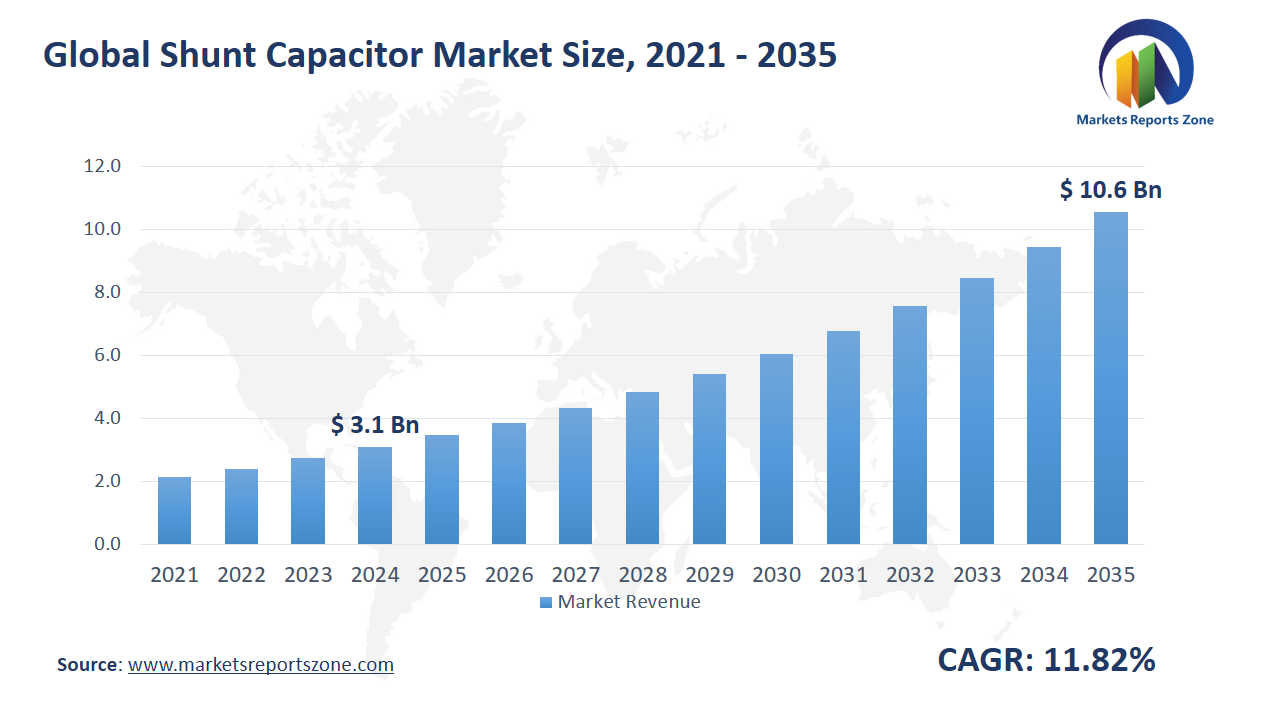
Global Shunt Capacitor Market Size is expected to reach USD 10.58 Billion by 2035 from USD 3.09 Billion in 2024, with a CAGR of around 11.82% between 2024 and 2035. Rising electricity demand has been driven by rapid industrialization and urbanization. Grid stability needs have been increased due to the growing number of renewable energy installations. To improve power factor and voltage control, shunt capacitors have been widely installed across power transmission networks. In countries like Vietnam and Morocco, power grids have been upgraded using shunt capacitors to handle load fluctuations. In remote mining and oil extraction zones, these devices have been deployed to reduce transmission losses. However, high initial investment has been faced as a key restraint, especially for small utilities and developing regions. In many African and Southeast Asian nations, budget constraints have delayed large-scale capacitor installations. Despite this, integration with smart grid technologies has been seen as a major opportunity. Real-time monitoring and automated control features have been added to enhance performance. Another opportunity has been created through the adoption of modular capacitor banks. These systems have been preferred in growing urban centers like Lagos and Bogotá due to space-saving design and easy maintenance. As energy systems become more complex, the importance of efficient reactive power management has been recognized. With more governments promoting energy efficiency, the market for shunt capacitors is being steadily transformed.
Driver: Urban Growth Demands Power Stability
Rapid industrialization and urbanization have been the key drivers for the rising adoption of shunt capacitors. As cities expand and industries grow, the pressure on electrical infrastructure has significantly increased. Shunt capacitors are being installed to maintain voltage levels and improve power factor, especially in fast-growing urban regions. In cities like Dhaka and Karachi, overloaded distribution networks have struggled to meet rising electricity demand, often leading to voltage drops and energy losses. To tackle this, utilities have deployed shunt capacitors in substations to stabilize voltage and reduce the burden on transformers. In industrial hubs like Ho Chi Minh City and Jalisco, manufacturing zones have required stable, high-quality power to keep production lines efficient. Shunt capacitors have been used there to reduce reactive power demand and ensure smoother operations. Without them, frequent equipment shutdowns and power quality issues were being faced. In newly developed urban residential areas like Addis Ababa’s Bole district, consistent power supply has been ensured by strategically placing capacitor banks along distribution feeders. With more homes, offices, and factories getting connected every day, the need for voltage support has grown rapidly. To support such expansion, shunt capacitors are being quietly installed, keeping the backbone of modern cities strong.
Key Insights:
- The Indian government has allocated approximately USD 109 billion by 2032 for renewable energy transmission infrastructure, including the integration of capacitor banks.
- ABB reported a significant increase in demand for its high-voltage shunt capacitors, with over 50,000 units sold globally in 2024.
- Schneider Electric's latest shunt capacitor series saw adoption in over 30% of new industrial installations in 2023.
- Asia-Pacific accounts for nearly 40% of global shunt capacitor consumption, driven by rapid urbanization and industrialization.
- The integration of renewable energy sources like solar and wind into power grids has increased the penetration rate of shunt capacitors to over 60% in utility-scale applications.
- Investments in grid modernization projects worldwide exceeded USD 50 billion in 2024, with a significant portion directed toward reactive power compensation solutions like shunt capacitors.
- The electrification of transport systems has boosted the use of shunt capacitors in high-voltage applications, with a reported annual growth rate of over 10% in this segment.
- In India alone, the Central Electricity Authority highlighted a rise in per capita electricity consumption to over 1,200 kWh in 2024, necessitating enhanced grid stability measures supported by shunt capacitors.
Segment Analysis:
The global shunt capacitor market has been segmented by type and application, each playing a distinct role in modern power systems. Low voltage shunt capacitors have been commonly used in commercial buildings and small-scale industries to improve power factor and reduce electricity bills. In cities like Nairobi and Kathmandu, local manufacturing units and office complexes have adopted low voltage capacitors for energy efficiency. Medium voltage capacitors have been deployed in regional substations and mid-sized industrial setups. For example, textile factories in Tiruppur and food processing units in Cebu have used medium voltage units to stabilize internal power distribution. High voltage capacitors have found critical use in long-distance transmission lines and grid infrastructure. In power-intensive regions like Alberta and Riyadh, these capacitors have supported grid reliability and reduced transmission losses. By application, utilities remain the largest users of shunt capacitors, especially in expanding suburban and rural networks. In areas like interior Peru and Eastern Turkey, capacitor installations have helped utilities extend stable power to underserved zones. Meanwhile, industries have been major adopters to maintain equipment performance and reduce downtime. In chemical plants of Surabaya and steel mills in Mersin, capacitor banks have been integrated into systems to ensure uninterrupted operations and enhance energy quality.
Regional Analysis:
The global shunt capacitor market has shown varied growth across key regions—North America, Europe, Asia-Pacific, Latin America, and the Middle East & Africa—driven by different energy needs and infrastructure priorities. In North America, aging electrical grids have pushed utilities to modernize with high voltage capacitor banks. In places like Quebec and Arizona, capacitor upgrades have improved voltage control in wide transmission networks. Europe has focused on energy efficiency and grid stabilization, especially with increasing renewable integration. Countries like Denmark and Poland have used capacitors to balance power flow from wind and solar farms. Asia-Pacific has witnessed the fastest adoption, with growing urban populations and industrialization. In regions like central Thailand and western Indonesia, shunt capacitors have supported expanding industrial parks and commercial centers. Latin America has used these systems to boost reliability in remote and underdeveloped areas. In rural Bolivia and parts of Paraguay, small utilities have added capacitor banks to reduce outages and improve voltage quality. In the Middle East & Africa, rising demand in mining and oil-based economies has driven installations. Capacitors have been used in industrial zones of Oman and urban developments in Ghana to maintain power quality. Across all regions, the role of shunt capacitors has steadily expanded to support evolving power demands.
Competitive Scenario:
The global shunt capacitor market has seen significant activity among key players focusing on innovation and strategic growth. ABB Ltd. has been investing in smart grid technologies, integrating shunt capacitors with advanced monitoring systems to enhance grid stability and efficiency. Schneider Electric has expanded its portfolio by acquiring ETAP, a leader in electrical power systems software, aiming to bolster its offerings in power management solutions. General Electric Company has opened a new advanced manufacturing facility in Florida, dedicated to producing capacitors and instrument transformers for the global market. Siemens AG has incorporated IoT-enabled shunt capacitors for real-time monitoring and predictive maintenance, improving operational efficiency. Larsen & Toubro Ltd has been focusing on infrastructure projects, integrating shunt capacitors to ensure power quality in large-scale developments. Eaton Corporation Plc offers a diverse range of capacitors, emphasizing energy efficiency and reliability. Aerovox Corp. has developed durable power factor correction capacitors for 50 Hz applications, targeting industrial settings. Magnewin Energy Private Limited and Energe Capacitors Pvt Ltd, both based in India, have been catering to the growing domestic demand for capacitors in utilities and industries. CIRCUTOR, SA from Spain specializes in power quality solutions, offering capacitors that optimize power factor correction in various applications. These companies collectively contribute to the dynamic landscape of the shunt capacitor market through technological advancements and strategic initiatives.
Shunt Capacitor Market Report Scope
| Report Attribute | Details |
|---|---|
| Market Size Value in 2024 | USD 3.09 Billion |
| Revenue Forecast in 2035 | USD 10.58 Billion |
| Growth Rate | CAGR of 11.82% from 2025 to 2035 |
| Historic Period | 2021 - 2024 |
| Forecasted Period | 2025 - 2035 |
| Report Coverage | Revenue forecast, company ranking, competitive landscape, growth factors, and trends |
| Regions Covered | North America; Europe; Asia Pacific; Latin America; Middle East & Africa |
| Countries Covered | U.S.; Canada; Mexico, UK; Germany; France; Spain; Italy; Russia; China; Japan; India; South Korea; Australia; Southeast Asia; Brazil; Argentina; Saudi Arabia; UAE; South Africa |
| Key companies profiled | ABB Ltd. (U.S.); Schneider Electric (France); General Electric Company (U.S.); Siemens AG (Germany); Larsen & Toubro Ltd (India); Eaton Corporation Plc (Ireland); Aerovox Corp. (U.S.); Magnewin Energy Private Limited (India); CIRCUTOR, SA (Spain); Energe Capacitors Pvt Ltd (India) |
| Customization | Free report customization (equivalent up to 8 analysts working days) with purchase. Addition or alteration to country, regional & segment scope. |
The Global Shunt Capacitor Market report is segmented as follows:
By Type,
- Low Voltage
- Medium Voltage
- High Voltage
By Application,
- Utilities
- Industries
By Region,
- North America
- U.S.
- Canada
- Mexico
- Europe
- UK
- Germany
- France
- Spain
- Italy
- Russia
- Rest of Europe
- Asia Pacific
- China
- Japan
- India
- South Korea
- Australia
- Southeast Asia
- Rest of Asia Pacific
- Latin America
- Brazil
- Argentina
- Rest of Latin America
- Middle East & Africa
- Saudi Arabia
- UAE
- South Africa
- Rest of Middle East and Africa
Key Market Players,
- ABB Ltd. (U.S.)
- Schneider Electric (France)
- General Electric Company (U.S.)
- Siemens AG (Germany)
- Larsen & Toubro Ltd (India)
- Eaton Corporation Plc (Ireland)
- Aerovox Corp. (U.S.)
- Magnewin Energy Private Limited (India)
- CIRCUTOR, SA (Spain)
- Energe Capacitors Pvt Ltd (India)
Frequently Asked Questions
How big is the Shunt Capacitor Market market?
Global Shunt Capacitor Market Size was valued at USD 3.09 Billion in 2024 and is projected to reach at USD 10.58 Billion in 2035.
What is the Shunt Capacitor Market market growth?
Global Shunt Capacitor Market is expected to grow at a CAGR of around 11.82% during the forecasted year.
Which region has the largest market share in Shunt Capacitor Market market?
North America, Asia Pacific and Europe are major regions in the global Shunt Capacitor Market.
Who are the key players in Shunt Capacitor Market market?
Key players analyzed in the global Shunt Capacitor Market are ABB Ltd. (U.S.); Schneider Electric (France); General Electric Company (U.S.); Siemens AG (Germany); Larsen & Toubro Ltd (India); Eaton Corporation Plc (Ireland); Aerovox Corp. (U.S.); Magnewin Energy Private Limited (India); CIRCUTOR, SA (Spain); Energe Capacitors Pvt Ltd (India) and so on.