
Global Vertical Roller Mill Market - Size and Forecast Analysis, 2021-2035
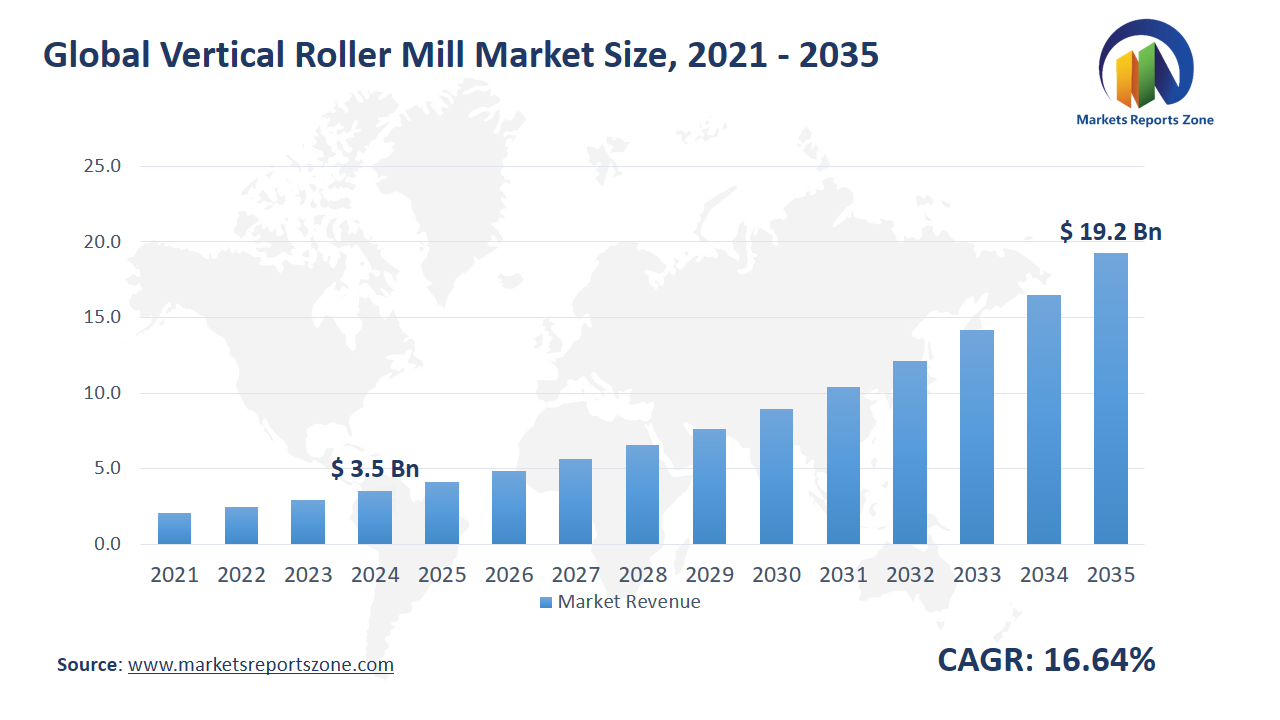
Global Vertical Roller Mill Market Size is expected to reach USD 19.28 Billion by 2035 from USD 3.54 Billion in 2024, with a CAGR of around 16.64% between 2024 and 2035. The global vertical roller mill market is driven by rising demand for energy-efficient grinding solutions and the growing adoption of sustainable cement manufacturing. Industries are shifting towards vertical roller mills to reduce energy consumption and operational costs. Cement manufacturers are replacing traditional ball mills with vertical roller mills to enhance efficiency and lower carbon emissions. However, the high initial investment cost remains a major restraint. Many small manufacturers hesitate to adopt this technology due to budget constraints. Despite this, significant opportunities exist in the expansion of infrastructure projects and the increasing demand for processed minerals. Rapid urbanization is driving the construction industry, boosting the need for efficient cement grinding solutions. Additionally, the mining sector is adopting vertical roller mills for ore processing, improving productivity and reducing waste. Real-life applications can be seen in companies like Lafarge, which uses vertical roller mills for sustainable cement production. In the steel industry, ArcelorMittal has implemented this technology to refine raw materials efficiently. Mining companies are also integrating vertical roller mills to improve ore grinding processes. As industries prioritize efficiency and sustainability, the adoption of vertical roller mills continues to grow, driving advancements in energy-saving and high-performance grinding solutions.
Driver: Energy Efficiency Drives Market Growth
The demand for energy-efficient grinding solutions is a key driver for the vertical roller mill market. Traditional ball mills consume excessive power, leading industries to seek alternative technologies that lower energy usage. Vertical roller mills operate with reduced power consumption, making them an ideal choice for cement, mining, and steel industries. These mills use advanced grinding mechanisms that require less energy while delivering higher output. Cement manufacturers are adopting vertical roller mills to cut production costs and meet environmental regulations. Large cement plants, such as those operated by HeidelbergCement, have integrated this technology to enhance efficiency while reducing carbon footprints. In the mining sector, Rio Tinto has implemented vertical roller mills for ore processing, improving material grinding without excessive energy consumption. The steel industry is also embracing this solution, with Tata Steel utilizing these mills to refine raw materials efficiently. Beyond industrial applications, vertical roller mills are contributing to global sustainability efforts by minimizing energy waste and reducing emissions. As industries focus on energy conservation and cost reduction, the adoption of vertical roller mills is expected to rise. This shift toward efficiency is shaping the future of grinding technology, driving innovation and operational improvements across multiple sectors.
Key Insights:
- The adoption rate of vertical roller mills in the cement industry is approximately 60%.
- Government investments in advanced milling technologies, including vertical roller mills, reached around $150 million in 2023.
- An estimated 400,000 units of vertical roller mills were sold globally in 2023.
- The penetration rate of vertical roller mills in the mining sector is about 30%.
- In 2023, the use of vertical roller mills in the power generation industry increased by approximately 15% compared to the previous year.
- The average operational lifespan of a vertical roller mill is estimated to be around 20 years, influencing replacement cycles.
- Training programs for operators and maintenance personnel on vertical roller mills have seen a growth of about 25% over the past two years.
- The construction industry accounts for approximately 35% of the total market share for vertical roller mills as of 2023.
Segment Analysis:
The vertical roller mill market is segmented by type into spring-type and hydraulic-type mills, each serving different industrial needs. Spring-type mills are widely used in small-scale operations due to their cost-effectiveness and simple design. These mills are preferred in manufacturing industries where moderate grinding efficiency is required. Small metal fabrication plants use spring-type mills to refine raw materials for production. On the other hand, hydraulic-type mills offer higher efficiency and advanced control, making them ideal for large-scale operations. These mills are commonly used in the mining sector, where high-pressure grinding is needed to process ores. Companies like BHP use hydraulic vertical roller mills to improve mineral extraction while reducing energy consumption. In foundries, vertical roller mills help in processing scrap metals and refining alloys for industrial use. Automotive foundries use these mills to create high-precision metal components. The cement industry remains one of the largest adopters, using hydraulic vertical roller mills for fine grinding of raw materials. Companies like UltraTech Cement rely on this technology to enhance production efficiency and meet sustainability goals. As industries seek better grinding solutions, demand for both spring-type and hydraulic vertical roller mills continues to rise, driving innovation and efficiency across multiple applications.
Regional Analysis:
The vertical roller mill market is expanding across five key regions: North America, Europe, Asia-Pacific, Latin America, and the Middle East & Africa. In North America, the adoption of advanced grinding technology is rising due to the push for energy-efficient manufacturing. Companies like Caterpillar are using vertical roller mills in heavy equipment production to enhance material processing. Europe is driven by strict environmental regulations, leading cement manufacturers like Holcim to implement these mills for sustainable production. Asia-Pacific dominates the market with rapid industrialization and infrastructure growth. In China, Sinoma has integrated vertical roller mills into large-scale cement plants to increase output and reduce emissions. Latin America is witnessing rising demand from the mining sector, with companies like Vale using these mills for efficient ore processing. The Middle East & Africa are focusing on infrastructure expansion, boosting demand in construction and cement industries. Major cement producers in Saudi Arabia have adopted vertical roller mills to improve grinding efficiency and support large-scale projects. As industries across all regions seek cost-effective and sustainable grinding solutions, the adoption of vertical roller mills continues to grow, shaping the future of cement, mining, and manufacturing industries worldwide.
Competitive Scenario:
The vertical roller mill market is driven by leading companies such as Gebr. Pfeiffer SE, Loesche, FLSmidth, and ThyssenKrupp Technologies, all focusing on technological advancements and efficiency improvements. Gebr. Pfeiffer SE has introduced next-generation mills with automated process control, enhancing productivity in cement and mining industries. Loesche is advancing energy-efficient grinding solutions, helping cement manufacturers reduce carbon emissions while increasing production capacity. FLSmidth is innovating with high-capacity mills designed to optimize raw material processing and lower operational costs. ThyssenKrupp Technologies is integrating smart monitoring systems in its mills to improve performance and predictive maintenance. Ube Machinery Corporation has expanded its product line to cater to heavy-duty mining applications, ensuring better material handling. Ecutec and GTY Machine are developing compact vertical roller mills suitable for mid-sized manufacturing industries. VAUTID specializes in wear-resistant components, extending the lifespan of vertical roller mills in harsh industrial environments. Strommashina and SHANGHAI ZENITH are focusing on modular designs for easier installation and maintenance. Hefei Zhongya Building Material Equipment is driving innovation in high-efficiency cement grinding technology. Recent developments include AI-driven optimization, advanced wear-resistant coatings, and hybrid drive systems, ensuring improved sustainability and performance in various industrial applications.
Vertical Roller Mill Market Report Scope
| Report Attribute | Details |
|---|---|
| Market Size Value in 2024 | USD 3.54 Billion |
| Revenue Forecast in 2035 | USD 19.28 Billion |
| Growth Rate | CAGR of 16.64% from 2025 to 2035 |
| Historic Period | 2021 - 2024 |
| Forecasted Period | 2025 - 2035 |
| Report Coverage | Revenue forecast, company ranking, competitive landscape, growth factors, and trends |
| Regions Covered | North America; Europe; Asia Pacific; Latin America; Middle East & Africa |
| Countries Covered | U.S.; Canada; Mexico, UK; Germany; France; Spain; Italy; Russia; China; Japan; India; South Korea; Australia; Southeast Asia; Brazil; Argentina; Saudi Arabia; UAE; South Africa |
| Key companies profiled | Gebr. Pfeiffer SE; Loesche; FLSmidth; ThyssenKrupp Technologies (Polysius); Ube Machinery Corporation; Ecutec; GTY Machine; VAUTID; Strommashina; SHANGHAI ZENITH; Hefei Zhongya Building Material Equipment |
| Customization | Free report customization (equivalent up to 8 analysts working days) with purchase. Addition or alteration to country, regional & segment scope. |
The Global Vertical Roller Mill Market report is segmented as follows:
By Type,
- Spring Type
- Hydraulic Type
By Application,
- Manufacturing Industry
- Mining
- Foundries
- Cements
By Region,
- North America
- U.S.
- Canada
- Mexico
- Europe
- UK
- Germany
- France
- Spain
- Italy
- Russia
- Rest of Europe
- Asia Pacific
- China
- Japan
- India
- South Korea
- Australia
- Southeast Asia
- Rest of Asia Pacific
- Latin America
- Brazil
- Argentina
- Rest of Latin America
- Middle East & Africa
- Saudi Arabia
- UAE
- South Africa
- Rest of Middle East and Africa
Key Market Players,
Frequently Asked Questions
How big is the Vertical Roller Mill market?
Global Vertical Roller Mill Market Size was valued at USD 3.54 Billion in 2024 and is projected to reach at USD 19.28 Billion in 2035.
What is the Vertical Roller Mill market growth?
Global Vertical Roller Mill Market is expected to grow at a CAGR of around 16.64% during the forecasted year.
Which region has the largest market share in Vertical Roller Mill market?
North America, Asia Pacific and Europe are major regions in the global Vertical Roller Mill Market.
Who are the key players in Vertical Roller Mill market?
Key players analyzed in the global Vertical Roller Mill Market are Gebr. Pfeiffer SE; Loesche; FLSmidth; ThyssenKrupp Technologies (Polysius); Ube Machinery Corporation; Ecutec; GTY Machine; VAUTID; Strommashina; SHANGHAI ZENITH; Hefei Zhongya Building Material Equipment and so on.