
Global Variable Speed Drive Market - Size and Forecast Analysis, 2021-2035
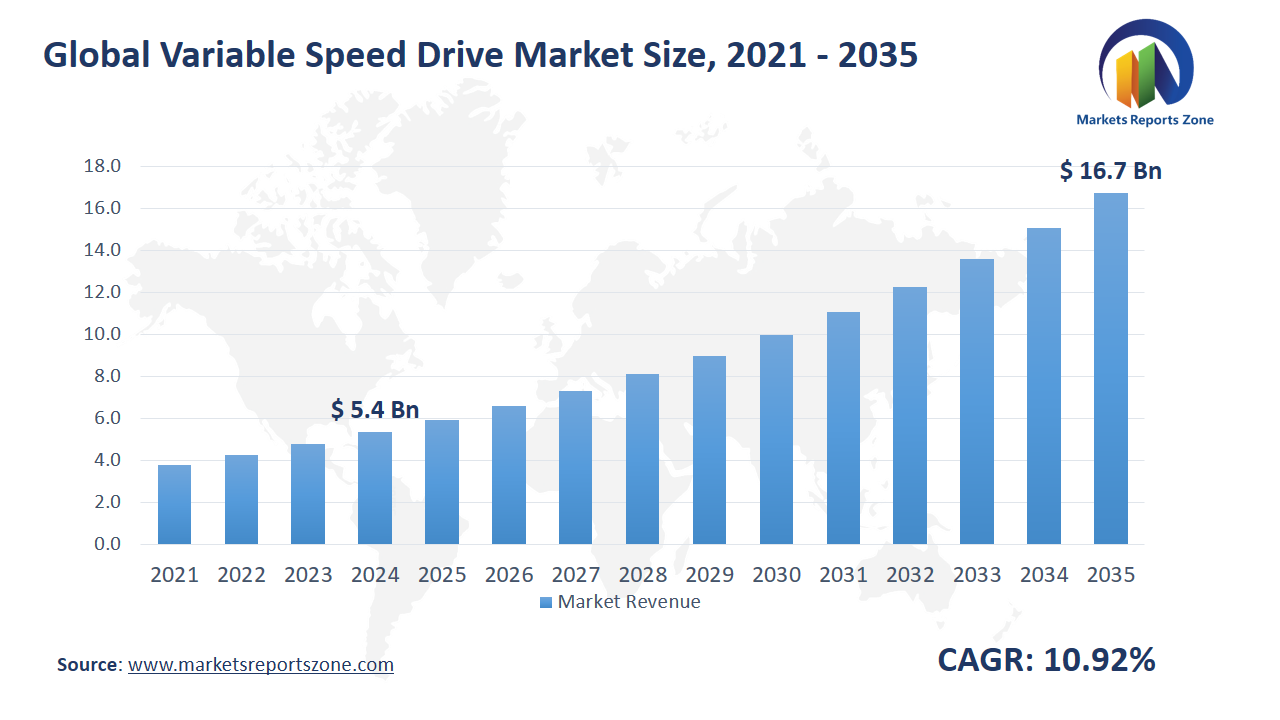
Global Variable Speed Drive Market Size is expected to reach USD 16.74 Billion by 2035 from USD 5.35 Billion in 2024, with a CAGR of around 10.92% between 2024 and 2035. The global variable speed drive market is driven by the growing demand for energy efficiency and the increasing adoption of industrial automation. Industries are focusing on reducing energy consumption, leading to the widespread use of variable speed drives in manufacturing and HVAC systems. Automation in industries is also increasing, boosting the need for precise motor control, where these drives play a crucial role. However, the high initial cost of installation acts as a major restraint. Many small businesses hesitate to invest due to budget limitations. Despite this, significant opportunities exist in the renewable energy sector and the rising adoption of smart grids. Wind and solar power plants use variable speed drives to optimize energy conversion and enhance grid stability. Utility providers are integrating smart grids with advanced motor control solutions to improve power efficiency. Real-life applications include Siemens using variable speed drives in energy-efficient building solutions. ABB has implemented them in industrial robots for improved performance. Metro systems in cities like London and New York rely on these drives for smooth train operations. As industries move toward sustainability and automation, the adoption of variable speed drives continues to rise, shaping the future of efficient energy management worldwide.
Driver: Energy Efficiency Demand Fuels Growth
The rising demand for energy efficiency is a major driver in the variable speed drive market. Industries are under pressure to reduce energy consumption and lower operational costs, making energy-efficient solutions a top priority. Traditional motors run at a constant speed, consuming excess power even when full capacity is not needed. Variable speed drives adjust motor speeds based on real-time requirements, significantly cutting energy waste. This technology is widely adopted in HVAC systems, manufacturing plants, and water treatment facilities to optimize performance and reduce electricity bills. Large-scale industries such as petrochemicals and steel manufacturing use these drives to enhance efficiency in heavy machinery. For instance, Coca-Cola has integrated variable speed drives into its bottling plants to improve energy usage and maintain production efficiency. Similarly, major airport facilities worldwide use these drives in ventilation and baggage handling systems to lower power consumption. The agriculture sector also benefits, with irrigation pumps using variable speed drives to regulate water flow efficiently. As energy costs rise and sustainability goals tighten, businesses across various industries are prioritizing these advanced motor control solutions. The shift toward smarter, energy-saving technologies is making variable speed drives essential in modern industrial and commercial operations.
Key Insights:
- The adoption rate of variable speed drives (VSDs) in the manufacturing sector is approximately 70%.
- Government investments in energy-efficient drive technologies, including VSDs, reached around $250 million in 2023.
- An estimated 1 million units of variable speed drives were sold globally in 2023.
- The penetration rate of VSDs in the HVAC industry is estimated to be about 45%.
- In 2023, the use of variable speed drives in the oil and gas sector increased by approximately 20% compared to the previous year.
- The average operational lifespan of a variable speed drive is estimated to be around 15 years, influencing replacement cycles.
- Training programs for technicians on variable speed drive systems have increased by approximately 30% over the past two years.
- The agriculture sector accounts for about 25% of the total market share for variable speed drives as of 2023.
Segment Analysis:
The variable speed drive market is segmented into AC drives, DC drives, and servo drives, each catering to specific industrial needs. AC drives are widely used in HVAC systems, water treatment plants, and industrial automation for efficient motor control. These drives adjust motor speed based on demand, reducing energy consumption and operational costs. Companies like Schneider Electric have integrated AC drives into commercial buildings to optimize cooling and ventilation. DC drives, on the other hand, are preferred in applications requiring precise speed control, such as electric vehicles and heavy machinery. Tesla and other EV manufacturers use DC drives to enhance motor efficiency and extend battery life. Servo drives are essential in robotics, CNC machines, and high-precision manufacturing processes. These drives provide rapid response and accurate positioning, making them crucial in industries like aerospace and automotive production. BMW has implemented servo drives in its automated assembly lines to ensure precision in car manufacturing. In the packaging industry, high-speed conveyor systems rely on servo drives for smooth and efficient operations. As industries move toward automation and energy efficiency, demand for all three drive types continues to grow. Businesses are investing in advanced drive technologies to enhance performance, reduce costs, and support sustainable operations.
Regional Analysis:
The variable speed drive market is expanding across five key regions: North America, Europe, Asia-Pacific, Latin America, and the Middle East & Africa. North America is leading due to the rapid adoption of energy-efficient solutions and smart manufacturing. Companies like General Electric are integrating variable speed drives into industrial automation to optimize production efficiency. In Europe, strict energy regulations and sustainability goals are driving demand. Siemens has implemented these drives in wind power projects to enhance energy conversion and grid stability. Asia-Pacific dominates the market with rapid industrialization and infrastructure development. Countries like China and India are investing in advanced motor control solutions for smart cities, with companies like Mitsubishi Electric equipping metro systems with variable speed drives for smoother train operations. Latin America is seeing increased adoption in mining and oil industries, where energy efficiency is critical. Petrobras has incorporated these drives into offshore drilling equipment to improve operational control. The Middle East & Africa are experiencing rising demand due to infrastructure growth and extreme climate conditions. Major desalination plants in Saudi Arabia use variable speed drives to regulate water pumps efficiently. As industries seek cost savings and sustainability, adoption of these drives is rising across all regions, transforming global energy management.
Competitive Scenario:
The variable speed drive market is shaped by leading companies such as ABB, Siemens, Rockwell Automation, Yaskawa Electric, and others, each driving innovation in motor control technology. ABB is advancing smart drive solutions with AI integration, improving energy efficiency in industrial applications. Siemens is focusing on digitalization, integrating IoT-enabled variable speed drives into automated manufacturing systems. Rockwell Automation is enhancing motor control precision, catering to high-demand industries like aerospace and automotive. Yaskawa Electric is expanding its robotics division, implementing servo drive advancements for next-generation automation. General Electric is leveraging variable speed drives to optimize renewable energy projects, particularly in wind and hydroelectric power plants. WEG Electric and Schneider are investing in eco-friendly drive solutions, promoting sustainability in HVAC and building automation. Emerson has introduced advanced motor control systems for oil and gas applications, enhancing operational reliability. Danfoss is developing compact and energy-efficient AC drives for industrial cooling and refrigeration systems. Shenzhen Veikong Electric is expanding in the Asia-Pacific region with cost-effective drive solutions for small and mid-sized enterprises. Recent innovations include AI-driven predictive maintenance, cloud-connected drive systems, and energy-efficient drive technologies. With increasing demand for automation and sustainability, these companies continue to lead advancements in the global variable speed drive market.
Variable Speed Drive Market Report Scope
| Report Attribute | Details |
|---|---|
| Market Size Value in 2024 | USD 5.35 Billion |
| Revenue Forecast in 2035 | USD 16.74 Billion |
| Growth Rate | CAGR of 10.92% from 2025 to 2035 |
| Historic Period | 2021 - 2024 |
| Forecasted Period | 2025 - 2035 |
| Report Coverage | Revenue forecast, company ranking, competitive landscape, growth factors, and trends |
| Regions Covered | North America; Europe; Asia Pacific; Latin America; Middle East & Africa |
| Countries Covered | U.S.; Canada; Mexico, UK; Germany; France; Spain; Italy; Russia; China; Japan; India; South Korea; Australia; Southeast Asia; Brazil; Argentina; Saudi Arabia; UAE; South Africa |
| Key companies profiled | ABB; Siemens; Rockwell Automation, Inc.; Yaskawa Electric Corporation; General Electric; WEG Electric Corp.; WEG; Schneider; Emerson; Danfoss; Shenzhen Veikong Electric |
| Customization | Free report customization (equivalent up to 8 analysts working days) with purchase. Addition or alteration to country, regional & segment scope. |
The Global Variable Speed Drive Market report is segmented as follows:
By Type,
- AC Drive
- DC Drive
- Servo Drive
By Application,
- AC Drive
- DC Drive
- Servo Drive
By Region,
- North America
- U.S.
- Canada
- Mexico
- Europe
- UK
- Germany
- France
- Spain
- Italy
- Russia
- Rest of Europe
- Asia Pacific
- China
- Japan
- India
- South Korea
- Australia
- Southeast Asia
- Rest of Asia Pacific
- Latin America
- Brazil
- Argentina
- Rest of Latin America
- Middle East & Africa
- Saudi Arabia
- UAE
- South Africa
- Rest of Middle East and Africa
Key Market Players,
- ABB
- Siemens
- Rockwell Automation, Inc.
- Yaskawa Electric Corporation
- General Electric
- WEG Electric Corp.
- WEG
- Schneider
- Emerson
- Danfoss
- Shenzhen Veikong Electric
Frequently Asked Questions
How big is the Variable Speed Drive market?
Global Variable Speed Drive Market Size was valued at USD 5.35 Billion in 2024 and is projected to reach at USD 16.74 Billion in 2035.
What is the Variable Speed Drive market growth?
Global Variable Speed Drive Market is expected to grow at a CAGR of around 10.92% during the forecasted year.
Which region has the largest market share in Variable Speed Drive market?
North America, Asia Pacific and Europe are major regions in the global Variable Speed Drive Market.
Who are the key players in Variable Speed Drive market?
Key players analyzed in the global Variable Speed Drive Market are ABB; Siemens; Rockwell Automation, Inc.; Yaskawa Electric Corporation; General Electric; WEG Electric Corp.; WEG; Schneider; Emerson; Danfoss; Shenzhen Veikong Electric and so on.